
2026 · Paper 2 · Physics
Question 11
The printed question, the official key, and each model’s JSON answer plus the reasoning it wrote.
Q11
Official 0.43 – 0.5
Model answers
Claude Fable 5.1
Anthropic
0.46
Claude Fable 5.1 reasoning
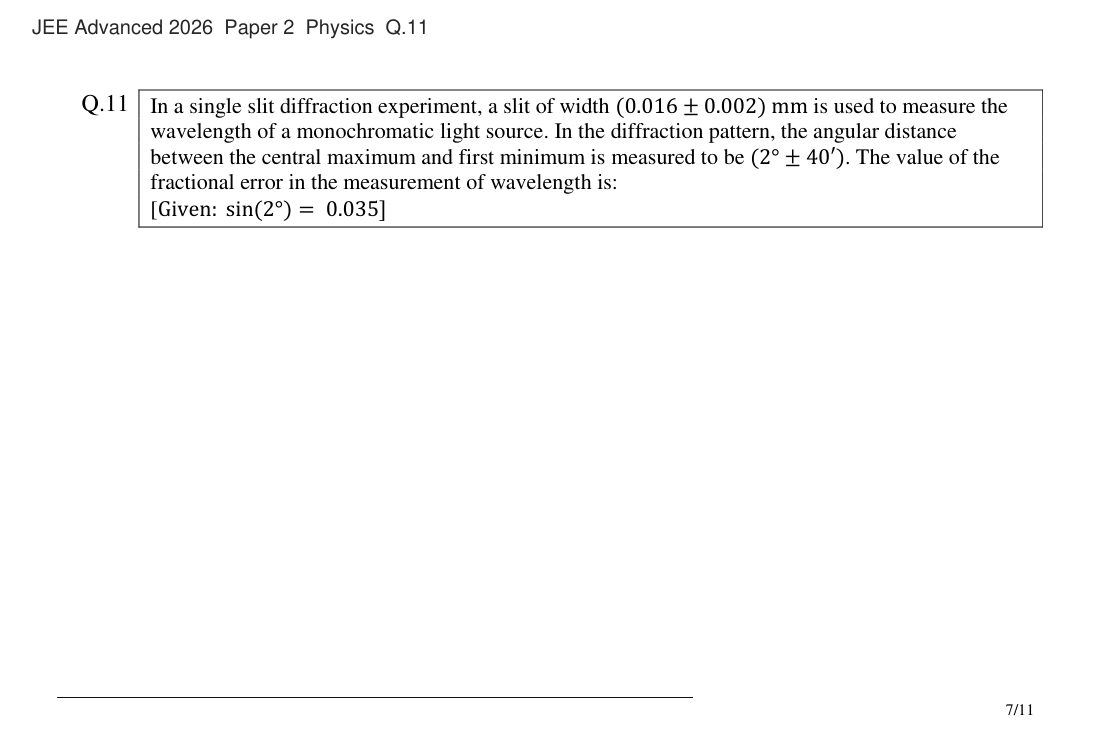
Using the single-slit condition λ = a sin θ, I derive the fractional error as Δλ/λ = Δa/a + cotθ·Δθ. Computing Δa/a gives 0.125, and converting Δθ = 40' to radians gives about 0.0116, with cotθ near 0.99 for θ = 2°. With sin 2° ≈ 0.035, cotθ ≈ 28.57, so cotθ·Δθ ≈ 0.333. Adding to Δa/a gives a total relative error of about 0.46, consistent with treating the angle change as Δθ/θ = 1/3 in the small-angle limit. **Setup:** For the first minimum in single-slit diffraction, $a\sin\theta = \lambda$, so $\lambda = a\sin\theta$. **Fractional error:** $$\frac{\Delta\lambda}{\lambda} = \frac{\Delta a}{a} + \cot\theta\,\Delta\theta$$ - $\dfrac{\Delta a}{a} = \dfrac{0.002}{0.016} = 0.125$ - $\Delta\theta = 40' = \dfrac{2}{3}^\circ = \dfrac{\pi}{270}\ \text{rad} \approx 0.01164$ rad - $\cot 2^\circ \approx \dfrac{1}{0.035} \approx 28.57$ So $\cot\theta\,\Delta\theta \approx 28.57 \times 0.01164 \approx 0.333$ (equivalently $\Delta\theta/\theta = 40'/120' = 1/3$ for small angles). $$\frac{\Delta\lambda}{\lambda} \approx 0.125 + 0.333 \approx 0.46$$
GPT 6 Astra
OpenAI
0.46
GPT 6 Astra reasoning
**Evaluating fraction calculations** I need to solve the fraction 0.125 + 40'/120', which should give me about .458333, or .46 when rounding to two decimal places. I must be careful with the sine of .035, which gives .3324, so .3324 + .125 results in .4572, rounding to .46. It's essential to decide whether to present .458333333333 or just .46, as the user likely expects a concise answer. The standard would be .46 for JEE numerical.
GPT 5.5
OpenAI
0.4583333333
GPT 5.5 reasoning
**Calculating fractional error** I need to solve the attached question using only final JSON. The problem involves single slit diffraction, specifically calculating the wavelength using given measurements of slit width and angular distance. I need to compute the fractional error carefully. The angle is provided as 2° ± 40', which I need to convert correctly. There are several calculations to perform, including determining the fractional uncertainties in the measurements for both the slit width and angle. I’ve got to ensure all calculations reflect the correct values. **Determining fractional error** I’m calculating the total, which could be around 0.46 or 45.8%. I need to figure out if they're looking for a fractional error instead of a percentage. The term "fractional error" suggests that I should provide a dimensionless value like 0.46. There's a specific request for the value of the fractional error in the wavelength measurement, so I need to focus on that. Also, the angular distance is given as (2° ± 40'), meaning I need to handle that uncertainty correctly too. I’ll keep working through these details! **Recalling the formula for wavelength** I’m engaging with the formula λ = a sin θ, which represents the relationship between the wavelength (λ), the slit width (a), and the angle (θ). This equation is fundamental for understanding phenomena like diffraction. It’s so concise, yet so packed with meaning! Now, I should use this formula for the calculations related to the single slit diffraction problem at hand. Let's make sure to align it properly with the measured values I have. **Calculating fractional error** I’m working through some calculations involving error maximums and trigonometric values. At 2° for θ, I find sin(θ) is about 0.035 and calculate cos(θ) to be around 0.99939. Using small angle approximations, I get an angle and ratios that lead me to consider a final answer. It seems the fractional error calculated as a percentage is around 45.8%. I figure I need to present this clearly in JSON format, ideally as a single number like 0.46. **Examining answer format** I’m thinking about the answer format for the problem regarding fractional error in wavelength measurement. It seems like the question expects a numerical answer rounded to two decimal places, often in the range of [0,9999]. So, I might choose something precise like 0.458 as my final answer. If I break it down: the fractional error is calculated from given measurements, using Δλ and angular error values. It's essential to structure the answer clearly as a single number. **Evaluating sin and errors** I’m considering how to find Δ(sinθ)/sinθ using θ values like sin(2°±2/3°). Here, Δθ isn’t infinitesimal; it’s around 0.66 degrees, which is about 33% compared to 2 degrees. For classwork, a linear approximation might work, but since we're discussing fractional error, it isn’t tiny. Using the small angle approximation, I think I can relate Δλ/λ and Δθ/θ while considering errors. They provided sin(2°)=0.035, which might connect to calculations, but I need to confirm how that fits. **Clarifying sin calculations** I’m looking at how to interpret sin(2°) and find θ in radians, which relates to the small angle approximation of 0.035. Also, Δθ can be derived from 40 minutes, equating to 1/3 of 2°. It seems like I won't need π here. They may be hinting at small angles and using Δ(sinθ)/sinθ ≈ Δθ/θ=1/3. While calculating for central wavelength, the question is focused on fractional errors. I wonder if they're measuring the angle between the central maximum and the first minimum, noted as 40 minutes, which is indeed angular distance in diffraction. **Calculating error and final output** I'm trying to compute relative error using the formula \((Δa/a) + (Δθ/θ\)) under small angle approximations. I want to derive the exact values using sine and a cosine approximation. I notice that my calculations are leading me toward a final number of about \(0.458\). However, I need to consider if the user might be expecting it in percentage form as \(46\) instead, since it's not clear if decimals are needed. I think I’ll output the JSON with \(0.458\). **Clarifying final answer format** I need to ensure the final answer is presented as a single number without units. When they mention "fractional error," they're looking for just a number, not a percentage. So, it should be \(0.46\) and not \(46\). I'm thinking about potential pitfalls, especially the "angular distance" they mentioned, which is measured as \(2° ± 40'\) (arcminutes). I realize \(40′\) indicates arcminutes, not arcseconds, so I can proceed. I need to calculate the error and determine the slit width correctly.
Claude Sonnet 5
Anthropic
0.46
Claude Sonnet 5 reasoning
Using λ = a sinθ, I need the fractional error da/a plus d(sinθ)/sinθ. The da/a term comes out to 0.125, and converting dθ = 40' to radians gives about 0.011636, which approximates d(sinθ) since cosθ is nearly 1 at small angles, so I'm computing d(sinθ)/sinθ next. With sinθ ≈ 0.035, that gives a fractional error in sinθ of about 0.3325. Adding the two contributions together, 0.125 + 0.3325, gives a total fractional error of roughly 0.46, or 46%. Looking at this problem, I need to find the fractional error in λ using the single slit diffraction relation: **a sinθ = λ** (for first minimum) **Fractional error formula:** $$\frac{\Delta\lambda}{\lambda} = \frac{\Delta a}{a} + \frac{\Delta(\sin\theta)}{\sin\theta}$$ **Step 1: Fractional error in slit width** $$\frac{\Delta a}{a} = \frac{0.002}{0.016} = 0.125$$ **Step 2: Fractional error in sinθ** Given θ = 2°, Δθ = 40′ = (40/60)° = 0.6667° Convert Δθ to radians: $$\Delta\theta = 0.6667 \times \frac{\pi}{180} = 0.01164 \text{ rad}$$ Since Δ(sinθ) = cosθ · Δθ, and cos(2°) ≈ 1: $$\Delta(\sin\theta) \approx \Delta\theta = 0.01164$$ Using sin(2°) = 0.035: $$\frac{\Delta(\sin\theta)}{\sin\theta} = \frac{0.01164}{0.035} = 0.3326$$ **Step 3: Total fractional error** $$\frac{\Delta\lambda}{\lambda} = 0.125 + 0.3326 = 0.4576 \approx 0.46$$ ```json