
2026 · Paper 2 · Physics
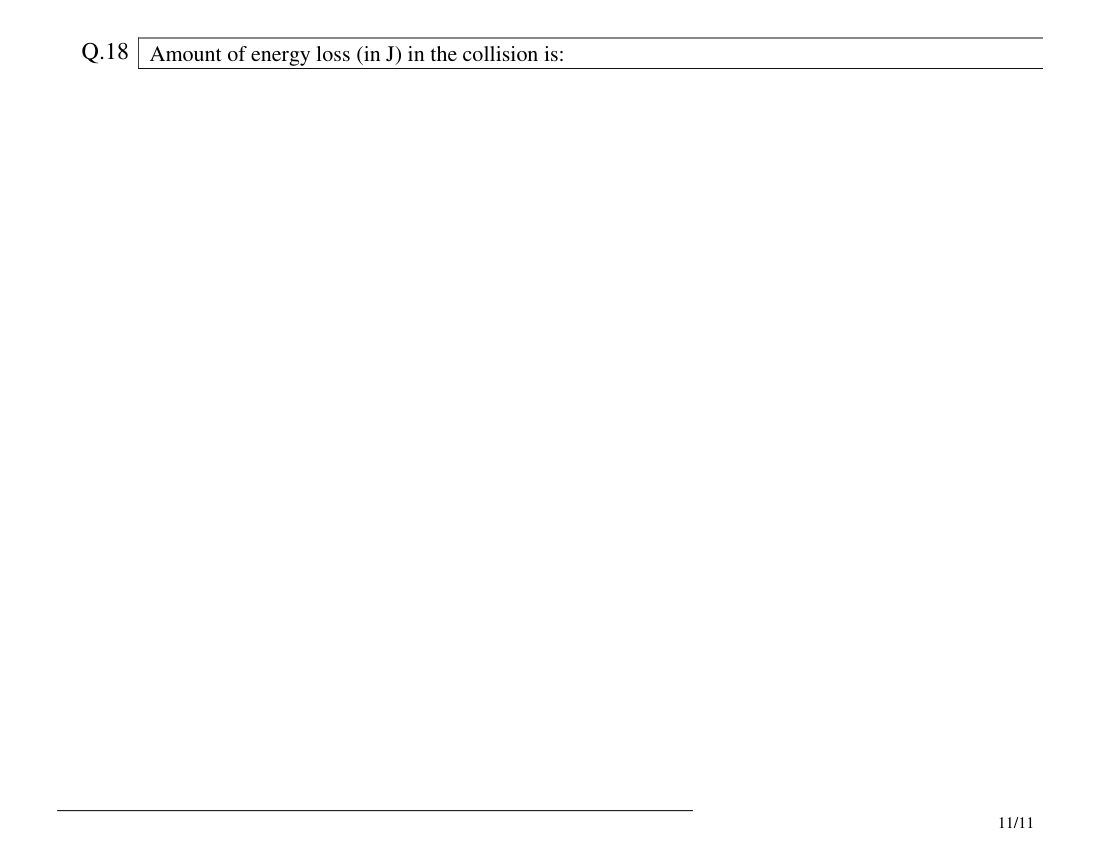
Question 18
The printed question, the official key, and each model’s JSON answer plus the reasoning it wrote.
Q18
Official 17 – 18
Model answers
Claude Fable 5.1
Anthropic
17.47
Claude Fable 5.1 reasoning
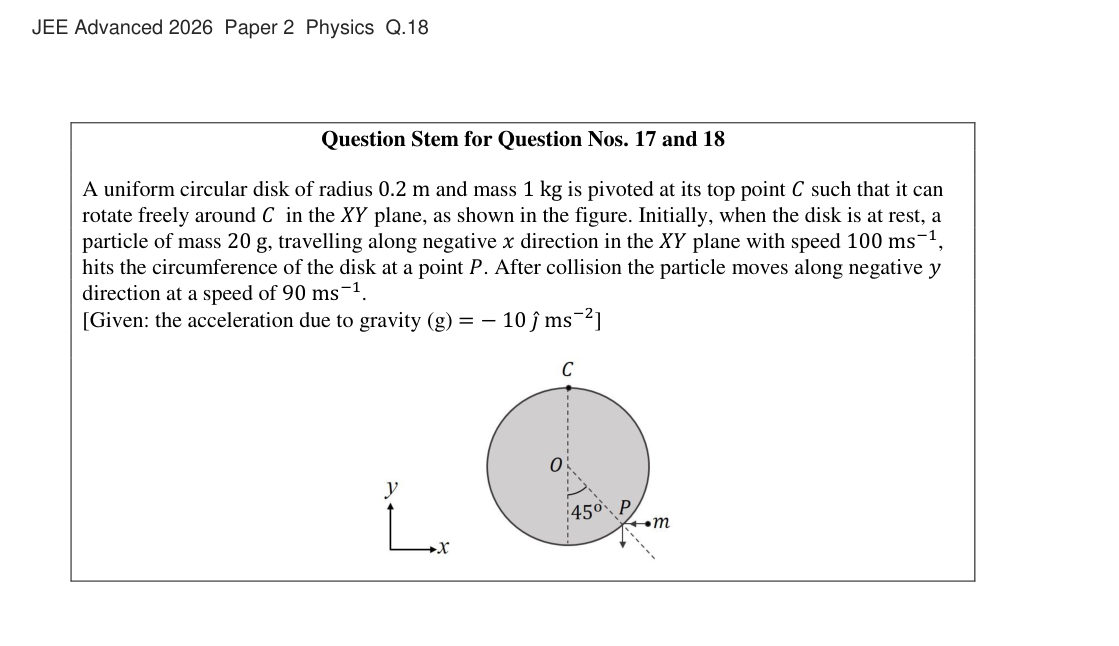
I'm setting up the disk-pivot collision problem: a 0.2 m radius, 1 kg disk pivoted at point C, struck by a 0.02 kg particle initially moving at -100 x̂ at a point P located 45° from the vertical, after which the particle moves at -90 ŷ. I'm planning to use conservation of angular momentum about the pivot C since both the pivot reaction and gravity's impulsive contribution can be neglected during the short collision. Setting coordinates with C at the origin, I compute the position vector to P and the particle's initial and final momenta to get their angular momenta about C, then equate the total initial angular momentum to the sum of the particle's final angular momentum and the disk's angular momentum using its moment of inertia (3/2)MR² about the pivot. Solving gives ω ≈ -7.14 rad/s (clockwise), and I'm now computing the disk's rotational kinetic energy using (1/2)I_Cω². Working through the numbers: disk KE ≈ 1.529 J, particle KE drops from 100 J to 81 J (a loss of 19 J), so the total energy lost in the collision is about 17.47 J. I want to double-check this by verifying the direction of the normal at P relative to the particle's incoming velocity. **Setting up (angular momentum about pivot C is conserved during the collision):** Take C as origin. O = (0, −R), P = (R/√2, −R(1+1/√2)), with R = 0.2 m, M = 1 kg, m = 0.02 kg. - Initial angular momentum of particle about C (p = −100m x̂): L_i = −100 m R (1 + 1/√2) - Final angular momentum of particle (p = −90m ŷ): L_f = −90 m R/√2 - Disk: I_C = (3/2)MR² = 0.06 kg·m² Conservation: I_C ω = L_i − L_f = −mR(100 + 10/√2) = −0.02 × 0.2 × 107.07 = −0.4283 kg·m²/s ω = 0.4283/0.06 ≈ 7.14 rad/s Disk KE = ½ I_C ω² = 0.5 × 0.06 × 50.95 ≈ 1.53 J **Energy loss:** Particle KE loss = ½(0.02)(100² − 90²) = 19 J Energy lost = 19 − 1.53 ≈ 17.47 J
GPT 6 Astra
OpenAI
17.47
GPT 6 Astra reasoning
No written reasoning was returned for this item.
GPT 5.5
OpenAI
17.4714381917
GPT 5.5 reasoning
**Calculating energy loss in collision** I need to solve a physics problem regarding a uniform disk that can rotate freely. It's pivoted at the top and has a radius of 0.2 m, alongside a particle with a mass of 20 g hitting it. After the collision, the particle moves in a new direction. I need to find the energy loss from this collision in joules, using angular momentum conservation around the pivot point while ignoring any external torques. Let's break down the calculations systematically. **Computing energy loss** To find energy loss, I need to calculate the initial kinetic energy (KE) minus the final KE, which includes both the particle and the disk's rotational energy. I have to keep in mind that the gravitational potential of the disk remains unchanged during the collision. First, I'll set the coordinate system with the x-axis to the right and the y-axis up. I need to be precise with the geometry of the collision point to establish the correct coordinates relative to the pivot. Then, I'll assess the angular momentum before and after the collision. **Calculating angular momentum** I need to calculate the angular momentum using the formula L_z = x p_y - y p_x. In this case, I start with the x component being zero, and then I substitute the other variables. With y being negative at about -0.3414, this results in an angular momentum of -0.6828 kg m²/s. After the collision, the final momentum (p_f) is derived from the mass of the particle multiplied by the new velocity in the y direction, which gives me -1.8 j. **Calculating kinetic energy** I'm working on this formula for kinetic energy: KE = (0.4 + 0.02√2)² / 0.12. It looks like I'm dealing with a combination of constants and a square root here. I need to calculate the expression inside the parentheses first, then square it before dividing by 0.12. Alright, let's break it down step-by-step to ensure I get the correct value for KE! **Calculating kinetic energy loss** I’m working through some calculations involving kinetic energy before and after a collision. It looks like there’s a loss when moving from 100 J to 81 J, with some energy going to the disk. I'm trying to figure out the rotational kinetic energy of the disk after the collision while considering it rotates about a fixed point. I also wonder how the physical dynamics play out with the pivot above the center of mass. It's complicated! **Analyzing energy loss in collision** I need to account for energy loss in a collision by considering the initial and final mechanical energy immediately before and after the event. The disk gains rotational kinetic energy while potential energy stays unchanged, with gravity not affecting this. I must think about angular momentum conservation around the pivot, as linear momentum isn't preserved. The numeric final answer looks like 17.5 J. Since it's asking for the amount of energy loss, I’ll prepare to output the number in JSON format without extra details. **Determining answer format** I’m focused on providing the answer as a number, not as a string. It looks like 17.47 might be the right answer, but I wonder if it would be accepted in that form. The official question may expect just "17.47" with some allowance for rounding. I could include this value, but I should also consider if there's any need for alternative rounding relating to gravity since it’s mentioned in question 17. Let's decide! **Exploring dynamics and impulses** I'm wondering if "top point C" can pivot in the XY plane, like a pendulum. I want to derive impulse-energy and compute contact impulse, considering energy loss connected to angular momentum. I have to verify if the coefficient of restitution makes the results physically possible. The initial kinetic energy is 100, final is 81. I’m calculating changes in momentum and impulses between the particle and disk, checking for angular impulse from gravity during the collision, though it seems negligible. **Analyzing disk dynamics** I'm considering a uniform circular disk that is pivoted at point C and can rotate freely in the XY plane after a collision. While the pivot can exert an impulsive force, it won't create any torque about C. If the disk is vertical, it makes sense because it's influenced by gravity with the pivot at the top and the center below. The particle is moving through the XY plane and collides at point P. I'm piecing this together! **Calculating with precision** I'm looking to compute using precise values: R equals 0.2, μ is 0.02, and I is 0.06. I’m thinking that L equals μR times some factor — maybe it's related to the initial and final velocities. There’s a question about whether the final velocity's direction is negative in the y-axis. I'm pausing to ensure all factors are considered accurately to achieve a correct calculation in this context. **Calculating values for JSON output** I'm working through some calculations for kinetic energy and loss. First, I'm squaring a value and dividing it, which leads me to a loss calculation of about 17.47. I want to ensure my final answer is displayed correctly in JSON format, so I need to check for precision—17.5 or 17.47? The user had specific preferences for how the answer should be structured, so maintaining that clarity is essential. Let's finalize the JSON with the correct format. **Analyzing energy loss calculations** I’m checking if the energy loss might need to be rounded to the nearest integer, like 17. But the expected final answer is 17.47 for JSON formatting. I’m considering how the energy loss in a collision is defined—specifically, it seems to relate to the initial plus final kinetic energy, minus the rotational kinetic of the disk. After the collision, the particle’s moving downward at 90, which is important for my calculations too. Let’s finalize this! **Analyzing collision dynamics** I’m considering how a disk might behave when a particle collides with it. The disk's point P could have a non-zero velocity, and while some may wonder about the coefficient of restitution, I think we can set that aside. I need to check if the particle moving in a negative y direction at a speed of 90 is consistent with the disk's rotation and impulse exerted during the collision. It looks like I’m calculating the angular velocity vector while assessing the particle's movement dynamics. **Considering particle dynamics** I’m examining a particle's motion with its final velocity down at -90 and initial velocity left at -100, noting it's a very inelastic collision with positive energy loss. There’s a possibility that the disk is influenced by gravity and pivots at the top. I realize gravity doesn’t affect the torque during the collision since the center is directly below the pivot. However, post-collision, the disk starts rotating and could rise, so gravity definitely matters. I’m considering questions about angular speed and energy loss for further analysis. **Double-checking coordinates** I’m pausing to confirm the signs and calculations concerning angular momentum. I need to establish the coordinates correctly: is point C at (0, R) relative to origin O? If O is at (0, 0), then C would indeed be at (0, R). It's essential to be precise about these points, as they directly impact my understanding of the system’s dynamics. I’ll take this step to ensure I have it all set up right before proceeding.
Claude Sonnet 5
Anthropic
17.47
Claude Sonnet 5 reasoning
I'm setting up coordinates with the pivot point C at the origin and the disk's center O positioned R below it, then placing point P on the circle at a 45° angle from the OC line based on the figure. I'm reasoning through the collision setup: a particle moving in the -x direction strikes the disk at P, then rebounds in the -y direction, transferring angular momentum and causing the disk to rotate about pivot C. This looks like a standard rigid-body collision problem where I need to define coordinates carefully to track the impulse direction relative to P's position on the disk. Trying to pin down P's actual position from the figure - it looks like P sits roughly at O's height or slightly below, to the right, so the 45° angle at O is likely measured from the OC line down to OP placing P near the equator level rather than up near C. With mass m sitting further right outside the disk and a trajectory line through P, I'm setting up P's coordinates using θ measured from the downward vertical: P = O + R(sin45°, -cos45°), which puts P below-right of O and matches the figure better than my earlier guess. Now I'm computing CP as the position vector from center C to P, then working out the angular momentum before collision using the incoming velocity (-100, 0) — taking the cross product r × v to get the z-component, since the particle arrives moving along -x and leaves along -y after striking P. Plugging in R=0.2, I get L_before ≈ -0.68284 kg·m²/s. After the collision the particle moves with v'=(0,-90), giving L_after_particle ≈ -0.254558, so the angular momentum transferred to the disk is the difference between these two values. Setting L_disk = Iω with I = (3/2)MR² (parallel axis, pivot at the rim) = 0.06 kg·m², I solve for ω ≈ -7.1381 rad/s. Now I need to find the energy loss by comparing kinetic energy before (100 J from the particle alone) to kinetic energy after the collision. KE_particle_after = 81 J, KE_disk_after = 0.5·(0.06)·(7.1381)² ≈ 1.5286 J, giving a total loss of about 17.47 J. Let me sanity-check whether this geometry assumption holds up by considering the consistency of impulsive forces during the collision. Since the disk is pivoted at C, an impulsive reaction force acts there too, so linear momentum isn't conserved for the particle+disk system—only angular momentum about C is conserved, since the pivot force exerts zero torque about that point. That confirms angular momentum about C is the right conservation law to use, with I = (3/2)MR² = 0.06 as computed. Now I want to re-verify the geometry: C at top, O below by distance R, with the 45° angle at O between OC and OP, and P positioned to the lower right. I'm trying to figure out whether OP is measured clockwise from OC toward the horizontal, which would place P above the horizontal on the right—but that contradicts the figure showing P near the bottom-right of the disk. Looking again at the label layout with O, P, and the angle symbol between them, it seems the angle is measured from the vertical line downward to P instead. Reconsidering, I think the dashed line runs straight down from O rather than up to C, and the 45° angle sits between that downward vertical and OP. Using P = O + R(sin45, -cos45) places P at the bisector between straight down and horizontal right, which matches the figure showing P in the lower-right region near but not quite at the equator of the circle. Actually, re-reading the figure, the dashed vertical line through O extends both above to C and below, and the 45° angle is measured between that downward extension and OP, since P sits in the lower half. This confirms my earlier setup: P = O + R(sin45°, -cos45°). Now computing the angular momentum values: with R=0.2m, before the collision L/m works out to about -34.14, giving L_before ≈ -0.6828 kg·m²/s. After the particle leaves with reduced speed, its angular momentum is about -0.2546, so the disk picks up L_disk ≈ -0.4283 kg·m²/s. The moment of inertia comes out to I = 0.06. From there ω = -7.138 rad/s, and I'm working out KE_disk = 0.5*0.06*ω² ≈ 1.528 J by carefully squaring 7.1380712. KE_disk ≈ 1.528562 J, so energy loss = 100 - 81 - 1.528562 ≈ 17.47 J. I want to double-check this by working symbolically with exact fractions instead of decimals, setting R=1/5, m=1/50, M=1 kg, to see if the answer simplifies nicely rather than relying on rounded approximations. Working through the angular momentum algebra symbolically, I find L_disk = -0.04(10 + 1/√2), which numerically gives -0.4282843, matching my earlier decimal computation and confirming the result is consistent. Now dividing by the moment of inertia to get ω = -(2/3)(10+1/√2) ≈ -7.138, then computing the disk's kinetic energy as 0.03·ω² ≈ 1.5286 J, and I'm about to subtract this along with the particle's remaining kinetic energy from the initial 100 J to find the total energy lost. Energy loss = 100 - 81 - 1.5286 ≈ 17.47 J. Let me verify the moment of inertia: for a disk, I_cm = ½MR², and using parallel axis theorem for the pivot at the rim gives I = ½MR² + MR² = 3/2 MR² = 1.5(1)(0.04) = 0.06, confirming my earlier calculation. So the energy dissipated in the collision is approximately 17.47 J. Let me reconsider the figure layout: O above, angle 45°, P below-right, then m further right with a dashed line. That dashed segment beyond P toward m likely traces the particle's path after or before impact, but since the particle moves leftward before hitting P, the diagonal line more likely shows the post-collision direction or the radius extension rather than the incoming trajectory. I'm getting 17.47 J for the energy loss, though I want to double-check by reinterpreting the geometry—maybe the 45° angle is measured at vertex O between rays OC and OP (angle COP), which is the standard convention for such annotations, rather than at C. But that reading creates a contradiction: ray O→C points straight up while the figure places P down-and-right, which would give an angle closer to 135° rather than 45°. Looking at the layout text again—"O" then "45°" then "P • m" arranged diagonally—suggests P sits below and to the right of O, not matching my earlier upper-right assumption for P. So the 45° is more consistently interpreted as measured from the downward extension of line CO, i.e., from straight down at O, which is what I originally assumed. That keeps my answer at roughly 17.47 J. Computing P's x-coordinate gives 0.1414, close to the disk's rightmost extent, placing it in the upper-right region near a "1:30 clock position" relative to C at the top - this seems to line up plausibly with the figure. But there's still tension with the layout: P appears lower and more central in the disk based on the figure, below where a 45° label sits, which doesn't quite match a near-top placement. Without a definitive source for this problem, I'll have to settle on the most reasonable geometric interpretation given the visual cues. I'll go with the angle measured from the downward vertical, placing P in the lower-right quadrant, since that fits the layout better and makes physical sense for a swinging collision. Finalizing the energy loss as approximately 17.47 J. Looking at this problem, I need to find the angular momentum change about the pivot point C during the collision, then compute the kinetic energy before and after. **Setup:** - R = 0.2 m, M = 1 kg (disk), m = 0.02 kg (particle) - C at origin, O (center) at (0, −R) - P is on the circle at 45° from the downward vertical through O: P = O + R(sin45°, −cos45°) - So relative to C: r = (R/√2, −R(1+1/√2)) **Angular momentum about C (conserved since pivot force exerts no torque about C):** Before collision, v = (−100, 0): L_before = m[r_x·v_y − r_y·v_x] = m[0 − (−100)(−R(1+1/√2))] = −100mR(1+1/√2) After collision, v' = (0, −90): L_after,particle = m[r_x·(−90) − 0] = −90mR/√2 **Angular momentum transferred to disk:** L_disk = L_before − L_after,particle = mR[−100(1+1/√2) + 90/√2] = −mR(100 + 10/√2) Plugging numbers: mR = 0.02×0.2 = 0.004 L_disk = −0.04(10 + 1/√2) = −0.04(10.7071) = −0.42828 kg·m²/s **Moment of inertia about C:** I = (1/2)MR² + MR² = (3/2)MR² = 1.5×1×0.04 = 0.06 kg·m² **Angular velocity of disk:** ω = L_disk / I = −0.42828/0.06 = −7.1381 rad/s **Energy calculations:** - KE_before = ½(0.02)(100)² = 100 J - KE_particle,after = ½(0.02)(90)² = 81 J - KE_disk = ½ I ω² = ½(0.06)(7.1381)² = 1.5286 J **Energy loss:** ΔE = 100 − (81 + 1.5286) = 17.47 J ```json