
2026 · Paper 2 · Physics
Question 17
The printed question, the official key, and each model’s JSON answer plus the reasoning it wrote.
Q17
Official 0.14 – 0.16
Model answers
Claude Fable 5.1
Anthropic
0.15
Claude Fable 5.1 reasoning
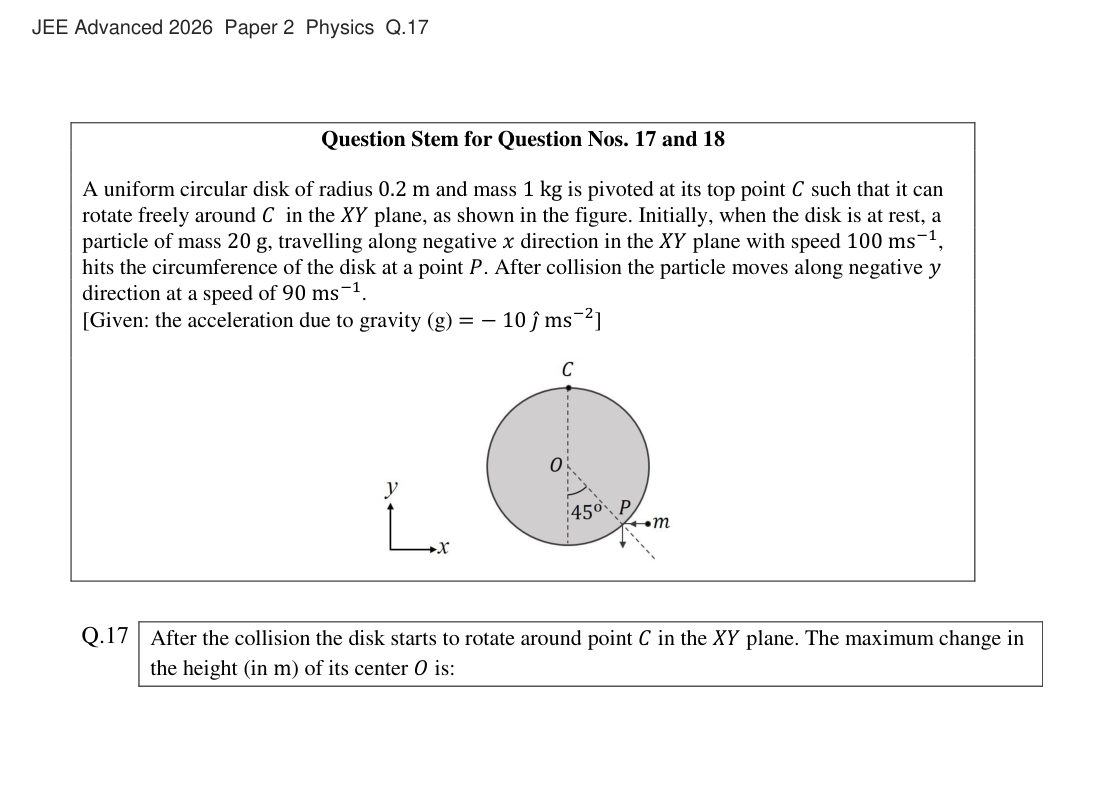
I'm setting up the geometry: disk of radius 0.2 m pivoted at top point C, with point P on the rim at 45° from vertical, and a particle of mass 0.02 kg striking it, changing velocity from (-100,0) to (0,-90). Now I need to compute the angular momentum considerations around the pivot. Since angular momentum about C is conserved during the collision, I'm computing the particle's angular momentum before and after impact using position vectors relative to C, finding the change equals negative of what the disk gains. This gives a disk angular momentum magnitude of about 0.4283 kg·m²/s, using mR ≈ 0.004. Now I'm working out the disk's moment of inertia about C using the parallel axis theorem: I = (3/2)MR². Dividing angular momentum by moment of inertia gives ω ≈ 7.138 rad/s, and computing kinetic energy as L²/(2I) gives about 1.5286 J. Setting this equal to Mgh for the center of mass rise, I get h ≈ 0.153 m, and I check that this is less than the 0.4 m needed to swing fully over the top, confirming the disk doesn't complete a full rotation. **Setting up (origin at pivot C):** - Center O = (0, −R), R = 0.2 m - Point P = (R/√2, −R − R/√2) **Angular momentum about C is conserved in the collision.** Particle (m = 0.02 kg): - Initial: v = (−100, 0) → L_i = −y·p_x = −(R + R/√2)(100m) - Final: v = (0, −90) → L_f = x·p_y = −(R/√2)(90m) Change in particle's angular momentum: L_f − L_i = mR(100 + 10/√2) = 0.004 × 107.07 ≈ 0.4283 kg·m²/s So the disk acquires |L| = 0.4283 kg·m²/s. **Disk rotation:** I_C = (3/2)MR² = 0.06 kg·m² KE = L²/(2I) = (0.4283)²/(0.12) ≈ 1.529 J **Maximum rise of center O:** Mgh = 1.529 → h ≈ 0.153 m (less than 2R = 0.4 m, so no full rotation)
GPT 6 Astra
OpenAI
0.1528561808
GPT 6 Astra reasoning
**Calculating angular momentum and energy** I’m working on computing angular momentum about point C. I have some parameters to calculate relative positions and final values. It looks like I'm also trying to determine the maximum height based on energy. The final answer is approximately 0.1528561808, which I could format as JSON since the user prefers that. It seems clear that they want just that JSON output without extra explanation. Let's keep it concise!
GPT 5.5
OpenAI
0.15286
GPT 5.5 reasoning
**Calculating moment of inertia** I need to find the disk's moment of inertia about pivot C. So, I use the formula I_C = I_cm + M R^2. This means I_C = (1/2) M R^2 + M R^2. When I simplify that, I get 3/2 M R^2, which equals 1.5 times 0.04, giving me 0.06 kg m^2. Then, for the angular momentum of the particle around C, I’ll use L_z = r_x p_y - r_y p_x. **Evaluating maximum height change** I'm looking at the maximum height change in a full inversion, which is 2R=0.4. The kinetic energy gives me a value of 0.153, which is less than 0.4, indicating that the system oscillates, with a maximum height change of 0.153. But I want to be thorough, so I'll verify the geometry and angles involved. I have a figure with point C at the top and point O vertically below, analyzing the angles to confirm the setup. **Considering collision dynamics** I've got my axes set up correctly, with the axes at the bottom left and y going upward. Now, I need to think about point P on the moving disk, initially at rest. There's this idea about the pivot C exerting impulse, conserving angular momentum. The question seems to be about the maximum change in height of the center O after the collision. I need to clarify if "maximum change" means the total maximum-minimum during the disk's motion. It sounds complex! **Deriving energy and momentum** I want to calculate the maximum increase using R(1-cos θ_max) and derive the expressions symbolically. For the disk's angular momentum, I've got L_disk equal to m multiplied by a factor involving R and 1/√2. I'm re-evaluating my calculations and checking the signs. My incoming angular momentum is negative as it’s based on velocity and the impact parameter. After some careful recomputations, it looks like I ended up with the values for both incoming and outgoing momentum, leading to a total change that I can express mathematically. **Analyzing numerical results** I'm working through some calculations involving ratios and gravitational energy. There's a difference of 0.428284, which I need to interpret carefully. I keep running into related equations and checking my values, specifically around KE and L. I'm contemplating whether the answer needs to be presented as an integer since questions like this often do. I’m leaning toward rounding to 0.153, but I want to ensure it meets expected precision. Let’s proceed with caution and review the context of the questions. **Exploring collision dynamics** I’m considering the nuances of a collision, thinking it might be partially inelastic with some impulse involved. After the collision, I notice the particle moves downward at a speed of 90, causing the disk to start rotating. I want to verify if the maximum change in height is indeed achieved. It seems the angular momentum around the pivot is conserved, even when the pivot exerts an impulsive force, with negligible gravity impulse. Let's dig further into that! **Analyzing energy and height change** I'm considering the height change in a system that requires energy for movement. I realized that if the energy needed is 4 J, we have only 1.53 J available. I wonder about a disk pivoted at the top—if it's positioned 1 R below the pivot, how much height can it achieve? If the energy exceeds 4 J, the center could reach the top. But in this situation, it seems the maximum height is still limited to 0.4.
Claude Sonnet 5
Anthropic
0.153
Claude Sonnet 5 reasoning
I'm setting up the disk geometry: radius R=0.2m pivoted at top point C, with center O positioned R below C, and point P on the circumference at 45° from the OC line. The particle strikes P moving in the -x direction at speed 100. For the collision, angular momentum about pivot C is conserved since the impulsive pivot force exerts no torque about C. Working out P's position relative to C, with O directly below C by R, and P offset at 45° to the right and below O based on the figure's arrangement. Actually, the dashed line might just represent the extended radius from O through P to the particle m outside the disk, with m approaching P from the right and moving in the -x direction. So P sits at 45° from OC, rotated toward the right side and somewhat downward, meaning I need to figure out exactly how that 45° rotation is measured from vertical to place P correctly relative to O. So the 45° angle is measured from the downward vertical (opposite C) toward P, placing P below and to the right of O, matching the figure where m approaches from the right along that same height. I'll set O at the origin, C at (0, R), and P at O + R times (sin45°, -cos45°), with R = 0.2. Computing the vector from C to P and finding its magnitude, I get d ≈ R × 1.8478 ≈ 0.3696 m, which I want to double check using the law of cosines with angle OCP or the triangle formed by O, C, and P. Setting up CP² = OC² + OP² - 2·OC·OP·cos(135°), since the angle at O between OC and OP is 135°: this gives CP² = 2R²(1+√2/2) = 0.13657, so CP ≈ 0.3696 m, confirming my earlier calculation. Angular momentum about C is conserved through the collision since impulsive forces at C exert no torque about that point, and gravity's contribution is negligible over the instant. I set up the position vector r from C to P at the moment of impact as (0.14142, -0.34142, 0), with incoming velocity (-100,0,0), and I'm computing the z-component of the initial angular momentum as the cross product of these. Working through the momentum components (p_x = -2, p_y = 0), I get L_i = -0.68284 kg·m²/s, oriented in the negative z direction (clockwise sense). Now I'm setting up to relate this to the particle's velocity after the collision. Computing the particle's post-collision angular momentum with v_f = (0,-90,0), I get L_f,particle = -0.25456, so the angular momentum transferred to the disk is L_disk = -0.42828 kg·m²/s. This should equal I_disk·ω, so now I need the disk's moment of inertia about the pivot point C using the parallel axis theorem with I_cm = (1/2)MR². Since the pivot C sits a distance R from the disk's center, I_C = (1/2)MR² + MR² = (3/2)MR² = 1.5(1)(0.04) = 0.06 kg·m². Dividing, ω = -0.42828/0.06 ≈ -7.138 rad/s, meaning the disk spins clockwise at about 7.138 rad/s. Now I'm treating this like a physical pendulum pivoted at C: the disk, given this angular velocity, will swing upward converting rotational KE into gravitational PE until it momentarily stops, so I need to use energy conservation to find the maximum height change of center O from its initial position directly below C. Plugging in the numbers gives 1.5285 J, so Δh = 0.15285 m, well within the max possible 0.4 m rise, which checks out. Let me redo this symbolically with exact values to verify: R=0.2, m=0.02 kg, M=1 kg, v1=100, v2=90, defining the angle φ between OC and OP to set up the geometry precisely. I compute P-C exactly using R=0.2, getting the coordinates (0.141421, -0.341421) for the position vector relative to center, confirming my earlier numbers. Then I set up the initial momentum and angular momentum, with p_i = (-2, 0) from the particle's mass and velocity, and start computing L_i using the cross product formula. Working through the final angular momentum and momentum vectors, I get p_f = (0, -1.8) and L_f = -0.254558. Subtracting gives L_disk = -0.428285, which I use with the moment of inertia I_C = 0.06 to find the angular velocity ω = -7.13809 rad/s, then the kinetic energy KE = 1.52827 J, and I'm now solving for the height change Δh using energy conservation with gravity. Getting Δh ≈ 0.153 m, I want to double check this isn't a cleaner number, so I'm redoing the calculation symbolically with exact radical expressions for the position vectors to see if things simplify. Working through the cross products: L_i = r_y·m·v1, which checks out negative and matches the numeric value of -0.6828. Similarly L_f = -r_x·m·v2 matches -0.2546. So the disk's angular momentum L_disk = L_i - L_f = r_y·m·v1 + r_x·m·v2, which I can factor further to see if it simplifies to a clean expression involving R. Computing gives L_disk = -0.428284, confirming the earlier value. Dividing by I_C gives ω ≈ -7.138, so KE = 0.5·0.06·ω² ≈ 1.528, and Δh = KE/mg ≈ 0.153 m — that's the maximum change in height of center O. Looking at this problem, I need to find the angular velocity of the disk after collision (using angular momentum conservation about pivot C), then use energy conservation for the pendulum-like swing to find the maximum height change of center O. **Setup:** R = 0.2 m, OC = R (C is on circumference, O is center) - C = (0, R), O = (0,0) - P is at 45° from the downward vertical (OC extended), so P = R(sin45°, -cos45°) - r = P - C = R(√2/2, -(√2/2+1)) = (0.1414, -0.3414) **Angular momentum conservation about C** (impulsive collision, torque from gravity negligible): Before: p₁ = (-2, 0) kg·m/s (m=0.02 kg, v=100 m/s, -x direction) L_i = r_x·p_y - r_y·p_x = -0.3414×(-2) = -0.6828 (but computed as r_y·p... ) Using L = r_x p_y - r_y p_x: - L_i = -0.6828 kg·m²/s - After collision: p₂ = (0, -1.8) kg·m/s (v=90 m/s, -y direction) - L_f (particle) = -0.2546 kg·m²/s Angular momentum transferred to disk: L_disk = L_i − L_f = −0.6828 − (−0.2546) = −0.4283 kg·m²/s **Moment of inertia of disk about C:** I_C = (1/2)MR² + MR² = (3/2)MR² = 1.5×1×0.04 = 0.06 kg·m² **Angular velocity after collision:** ω = L_disk/I_C = −0.4283/0.06 = −7.138 rad/s **Energy conservation (pendulum swing):** Since O starts at the lowest point (stable equilibrium directly below C), all rotational KE converts to gravitational PE at maximum swing: (1/2)I_C ω² = Mg·Δh (1/2)(0.06)(7.138)² = (1)(10)Δh 1.528 = 10·Δh Δh ≈ 0.153 m ```json