
2026 · Paper 1 · Chemistry
Question 6
The printed question, the official key, and each model’s JSON answer plus the reasoning it wrote.
Q06
Official A, C
Model answers
Claude Fable 5.1
Anthropic
A, C
Claude Fable 5.1 reasoning
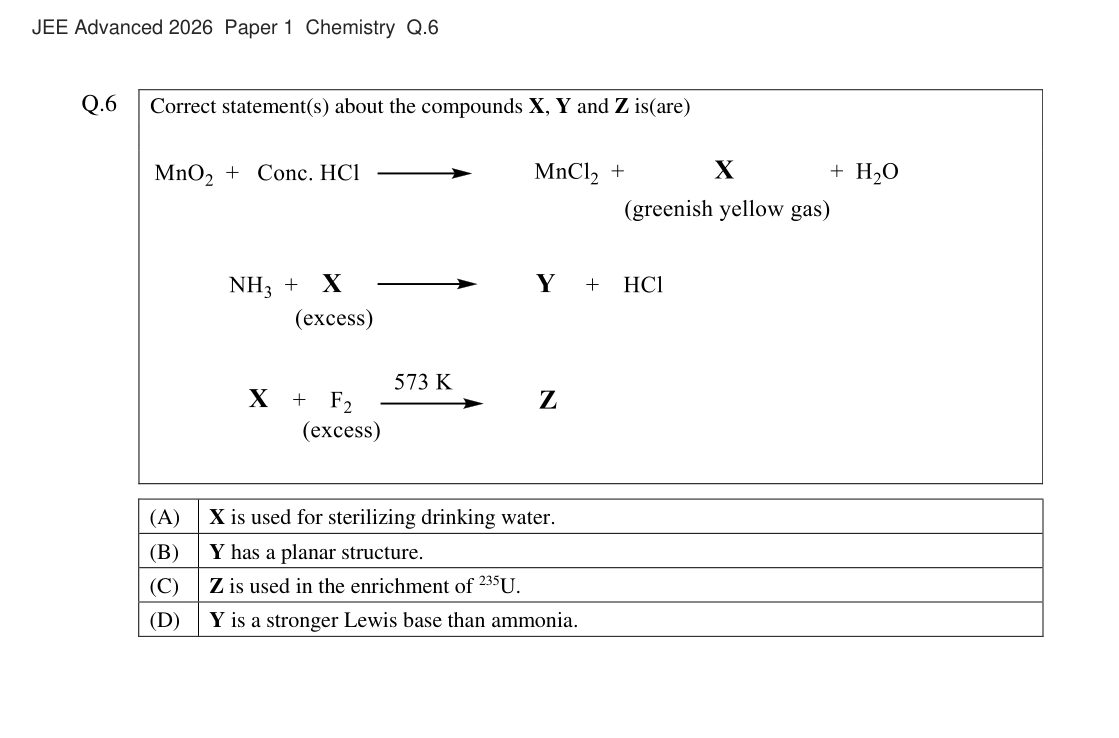
X = Cl2 (greenish yellow gas). NH3 + excess Cl2 → NCl3 (Y) + HCl. Cl2 + excess F2 at 573 K → ClF3 (Z). (A) Cl2 is used for sterilizing drinking water — correct. (B) NCl3 is pyramidal, not planar — incorrect. (C) ClF3 is used in production of UF6 for uranium enrichment — correct. (D) NCl3 is a weaker Lewis base than NH3 — incorrect.
GPT 6 Astra
OpenAI
A, C
GPT 6 Astra reasoning
No written reasoning was returned for this item.
GPT 5.5
OpenAI
A, C
GPT 5.5 reasoning
**Parsing coordinates** I'm working on interpreting the coordinates from the image. NH3 is positioned at x=228, the "+" sign is at x=288, and the "X" is at x=331. The arrow starts at x=377. The word "(excess)" falls roughly between x=294 and x=371, with the center around x=332, right below the "X." So it seems like the "X" is associated with "excess." **Analyzing interhalogen compounds** I'm considering if Z is ClF3 and whether it's directly used in gaseous diffusion. ClF3 acts as a fluorinating agent in converting uranium to UF6 for nuclear fuel processing. While UF6 is used for enriching U-235, I'm wondering if ClF3 is actually used in enrichment itself. Alternatively, Z might be ClF5 if there's excess F2. I need to check the reaction of chlorine with fluorine at 573 K to see how ClF5 forms, especially under specific conditions. **Classifying chemical properties** I’m considering whether Y equals N2 means that N2 is linear. It seems trivially linear, but I need to clarify that it’s not planar. I dismiss option D and note A and C as the likely answers, which I should sort in the final message as a JSON object without any extra text. I’m pondering the details about water sterilization, recognizing Cl2 as a yellow-green gas used for that purpose. I also need to confirm that ClF3 is indeed used in U-235 enrichment based on reliable sources. **Clarifying enrichment processes** I’m analyzing the statement that "Z is used in the enrichment of U-235" but it lacks mention of "production of UF6." This could be accepted as true, although there’s a potential issue to consider: ClF3 might not be directly "used" in the enrichment process itself. Instead, UF6 is the key substance in that context. I need to ensure clarity in how these chemical processes are described and connected. **Evaluating chemical structure** I'm thinking about whether to say that Y has a planar structure if Y is NCl3. It doesn’t seem right because NCl3 actually has a pyramidal shape according to the VSEPR model, specifically AX3E. I also consider what X might be; maybe "nascent chlorine" from a reaction? But no, it definitely refers to Cl2, which is a greenish-yellow gas. I’m trying to keep my chemical knowledge straight!
Claude Sonnet 5
Anthropic
A, C
Claude Sonnet 5 reasoning
I'm identifying X as Cl2 used for water sterilization (true), Y as NCl3 which is actually pyramidal like NH3 rather than planar (making that statement false), and Z as ClF3, checking whether it's used in uranium-235 enrichment. ClF3 does react with UF4 to produce UF6, confirming its role in enrichment, so that statement is true. For Y as NCl3, since chlorine's electronegativity pulls electron density away from nitrogen, its lone pair becomes less available, making NCl3 a weaker Lewis base than NH3 rather than stronger - so that statement is false, leaving A and C as the correct answers. Looking at this problem: - MnO₂ + conc. HCl → MnCl₂ + Cl₂ (X) + H₂O (X = Cl₂, greenish yellow gas) - NH₃ (excess) + Cl₂ → NCl₃ (Y) + HCl (nitrogen trichloride, pyramidal like NH₃) - Cl₂ + F₂ (excess) at 573 K → ClF₃ (Z) Checking statements: - (A) Cl₂ is indeed used for sterilizing drinking water — **True** - (B) NCl₃ has a pyramidal structure (lone pair on N), not planar — **False** - (C) ClF₃ is used in the enrichment of ²³⁵U (reacts with UF₄ to form volatile UF₆) — **True** - (D) NCl₃ is a weaker Lewis base than NH₃ due to electron-withdrawing Cl atoms reducing electron density on N — **False** ```json