
2026 · Paper 1 · Chemistry
Question 7
The printed question, the official key, and each model’s JSON answer plus the reasoning it wrote.
Q07
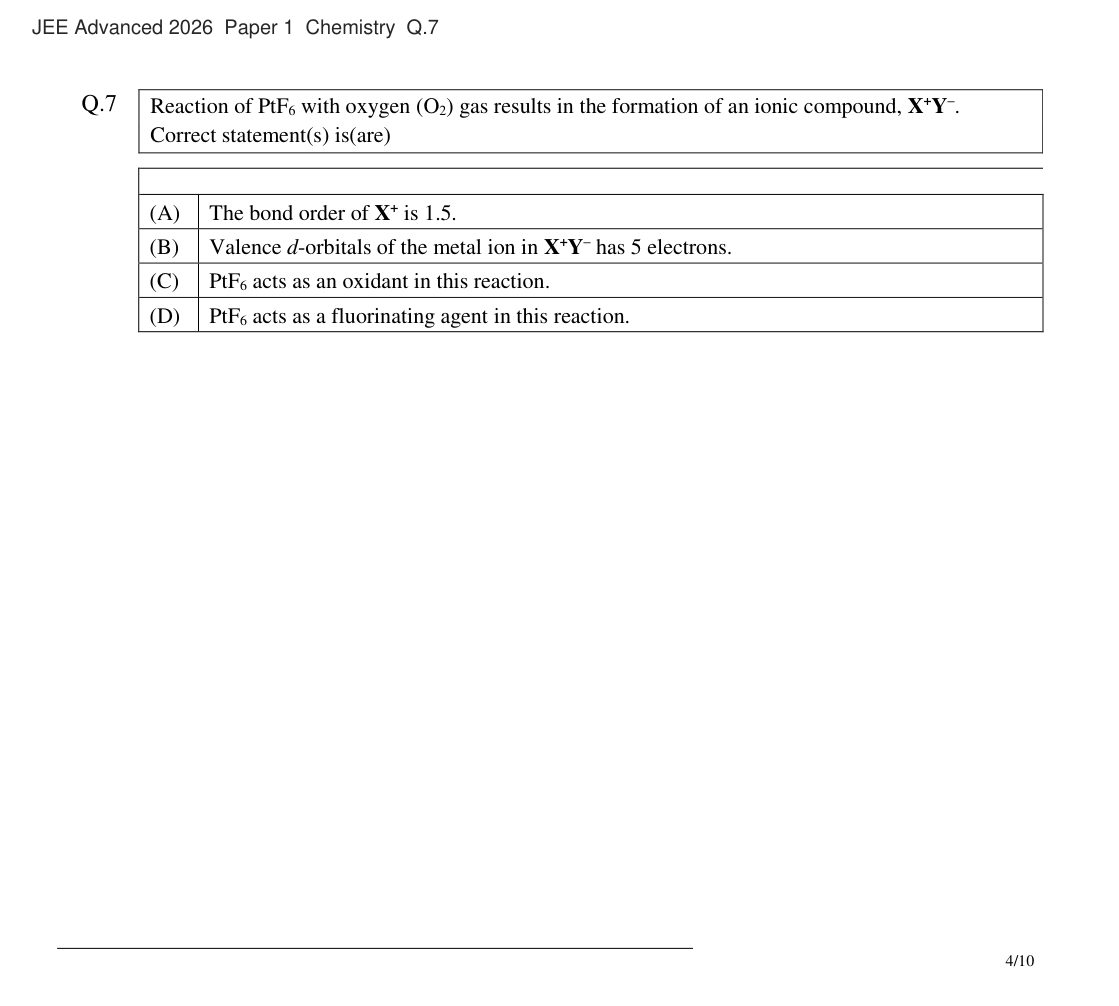
Official B, C
Model answers
Claude Fable 5.1
Anthropic
B, C
Claude Fable 5.1 reasoning
O2 + PtF6 → O2⁺[PtF6]⁻ (dioxygenyl hexafluoroplatinate). X⁺ = O2⁺: 15 electrons, bond order = 2.5, so (A) is wrong. Y⁻ = [PtF6]⁻: Pt in +5 oxidation state. Pt is 5d⁹6s¹ (Z=78, 10 valence electrons); Pt(V) has 5 d-electrons → (B) correct. PtF6 oxidizes O2 to O2⁺, so PtF6 is an oxidant → (C) correct. No fluorine is transferred to oxygen; PtF6 is not acting as a fluorinating agent → (D) wrong.
GPT 6 Astra
OpenAI
B, C
GPT 6 Astra reasoning
**Solving chemical reaction** I need to tackle the reaction involving O2 and PtF6 to yield O2, PtF6-, and Pt5+ in a d5 group 10 context. I'm observing that there’s a false statement in option A and true statements in options B and C. I should focus on coming up with just the end JSON format for my answer, omitting anything unnecessary while ensuring it's concise and direct. Let's ensure we get that right!
GPT 5.5
OpenAI
B, C
GPT 5.5 reasoning
**Evaluating fluorination reactions** I'm analyzing how PtF6 acts as a fluorinating agent in reactions. It seems PtF6 can oxidize, but does it fluorinate O2? I find that electron transfer occurs without fluorinating oxygen, which makes it inaccurate to label PtF6 as a fluorinating agent in this context. I also have to consider the formation of potential compounds like O2PtF6. I need to verify details thoroughly, possibly referencing official sources for the best final answer regarding the reactions involved. **Analyzing PtF6 and O2 reactions** I'm digging into the reaction of PtF6 with oxygen gas to see what ionic compounds form. It looks like the product might be something like X+Y−, possibly O2F+ and PtF6−. I’m considering bond orders, and if X+ equals O2+, then the bond order would be 2.5. I need to verify whether an ionic compound like O2+[PtF6]− actually exists, considering the oxidation state and valence electrons of platinum. There's quite a bit to verify! **Analyzing reaction equations** I'm looking at the reaction equation involving O2 and PtF6. There's no additional fluorine atom to form a bond with O2, which raises the question about PtF6 acting as a fluorinating agent. However, in a different context with xenon, PtF6 does act as both an oxidizing and fluorinating agent, yielding various products. In the case with O2, the products are O2 with a negative charge and PtF6, but not a fluorinated compound. So, if asked about the reaction with oxygen, it wouldn't be about forming oxygen fluoride.
Claude Sonnet 5
Anthropic
B, C
Claude Sonnet 5 reasoning
This reaction forms O2+PtF6-, dioxygenyl hexafluoroplatinate, so X+ is O2+ and Y- is PtF6-. Removing an electron from O2's antibonding π* orbital raises its bond order from 2 to 2.5, so the claim of 1.5 is incorrect. Now I'm working out the oxidation state and d-electron configuration of platinum in the PtF6- anion. With overall charge -1 and six fluoride ions contributing -6, platinum must be +5. Starting from Pt's neutral valence configuration of 10 electrons (5d9 6s1), removing five gives a d5 count in Pt5+, confirming that the valence d-orbitals hold five electrons. PtF6 clearly acts as an oxidizer here since it converts O2 to O2+, but it isn't functioning as a fluorinating agent since the fluorines all remain bound to platinum in the product rather than transferring elsewhere. So the correct answers are B and C. Looking at this reaction, PtF₆ oxidizes O₂ to form the dioxygenyl cation O₂⁺ (X⁺) and PtF₆⁻ (Y⁻), i.e., O₂⁺PtF₆⁻ (analogous to the classic PtF₆ + O₂ reaction discovered by Bartlett). **Analysis:** - **X⁺ = O₂⁺**: O₂ has bond order 2 (σ2s², σ*2s², σ2pz², π2px²=π2py², π*2px¹=π*2py¹). Removing one electron from the antibonding π* orbital gives O₂⁺ a bond order of 2.5, not 1.5. **(A) is incorrect.** - **Y⁻ = PtF₆⁻**: Here Pt is in +5 oxidation state (6 F⁻ contribute −6 charge, overall ion charge −1, so Pt = +5). Neutral Pt has valence configuration 5d⁹6s¹ (10 valence electrons). Removing 5 electrons for Pt⁵⁺ leaves 5 d-electrons. **(B) is correct.** - PtF₆ oxidizes O₂ to O₂⁺ (removes an electron from O₂), consuming an electron itself (Pt goes from +6 to +5), confirming PtF₆ acts as an **oxidant**. **(C) is correct.** - Since fluorine remains bonded to Pt (forming PtF₆⁻) rather than being transferred to oxygen, PtF₆ does **not** act as a fluorinating agent here — it acts purely as an oxidizing agent. **(D) is incorrect.** ```json