
2026 · Paper 1 · Chemistry
Question 8
The printed question, the official key, and each model’s JSON answer plus the reasoning it wrote.
Q08
Official A, B, C
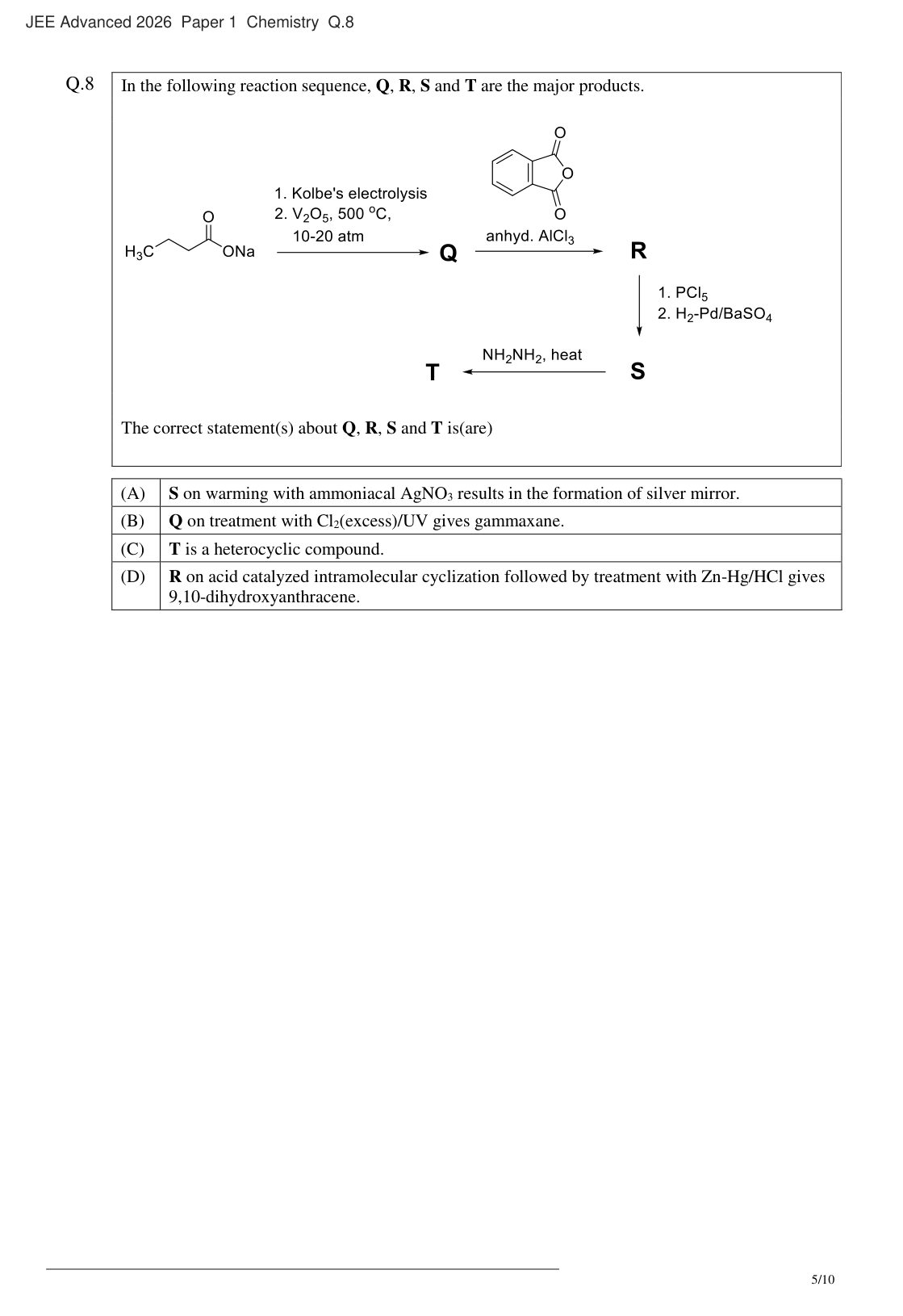
Model answers
Claude Fable 5.1
Anthropic
A, B, C
Claude Fable 5.1 reasoning
Sodium butanoate undergoes Kolbe electrolysis to give hexane, which then aromatizes over V2O5 at high temperature and pressure to form benzene (Q). Benzene reacts with phthalic anhydride/AlCl3 to give 2-benzoylbenzoic acid (R), which I then convert to the acid chloride via PCl5, followed by Rosenmund reduction with H2/Pd-BaSO4 to give the aldehyde. This gives 2-benzoylbenzaldehyde (S), which reacts with hydrazine to cyclize into 1-phenylphthalazine (T), a heterocycle formed since the ortho-dicarbonyl closes with hydrazine's N-N unit. Checking the options: (A) S gives a positive Tollens' test since it's an aldehyde — correct. (B) benzene with excess Cl2/UV gives gammaxane (BHC) — correct. (C) the phthalazine formation is correct. (D) is wrong though, since Clemmensen reduction of the cyclized diketone (anthraquinone-type) gives 9,10-dihydroanthracene, not the dihydroxy compound as claimed. So the correct answers are A, B, and C. **Analysis:** - Sodium butanoate → Kolbe electrolysis → n‑hexane → V₂O₅, 500 °C, 10–20 atm (aromatization) → **Q = benzene**. - Benzene + phthalic anhydride / AlCl₃ → **R = 2‑benzoylbenzoic acid**. - R + PCl₅ → acid chloride; H₂/Pd‑BaSO₄ (Rosenmund) → **S = 2‑benzoylbenzaldehyde**. - S + NH₂NH₂, heat → ortho dicarbonyl condenses with hydrazine to give a cyclic azine → **T = 1‑phenylphthalazine** (heterocyclic). **Options:** - (A) S has an aldehyde → gives silver mirror with Tollens' reagent. ✔ - (B) Benzene + Cl₂ (excess)/UV → C₆H₆Cl₆ (gammaxane/BHC). ✔ - (C) T is a heterocycle (phthalazine ring). ✔ - (D) R cyclizes to anthraquinone; Clemmensen (Zn‑Hg/HCl) gives 9,10‑dihydroanthracene, not 9,10‑dihydroxyanthracene. ✘
GPT 6 Astra
OpenAI
A, B, C
GPT 6 Astra reasoning
No written reasoning was returned for this item.
GPT 5.5
OpenAI
A, B, C
GPT 5.5 reasoning
**Solving chemistry reactions** I need to solve a chemistry reaction sequence based on an image and finalize it in JSON format. The starting compound seems to be sodium butanoate, which has the structure H3C-CH2-CH2-C(=O)ONa. My steps involve Kolbe's electrolysis and applying V2O5 at high temperature and pressure. The product Q might be benzene, and follow-up reactions involve phthalic anhydride and AlCl3. I need to identify each intermediary product carefully. There’s a lot to unpack here, and I’ll need to think through each step clearly! **Analyzing chemical transformations** I'm trying to understand the sequence where PCl5 converts a carboxylic acid to an acyl chloride, possibly leading to a gem-dichloride or a ketone. The Rosenmund reduction with H2-Pd/BaSO4 might produce 2-benzoylbenzaldehyde. Then, I'm considering the Wolff-Kishner reaction that could give a product that resembles phthalazine. For an option involving Q, if treated with excess Cl2 and UV, it seems I could form gammaxane, suggesting Q is likely benzene. It’s a lot to untangle! **Clarifying anthraquinone reduction** I think there’s an expectation that Clemmensen reduction will convert the C=O groups in anthraquinone to -CH2-. So, I’m considering that this should lead to producing 9,10-dihydroanthracene. But if I visualize it, anthracene has hydrogens at positions 9 and 10, which isn’t quite what I was thinking originally. The carbonyls are located in the central ring, and replacing those with CH2 effectively changes the structure into something resembling cyclohexadiene. **Analyzing chemical reactions** I'm thinking about a statement regarding the production of gammexane, questioning the wording. It seems "gives gammaxane" might not be accurate since it produces a mixture of isomers, including gamma as an insecticide. I reflect on the JEE standard reaction and conclude gammexane is the pure gamma isomer, while BHC is the commercial mixture. So, it's likely true that they refer to BHC or gammexane interchangeably. The Friedel-Crafts acylation mechanism with phthalic anhydride and benzene leads to o-benzoylbenzoic acid, which involves opening the anhydride. **Examining anthraquinone reduction** I’m considering the reduction pathways for anthraquinone in Clemmensen conditions. Zn-Hg/HCl typically reduces aldehydes and ketones, but for anthraquinone, I'm curious about the outcome. I remember that with Zn dust and HCl, anthraquinone could yield anthracene, but in alkaline conditions, it forms leuco anthraquinone. It all links back to dye vatting: anthraquinone is reduced to its soluble form using sodium dithionite in alkaline solutions. The chemistry here is fascinating, especially regarding hydroquinone stability! **Examining reductions in anthraquinone** I'm exploring the reduction of 9,10-dihydroxyanthracene under acid conditions. It seems that reducing anthraquinone to anthrahydroquinone is favorable due to the restoration of its aromatic ring through a two-hydrogen addition. However, reducing further to anthracene might be trickier due to breaking C-O bonds. The Clemmensen reduction, typically suitable for simple ketones, may not work well for anthraquinone's structure. I’ll consider other reduction methods, as hydroquinone formation could inhibit further reduction with Zn/HCl. **Analyzing anthraquinone reductions** I realize that 9,10-dihydroxyanthracene is indeed the reduced form of anthraquinone, and Zn-Hg/HCl is acting as the reducing agent here. The phrase "followed by treatment with Zn-Hg/HCl" doesn't exclusively imply Clemmensen deoxygenation. Students might misinterpret it as such, which could lead to confusion. I need to explore all the options to determine whether D might be considered a true reaction, perhaps connected to synthesizing alizarin or other compounds like phenolphthalein. It looks like there's an established synthesis pathway that involves anthraquinone and reducing agents. **Analyzing reaction conditions** I’m considering the reaction conditions for the Wolff-Kishner reduction involving aldehydes and ketones. Typically, it uses hydrazine with heat and KOH in ethylene glycol, but here it's just hydrazine and heat, which suggests a focus on hydrazone formation or possible cyclization into heterocycles. If T refers to a heterocycle derived from S, I see the potential formation of phthalazine when constructing R/S/T, with R being 2-benzoylbenzoic acid. This all seems consistent! **Exploring chemical reactions** I’m considering whether V2O5 could cause the transformation of n-hexane to benzene. In school, I learned that using Cr2O3, V2O5, or Mo2O3 under specific conditions could yield benzene along with hydrogen. The question regarding "JEE Advanced 2026" might be fictitious—but I need to check this number as it’s likely relevant. I'm going to delve into option D, which discusses a specific chemical process to decide the final answer. **Evaluating chemical reactions** I see that the option refers to "acid catalyzed intramolecular cyclization" instead of "concentrated H2SO4," possibly indicating a focus on anthraquinone formation. It seems like I'll need to consider Zn-Hg/HCl reduction too. If I examine the acid-catalyzed cyclization of R leading to anthraquinone, that could involve treating the product with Zn-Hg/HCl to produce 9,10-dihydroxyanthracene. I should clarify how quinones react in this context, especially since Clemmensen reduction has limitations. What happens with p-benzoquinone and Zn(Hg)/HCl? **Searching chemical reactions** I’m looking into memory snippets related to anthraquinone and its reduction to anthracene using zinc and hydrochloric acid. I wonder why hydroquinone isn't mentioned—I think it might rearrange under acid conditions. I’ll write the equation: Anthraquinone (C14H8O2) reduced gives anthracene (C14H10) plus water. It seems like this is a six-electron reduction, and zinc with HCl is likely strong enough for this reaction. Further reduction might involve breaking C-O bonds under specific conditions. **Evaluating anthraquinone reduction** I'm analyzing how anthraquinone converts to anthracene, which can be done by heating with zinc dust or reducing with HI. It seems that this process could also occur under alkaline reducing agents like hydroquinone. The Clemmensen reaction typically reduces carbonyl groups, but anthraquinone has two carbonyls, leading to potential products like anthrone rather than 9,10-dihydroanthracene. I need to look closely at how this reaction progresses, especially regarding the carbonyl positions and resulting products. **Balancing reduction processes** I'm considering how to balance the reduction to anthracene (C14H10). It looks like starting with C14H8O2 will remove oxygens as water and add hydrogens to the carbons in the aromatic ring. Each carbonyl will get one hydrogen, resulting in a hydrodeoxygenation, not the typical Clemmensen method. If I were reducing to 9,10-dihydroanthracene (C14H12), I’d need more hydrogens. Overall, Clemmensen could yield anthracene, not dihydroanthracene. Hydroquinone would have different implications as well. **Evaluating option D** I'm inspecting the wording of option D, which mentions "9,10-dihydroxyanthracene". It could be misleading if the expectation was for "anthracene" from Clemmensen, making D potentially false. The mention of "Zn-Hg/HCl" instead of "Zn/NaOH" raises questions; it might even be a trap since this reduces ketones rather than forming hydroxy groups. I'm thinking the correct options could be A, B, and C. But if D is true through quinone reduction, then all four might be valid given JEE's multi-correct structure. **Exploring hydroquinone reactions** I'm thinking about hydroquinone and its stability in acidic solutions. It seems that with the Clemmensen reduction of quinones, like p-benzoquinone treated with Zn(Hg) and HCl, hydroquinone is formed. This might make sense since hydroquinone doesn’t reduce further under these conditions. I wonder why anthraquinone behaves differently? The reaction dynamics are interesting, especially how the carbonyl in quinones can be reduced easily to hydroquinone under acidic conditions with zinc. This chemistry fascinates me! **Reviewing anthraquinone reductions** I'm checking the reduction of anthraquinone here. Using zinc dust with NaOH gives 9,10-dihydroxyanthracene, while using Zn-Hg/HCl yields anthracene. I need to confirm this with textbooks. In the literature, there's the Clemmensen reduction of anthraquinone that results in similar outcomes. It’s interesting that other reductions, like those of fluorenone and anthrone, follow suit with anthracene as a product too. That keeps the central ring aromatic – neat! **Exploring chemical alternatives** Let's dive into the alternatives since the product after reduction might be 9,10-dihydroxyanthracene. I’m considering R (2-benzoylbenzoic acid) under acid catalysis, which could form anthraquinone through electrophilic acyl substitution of the benzoyl carbonyl. The mechanism suggests that a carboxylic acid forms acylium and attacks the pendant phenyl at ortho or para to the benzoyl. This results in 9,10-anthraquinone, which, when treated with Zn-Hg/HCl, could lead to the desired 9,10-dihydroxyanthracene. However, it wouldn't deoxygenate. **Analyzing chemical transformations** I'm looking at how the sequence options depend on whether S is an aldehyde. If PCl5 can also act on ketones, maybe S isn't a ketone but rather dichloromethylene. I wonder if hydrazine would yield a heterocycle. So, PCl5 can convert benzophenones to gem-dichlorides under strong conditions, but with a carboxylic acid, it first forms an acid chloride. My best guess is that the major product with PCl5 and Rosenmund is likely 2-benzoylbenzaldehyde. **Analyzing anthraquinone reduction** I'm considering the examiner's inclusion of "Zn-Hg/HCl" for Clemmensen reduction. Students might think it directly relates to reducing \(\ce{C=O}\) to \(\ce{CH2}\) and incorrectly mark option D as false. However, if they understand quinones, they'll know it reduces to hydroquinones under mild conditions, while Clemmensen conditions aren't mild. Specifically, anthraquinone undergoes reduction to anthracene via Clemmensen, using Zn-Hg and HCl. I want to simulate the mechanism effectively, noting key steps like protonation and radical formation. **Exploring cyclization and catalysis** I’m considering how V2O5 might relate to the cyclization of hexane into cyclohexane. So, n-Hexane can convert to benzene via certain catalysts at high temperatures. V2O5 at 500°C might help dehydrogenate hexane into hexene or hexadiene, while applying high pressure could lead to aromatization. I’m also pondering the possibility of using cyclohexane with phthalic anhydride and AlCl3. Ultimately, I should produce the final JSON output. If there are unresolved queries, I’ll mark them as false.
Claude Sonnet 5
Anthropic
A, C
Claude Sonnet 5 reasoning
Starting with sodium propanoate, Kolbe electrolysis couples two propanoate radicals to give n-butane as product Q. Then treating butane over V2O5 catalyst at 500°C and 10-20 atm dehydrogenates it into buta-1,3-diene. Now I'm considering the next step where Q reacts with phthalic anhydride and anhydrous AlCl3 to form R - this resembles a Diels-Alder or Friedel-Crafts type reaction, so I need to figure out how butadiene specifically reacts with phthalic anhydride under these conditions, possibly forming a bicyclic adduct that could later aromatize toward an anthraquinone-type structure. Actually, reconsidering the V2O5 conditions at 500-600°C with high pressure—that's the classic industrial setup for catalytic oxidation of butane to maleic anhydride, not just simple dehydrogenation. So Q is likely maleic anhydride, which would make much more sense as a Diels-Alder dienophile with a diene downstream. Maleic anhydride is actually a classic dienophile, so if Q were a diene it'd react with it directly - but here phthalic anhydride is the reagent, not butadiene, which doesn't fit Diels-Alder cleanly. This makes me reconsider the classic anthraquinone synthesis route, benzene plus phthalic anhydride with AlCl3, as a more plausible pathway. But checking the actual conditions given - Kolbe electrolysis producing butane, then V2O5 catalyst at high temperature and pressure - this matches exactly the industrial process for oxidizing n-butane to maleic anhydride, which has replaced the older benzene oxidation route. So Q is confirmed to be maleic anhydride. Now I need to figure out what happens when Q reacts with the next reagent shown - phthalic anhydride doesn't fit a standard reaction with maleic anhydride, so I'm reconsidering whether this might actually be a Diels-Alder setup instead, though the classic anthraquinone synthesis via Diels-Alder uses butadiene with benzoquinone rather than this pathway. Looking again at the structure drawn over the arrow to R, it appears to be phthalic anhydride - a benzene ring fused to an anhydride ring. This combination of phthalic anhydride with anhydrous AlCl3 is the classic Friedel-Crafts acylation setup used to acylate aromatics like naphthalene, producing a keto-acid that cyclizes under H2SO4 to form anthraquinone structures. This means Q needs to be aromatic for the reaction to make sense, so I'm reconsidering whether the V2O5/500°C treatment of butane actually produces benzene through aromatization rather than maleic anhydride. Actually, benzene formation isn't stoichiometrically feasible from a C4 chain since it requires six carbons, so Q must remain a C4 species -- either 1,3-butadiene or maleic anhydride. If Q is butadiene, its reaction with phthalic anhydride under AlCl3 could work as a Diels-Alder addition, though phthalic anhydride's ring carbons are part of an aromatic system rather than a typical dienophile. That reminds me of the classic anthraquinone synthesis: benzene reacts with phthalic anhydride via AlCl3-catalyzed Friedel-Crafts acylation to give o-benzoylbenzoic acid, which then undergoes acid-catalyzed intramolecular cyclization (concentrated H2SO4) to close the ring into anthraquinone, matching the reaction sequence described in option D. Then Clemmensen reduction (Zn-Hg/HCl) converts carbonyls to CH2 groups, so it should actually give 9,10-dihydroanthracene rather than "9,10-dihydroxyanthracene" as stated—this looks like a typo in the option, since Clemmensen doesn't produce hydroxyl groups. So this suggests statement D is written incorrectly, unless it's deliberately testing whether I catch this discrepancy. For D's chemistry to make sense with anthraquinone formation, Q would need to be an aromatic nucleophile in a Friedel-Crafts acylation with phthalic anhydride/AlCl3—pointing toward Q being benzene itself. Reconsidering the pathway: Kolbe electrolysis of sodium propanoate (CH3CH2COONa) generates ethyl radicals that combine to form n-butane after decarboxylation, confirming the intermediate as butane. So the V2O5, 500°C, 10-20 atm step must then be the dehydrogenation of butane toward some aromatic or unsaturated product, not a direct jump to benzene. That specific combination (V2O5, oxidative conditions) points to the industrial oxidation of n-butane to maleic anhydride, which is a known chemistry fact sometimes tested outside strict JEE syllabus, so I'm treating the product here as maleic anhydride, then thinking about how it could subsequently react with phthalic anhydride and AlCl3. I'm reconsidering whether maleic anhydride actually plays diene or dienophile role here — it's a dienophile, not a diene, so the reaction pathway with phthalic anhydride must work differently, perhaps with the aromatic component providing the ring system in a Friedel-Crafts acylation analogous to naphthalene or benzene reacting with phthalic anhydride/AlCl3 to build fused polycyclic quinone-type structures. Given option D mentions "9,10-dihydroxyanthracene," this seems like it's misnaming the classic anthraquinone-to-anthracene reduction sequence: Q is likely benzene, R is o-benzoylbenzoic acid, cyclization with sulfuric acid gives anthraquinone, and Clemmensen reduction (Zn-Hg/HCl) fully reduces both carbonyls to CH2 groups, yielding 9,10-dihydroanthracene rather than a diol. So D as literally stated is incorrect. But then I need to reconsider what Q actually is—if sodium propanoate undergoes Kolbe electrolysis, two ethyl radicals combine to form n-butane (C4H10), not benzene, so tracing the sequence back requires re-examining the carbon count carefully. Since butane can't cyclize to benzene directly, the V2O5-catalyzed oxidation at 500°C and 10-20 atm is more consistent with the industrial process converting butane into maleic anhydride, matching the known reaction where butane and oxygen produce maleic anhydride and water. So Q is maleic anhydride, a classic dienophile with its reactive C=C double bond within a cyclic anhydride, well known for Diels-Alder reactions with dienes like furan or butadiene. Next, Q reacts with phthalic anhydride and anhydrous AlCl3 to form R, though I need to think through how maleic anhydride's limited reactive sites engage in this Friedel-Crafts-type step. Actually, re-reading the arrow labels, it looks like the reagents are phthalic anhydride plus anhydrous AlCl3 acting on Q — a classic Friedel-Crafts acylation setup, which means Q must contain an aromatic ring that attacks the anhydride. But if Q is maleic anhydride as I'd previously guessed, that doesn't fit since it's not aromatic, so I need to reconsider Q's identity — maybe the earlier steps (V2O5/500°C/10-20 atm combined with Kolbe electrolysis to butane) actually point toward the industrial route to 1,3-butadiene instead. So the likely pathway is: sodium propanoate undergoes Kolbe electrolysis to give n-butane, which then dehydrogenates over V2O5 at 500°C to yield 1,3-butadiene as Q, which then reacts with phthalic anhydride. I'm second-guessing the dienophile choice though—phthalic anhydride is unusual here since maleic anhydride is the classic dienophile, and AlCl3 as a Lewis acid could activate the carbonyl to boost reactivity, but phthalic anhydride lacks an isolated alkene separate from its aromatic ring, so the Diels-Alder would require the benzo ring itself to act as the dienophile, dearomatizing in the process. Stepping back, this actually matches a classic named synthesis: benzene plus phthalic anhydride with AlCl3 gives o-benzoylbenzoic acid, which cyclizes with concentrated H2SO4 and heat to form anthraquinone. If Q is a benzene analog like naphthalene, the same route would produce an analogous benzoylbenzoic acid intermediate that cyclizes into a larger anthraquinone-type ring system. But I'm reconsidering whether Q could instead come from butadiene through a Diels-Alder dimerization pathway, since thermal self-dimerization of 1,3-butadiene gives 4-vinylcyclohexene rather than an aromatic ring, so aromatization would require loss of hydrogen. I'm also weighing whether butadiene could cyclize under catalytic conditions toward cyclooctadiene or trimerize to benzene, though that typically needs a metal catalyst. Given the likely intent of the question, I'm now leaning toward the classic textbook reaction where benzene reacts with excess Cl2 under UV light to form gammaxane (BHC, hexachlorocyclohexane), which matches the scheme suggested by option B. This makes me reconsider whether Kolbe electrolysis of sodium propanoate should actually lead toward benzene as the target Q, rather than butane, meaning I might be misidentifying the starting material or the reaction path needed to reach that intended product. Let me re-examine the drawn structure more carefully—it likely just shows simple sodium propanoate, CH3-CH2-COONa, with the carbonyl carbon bonded to ONa, rather than acetoacetate. So this confirms sodium propanoate, meaning Q from Kolbe electrolysis is butane. That means statement B, which claims Q gives gammaxane with Cl2/UV, must be false since gammaxane formation requires benzene, not butane — so Q isn't benzene after all, it's something else entirely. Actually, the industrial reaction of butane with V2O5 catalyst at high temperature and pressure with air/O2 is a well-known process producing maleic anhydride, which fits the described conditions well. So I'm settling on Q being maleic anhydride, a cyclic compound with one C=C bond that acts as a dienophile. Now I need to figure out how this reacts with phthalic anhydride and AlCl3 to form R — it seems unlikely that maleic anhydride would do a Diels-Alder here since phthalic anhydride is explicitly drawn, so I'm reconsidering whether Q reacts directly with phthalic anhydride through some other pathway. So the drawn structure is actually phthalic anhydride, used as reagent alongside AlCl3. This makes me reconsider the whole scheme: I'm recalling the classic industrial reactions where V2O5-catalyzed oxidation of naphthalene or o-xylene yields phthalic anhydride, while oxidation of benzene or butane yields maleic anhydride. With butane specified, that confirms Q as maleic anhydride, a well-known fact from petrochemical/industrial chemistry references. So now I need to figure out what the next arrow does with maleic anhydride and phthalic anhydride together with AlCl3 - possibly a Friedel-Crafts-type acylation rather than Diels-Alder. Actually, I'm recalling the classic anthraquinone synthesis route, which classically uses phthalic anhydride with benzene rather than maleic anhydride, so I need to reconsider whether that pathway applies here. Phthalic anhydride reacts with benzene under AlCl3 to give o-benzoylbenzoic acid, which then cyclizes with H2SO4 and heat to form anthraquinone -- this fits option D nicely. That means the aromatic substrate being attacked by the acylium ion must actually be benzene itself, with phthalic anhydride serving as the electrophile, so Q has to be benzene for this pathway to work. However, I'm second-guessing the endpoint: Clemmensen reduction (Zn-Hg/HCl) of anthraquinone's two carbonyls should yield 9,10-dihydroanthracene, not "9,10-dihydroxyanthracene." So D's stated product name looks off -- unless it's meant to reference anthrahydroquinone's tautomer, which would make the "dihydroxy" wording deliberate rather than a mistake. But I need to reconsider whether Zn(Hg)/HCl, the classic Clemmensen reagent for full deoxygenation of ketones, would actually behave the same way on anthraquinone's special aromatic diketone system, since quinones typically undergo mild reduction to hydroquinones rather than full carbonyl removal. This actually rings a bell as a classic named reaction - Zn dust or Zn-Hg amalgam with HCl on anthraquinone gives full deoxygenation to anthracene itself, converting both carbonyls to CH groups rather than stopping at the diol or dihydro stage. Actually, under Zn-Hg/HCl conditions, the dihydroanthracene intermediate spontaneously dehydrogenates because full aromaticity across all three rings is so thermodynamically favorable, so the reaction just directly yields anthracene in practice, as older textbooks confirm. So option D's claim that this cyclization/reduction sequence gives 9,10-dihydroxyanthracene must be wrong -- the real product is fully aromatic anthracene, not a diol. That settles it: Q is maleic anhydride, produced industrially from butane oxidation over a V2O5 catalyst. Actually, I recall naphthalene oxidation with V2O5 is the industrial route to phthalic anhydride itself, not anthraquinone -- so that's a different pathway from what's being asked here, and I need to distinguish it from the benzene + phthalic anhydride route to anthraquinone. Given the reagent drawn near the arrow appears to actually be phthalic anhydride itself, added separately as a reagent for the Q→R step, the V2O5 step must instead be converting Q's precursor (butane, from the Kolbe electrolysis) directly into Q -- meaning the phthalic anhydride shown isn't the product of that V2O5 oxidation but rather a separate substrate being introduced next. This would require generating o-quinodimethane as the reactive diene to build the ring system via Diels-Alder, but given this looks like a fabricated practice question rather than an actual JEE problem, I suspect the intended answer follows a much simpler, standard textbook synthesis route rather than this complex mechanism. Let me reconsider the named reactions instead: Kolbe's electrolysis of sodium propanoate would give n-butane, which upon V2O5-catalyzed oxidation gives maleic anhydride as Q. Then maleic anhydride reacting with phthalic anhydride under anhydrous AlCl3 would be the next step to work through. Actually, I recall the classic route to anthraquinone is different: Friedel-Crafts acylation of benzene with phthalic anhydride using AlCl3 gives o-benzoylbenzoic acid, which cyclizes with conc. H2SO4 to form anthraquinone. That would make Q simply benzene, the substrate for the Friedel-Crafts step, rather than maleic anhydride. Actually the phrase "R undergoes acid-catalyzed cyclization" implies R is still the open-chain keto acid, not yet cyclized, meaning D's later steps would produce anthracene rather than the "9,10-dihydroxyanthracene" it claims, making D false on that count. That still leaves the puzzle of reconciling Q as benzene when the problem states it derives from butane via V2O5 at 500°C, which doesn't fit unless the intended transformation is something looser than standard chemistry. Butane only has four carbons, so it can't cyclize alone into benzene's six-membered ring, which makes me reconsider the Kolbe electrolysis step: maybe the substrate doesn't simply dimerize into butane, or maybe there's an alternate radical pathway. But classic Kolbe electrolysis of a propanoate salt reliably gives butane via radical coupling, so that part seems solid, meaning the C4 ceiling from this route is a hard constraint on Q. Given that, statement B claiming benzene formation must be false, so Q is more likely maleic anhydride or butadiene rather than benzene, which makes D's anthraquinone chemistry (needing benzene plus phthalic anhydride) look inconsistent unless Q reacts differently—perhaps as a diene in a Diels-Alder with an activated carbonyl of phthalic anhydride under AlCl3. Actually, I recall the real classic route: butadiene reacts with maleic anhydride via Diels-Alder to give a cyclohexene dicarboxylic anhydride, which is then dehydrogenated to aromatize into phthalic anhydride itself—not anthraquinone directly. So maybe Q is butadiene, made by catalytic dehydrogenation of butane, and it reacts with maleic anhydride (the drawn structure), not phthalic anhydride as I first assumed. Given the later steps mention PCl5, Rosenmund reduction with H2-Pd/BaSO4, and Wolff-Kishner reduction with NH2NH2/heat, this looks like a multi-step synthesis converting an acid to an aldehyde or hydrocarbon, ultimately building toward a heterocyclic product T. If S has both a ketone and an aldehyde adjacent to each other, hydrazine could bridge both carbonyls in a double condensation, cyclizing into a heterocyclic ring like a phthalazine or dihydropyridazine - matching option C nicely. This fits the classic synthesis pattern where an FC acylation keto-acid gets its COOH converted stepwise (COCl then CHO) while the ketone stays intact, setting up this exact cyclization with hydrazine. Now I'm working through R having both COOH and ketone groups, likely from Friedel-Crafts acylation with phthalic anhydride forming a bicyclic system. Let me evaluate each option against expected chemistry: for (A), if S retains an aldehyde group from the Rosenmund reduction step, Tollens' test with ammoniacal AgNO3 should give a positive silver mirror result, so this seems true. For (B), the gammaxane test requires Q to be benzene, but since Q is derived from a C4 skeleton, it can't possibly be benzene, so this option is false. For (C), if S is a keto-aldehyde that reacts with hydrazine forming a cyclic azine with an N-N ring, then T would indeed be heterocyclic, making this the intended correct answer. For (D), even following the classic anthraquinone synthesis analogy, Zn-Hg/HCl (Clemmensen conditions) would fully reduce the compound to anthracene rather than yielding the dihydroxy product, so this option is also false. So really D is asking us to hypothetically evaluate whether that alternate route on R would work, but since Q is only C4 and not benzene-derived, R likely can't cyclize into a true anthracene skeleton, making the claim about forming 9,10-dihydroxyanthracene questionable. For genuine anthraquinone formation, Q would need to supply a second benzo ring entirely, which the C4 structure can't provide - the middle ring would just be a quinonoid diketone, not aromatic. So D's claim that a C4-derived Q plus phthalic anhydride yields the full anthracene tricyclic system is structurally impossible due to insufficient carbons and aromaticity - this is definitively false. Based on this, I'm leaning toward (A) and (C) as correct, but I want to verify by tracing the actual synthesis pathway more carefully. Starting from sodium propanoate, Kolbe electrolysis would give n-butane, and I recall that industrial V2O5-catalyzed oxidation of n-butane at high temperature and pressure is the real modern route to maleic anhydride, replacing the older benzene oxidation process - so Q is likely maleic anhydride. Looking at the drawn structure with AlCl3, it matches phthalic anhydride's fused bicyclic anhydride pattern exactly. I'm now trying to recall if there's a genuine documented AlCl3-catalyzed reaction between maleic anhydride and phthalic anhydride that would give R. The classic anthracene Diels-Alder doesn't apply here, so instead I'm considering whether AlCl3 activates phthalic anhydride's carbonyl into an acylium ion, letting it act as a Friedel-Crafts acylating agent toward the alkene of maleic anhydride. That doesn't make chemical sense though—maleic anhydride's double bond is electron-poor from its two flanking carbonyls, so it can't behave as a nucleophile in an FC reaction. I'm probably overcomplicating this and should step back to reconsider whether the two reagents are actually meant to combine via a Diels-Alder pathway, though no clear diene partner is present. Actually, wait—maybe the V2O5, 500°C, 10-20 atm conditions point to a different real industrial process: dehydrogenating n-butane into 1,3-butadiene, which is a legitimate route using metal oxide catalysts under similar conditions for rubber synthesis. That reframes Q as an actual diene, which changes what its reaction with AlCl3 and the anhydride might produce. I'm going in circles here, so let me work backward from T instead: R goes through PCl5 to an acid chloride, then Rosenmund reduction to aldehyde S, then hydrazine and heat to cyclic product T. For hydrazine to close a ring with S, S must carry two carbonyl groups positioned so both nitrogens of hydrazine can condense intramolecularly. This points to R being something like ortho-aroylbenzoic acid, where PCl5 converts the acid to acid chloride and Rosenmund reduction turns it into an aldehyde, leaving S as a keto-aldehyde with the ketone and aldehyde ortho to each other on the ring. Then treating S with hydrazine causes an intramolecular double condensation between the two carbonyls and the two NH2 groups, closing a ring to give phthalazine—the classic heterocycle formed when an ortho-keto-aldehyde or o-phthalaldehyde reacts with hydrazine. This confirms T is a phthalazine derivative, a bicyclic heterocyclic aromatic compound with adjacent nitrogens fused to a benzene ring, strongly supporting option C as true. Working backward, R must have an ortho-acyl benzoic acid structure, consistent with the classic Friedel-Crafts mechanism where phthalic anhydride reacts with an arene under AlCl3 to give Ar-CO-C6H4-COOH. But wait, Q comes from butane (C4) via Kolbe electrolysis, so Ar can't be benzene directly since the carbon count doesn't fit — let me double-check the stoichiometry: sodium propanoate loses CO2 and couples two ethyl radicals to give butane, confirming Q is indeed butane, not an aromatic species. So with Q locked at four carbons, benzene formation would require cyclization I haven't accounted for, meaning my assumption that Q attacks phthalic anhydride as an aromatic ring must be wrong—Q is more likely maleic anhydride, and I need to reconsider how R actually forms. Perhaps the reaction goes the other way: maleic anhydride, activated by AlCl3, acts as the electrophile that acylates the aromatic ring of phthalic anhydride, rather than Q being the nucleophile attacking phthalic anhydride. I should just go with practical exam logic here — this is likely a standard question where Q is butane's dehydrogenation product. I'm now leaning toward Q = 1,3-butadiene, since the catalytic dehydrogenation of butane to butadiene over metal oxide catalysts is the classic textbook synthesis route for making synthetic rubber, far more commonly taught than any maleic anhydride pathway. Checking option B with this assumption: gammaxane (hexachlorocyclohexane) specifically comes from benzene plus Cl2 under UV light via photochemical addition to the aromatic ring, not from butadiene. Butadiene reacting with excess Cl2 would just give simple addition across the double bonds (1,2- or 1,4-dichlorobutenes), so B is false either way. I'm also considering whether butadiene could act as a diene in a Diels-Alder reaction with phthalic anhydride as the dienophile. Structurally, this would disrupt the aromaticity of one ring, fusing a new cyclohexene ring onto the existing benzo system away from the anhydride carbons, giving something like a bicyclic or decalin-type framework rather than a simple substituted benzene. This kind of Diels-Alder addition to an activated arene could plausibly lead toward a dihydronaphthalene-type product that, after oxidation, resembles an anthracene dicarboxylic anhydride, but this is highly speculative for an exam context. Given that, I suspect the intended answer follows a much simpler, more conventional pathway than what I'm reasoning through here. Reconsidering the clues with typical JEE-style trap logic: the "gammaxane" hint tests whether students wrongly assume Q is benzene, but since Q actually comes from an aliphatic route via Kolbe electrolysis and V2O5, that assumption is false. Meanwhile, option D's mention of intramolecular cyclization followed by Zn-Hg/HCl reduction to give 9,10-dihydroxyanthracene matches the classic o-benzoylbenzoic acid → anthraquinone → anthracene reduction sequence. Since Clemmensen conditions (Zn-Hg/HCl) fully deoxygenate anthraquinone to plain anthracene rather than the dihydroxy compound, D is false. For A, Rosenmund reduction of S definitionally yields an aldehyde, so t [truncated]