2026 · Paper 1 · Chemistry
Question 9
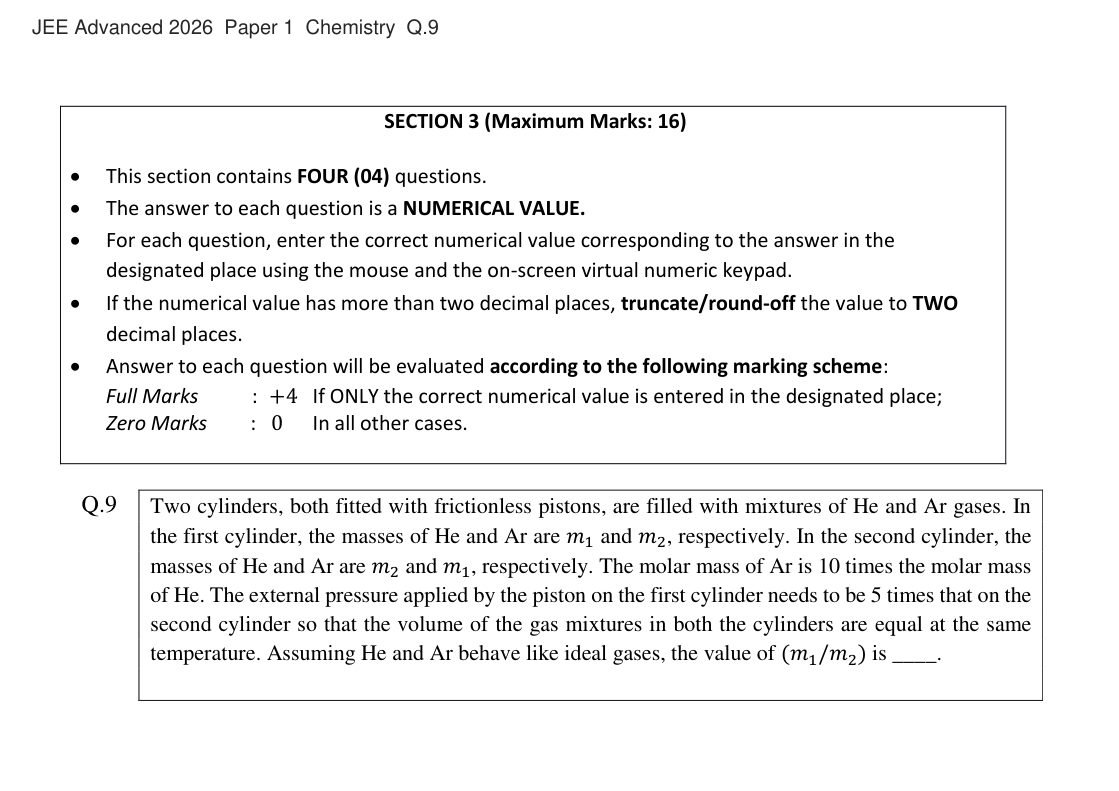
The printed question, the official key, and each model’s JSON answer plus the reasoning it wrote.
Q09
Official 9.8
Model answers
Claude Fable 5.1
Anthropic
9.8
Claude Fable 5.1 reasoning
Let molar mass of He = M, Ar = 10M. Cylinder 1 moles: n₁ = m₁/M + m₂/(10M) = (10m₁ + m₂)/(10M) Cylinder 2 moles: n₂ = m₂/M + m₁/(10M) = (10m₂ + m₁)/(10M) Same V and T, so P ∝ n: P₁/P₂ = 5 (10m₁ + m₂)/(10m₂ + m₁) = 5 10m₁ + m₂ = 50m₂ + 5m₁ 5m₁ = 49m₂ m₁/m₂ = 49/5 = 9.8
GPT 6 Astra
OpenAI
9.8
GPT 6 Astra reasoning
**Solving proportions** I need to solve the straightforward equation p1/p2 = n1/n2 = 5, which gives me (10m1 + m2)/(10m2 + m1) = 5. This simplifies down to 5m1 = 49m2 with 9.8 involved somehow. It seems I just need to produce a final JSON object that satisfies this equation. It feels like there’s a lot of math to unpack, but I’ll focus on crafting that final object.
GPT 5.5
OpenAI
9.8
GPT 5.5 reasoning
**Solving gas mixture problem** I need to finalize a JSON output for a problem involving two cylinders of ideal gas mixtures, specifically helium (He) and argon (Ar). The first step is to understand the relationship between their masses, defined as m1 for He and m2 for Ar, where the molar mass of Ar equals ten times that of He. The external pressure on the first cylinder must be five times that on the second for equal volumes at the same temperature. After deducing the equations and relationships, I find that m1/m2 equals approximately 9.8. **Finalizing gas equation** I need to apply the ideal gas law, where pressure (P), volume (V), and temperature (T) are key factors. With equal volumes and temperatures, pressure is proportional to the number of moles (n). If the external pressure on the first cylinder is five times that of the second, then, at equilibrium, the gas pressure will match the external pressure. I'm set to calculate m1/m2, which results in approximately 9.8. Finally, I’ll prepare the output as a JSON showing only this number.
Claude Sonnet 5
Anthropic
9.8
Claude Sonnet 5 reasoning
Setting molar mass of Argon as 10 times Helium's, I compute moles in each cylinder from the gas mixtures, then use equal volume and temperature to relate pressures: P1 = 5P2 gives me n1 = 5n2, so I'm setting up the equation (10m1+m2) = 5(10m2+m1) to solve for the mass ratio. Solving this out: 10m1+m2 = 50m2+5m1, so 5m1 = 49m2, giving m1/m2 = 9.8.