
2026 · Paper 1 · Chemistry
Question 10
The printed question, the official key, and each model’s JSON answer plus the reasoning it wrote.
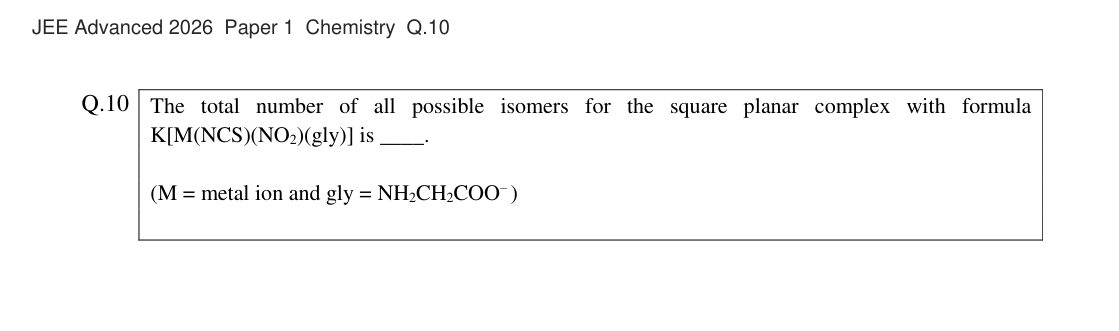
Q10
Official 8
Model answers
Claude Fable 5.1
Anthropic
8
Claude Fable 5.1 reasoning
This is a square planar complex with an unsymmetrical bidentate glycinate ligand plus two ambidentate monodentate ligands (thiocyanate and nitrite), so I need to work out how many distinct geometrical arrangements are possible given the asymmetry of each ligand type. I get 2 geometrical arrangements from the placement of the two monodentate ligands relative to the N/O ends of glycine, then multiply by 2×2 linkage possibilities for thiocyanate and nitrite, giving 8 total. Since the complex is planar, there's no chirality to add, and no ionization isomerism since there's no ionizable counterion in the coordination sphere, so 8 stands as the final count. **Analysis** The complex is [M(NCS)(NO₂)(gly)]⁻, square planar, with: - **NCS⁻**: ambidentate → can bind via N (isothiocyanato) or S (thiocyanato) → 2 linkage possibilities - **NO₂⁻**: ambidentate → can bind via N (nitro) or O (nitrito) → 2 linkage possibilities - **gly⁻**: unsymmetrical bidentate (N and O donors) **Geometrical isomers:** In a square planar complex with an unsymmetrical bidentate ligand (N–O) and two different monodentate ligands, the two monodentates can be arranged in 2 ways (NCS trans to N of gly, or NCS trans to O of gly) → 2 geometrical isomers. **Linkage isomers:** 2 (NCS) × 2 (NO₂) = 4 Square planar complexes are planar, hence no optical isomers. **Total isomers** = 2 × 4 = **8**
GPT 6 Astra
OpenAI
8
GPT 6 Astra reasoning
**Evaluating coordination complexes** I need to solve for eight configurations, considering glycine's linkage. The structure seems to involve a typical square planar geometry. I should check for isomers, and yes, I confirm there are eight. I want to make sure I’m accurately reading the complex formula K[M(NCS)(NO2)(gly)], where M is a metal ion and gly is glycine. Each ligand has distinct linkages. The user wants only the answer in JSON format, implying no lengthy explanations are necessary. I'll keep it concise!
GPT 5.5
OpenAI
8
GPT 5.5 reasoning
**Analyzing coordination isomers** I need to solve a chemistry problem that asks for the total number of isomers for the square planar complex with the formula K[M(NCS)(NO2)(gly)]. The compound includes various ligands, such as ambidentate NCS and NO2, and a bidentate gly ligand. I’m considering how to count different types of isomers: geometrical, linkage, and optical. I need to clarify if the total might be around 8 or 16. Careful reasoning is important here! **Exploring geometry and isomers** I'm working through the square planar complex with a bidentate gly ligand adjacent to two monodentate ligands. The gly ligand occupies adjacent positions, leading to potential geometrical isomers based on the arrangement. For example, if one monodentate is trans to the nitrogen of gly, the other will be trans to the oxygen, creating two distinct arrangements. Since both ligands can bind in multiple ways, the naive count of isomers might be 8. I need to think about the optical activity too, but square planar complexes typically aren't optically active, though the unsymmetrical gly could be an exception. **Calculating vertex arrangements** I’m trying to calculate arrangements for a shape with 4 vertices, considering the effects of a dihedral symmetry group D4. This group acts transitively, and I want to see how fixing certain vertices affects the arrangements. The ordered adjacent pairs seem to be mapped by reflections. I’m evaluating the stabilizers and considering how orientation plays a role. Eventually, I’m thinking about how these mirror images can correspond to optical enantiomers. I wonder which physical symmetry group applies here for square planar shapes. **Exploring D4h point group** I’m considering the full point group D4h for a square, which encompasses various operations in 3D, including rotations and reflections. I see that it includes rotations about the z-axis and C2 axes in the plane, along with vertical and horizontal mirrors and inversion. Now, if I focus on the permutation group formed by proper rotations only, I can identify it as D4, which has an order of 4. I’m curious about how these rotations affect the square’s symmetry properties overall. **Evaluating geometrical configurations** I’m looking at M-SCN and M-ONO complexes, and it seems they can have 2 geometrical orientations, leading me to consider 8 possible configurations altogether. But I don’t want to finalize my thoughts just yet; I need to think about whether square planar with a glycine N or O adjacent, along with monodentates, would affect the cis/trans possibilities. A and B seem to be labeled as cis since their remaining sites are adjacent, and there's no trans between them. **Analyzing isomer linkages** It seems the user is asking about potential linkages, especially with the isomers and formulas involving NCS/NO2. The given formula K[M(NCS)(NO2)(gly)] probably represents one form, but I should consider all possible isomers like ONO and SCN. I need to count those as well. I wonder about "coordination position isomerism" when NO2 binds through different atoms. Also, what is the charge on "gly"? It's bidentate and could potentially act as monodentate too. **Analyzing coordination complexes** In standard JEE, glycinato seems to act as bidentate through NH2 and COO−, but not through O,O. The question likely uses "gly" as an unsymmetrical bidentate ligand. It's possible that in JEE, they expect gly to coordinate via either N,O or O,O. I need to analyze the provided formula for K[M(NCS)(NO2)(gly)] and consider all potential isomers. This might be challenging, especially since they didn't list options. I'll explore various isomer types to get a solid answer. **Interpreting ligand abbreviations** I’m thinking about the abbreviation "NCS" in the formula. It represents the arrangement of atoms as N-C-S. It’s important to clarify this structure as it can affect how I analyze the coordination complex. Understanding these abbreviations will help me interpret the overall formula better. I need to ensure that I'm considering these specifics as I continue with my task. This approach will guide my reasoning as I progress. **Evaluating square planar coordination** I’m looking at square planar coordination centers, which are indeed planar, but the ligands can sometimes lie outside that plane. The coordination polygon is in a plane, but it might not be symmetrical if chelate rings are puckered. I think all donor atoms and the metal ideally lie in the same plane, but that doesn’t always reflect the actual ligand structures. Chelate rings might bend out of plane, allowing for enantiomeric conformations to interconvert. Configurational isomers can also create chiral arrangements based on ligand characteristics. **Recalling square planar stereochemistry** I’m thinking about square planar complexes, like those of the type [M(AB)2], where AB is an unsymmetrical bidentate ligand. It seems that there can be three geometrical isomers for these complexes. For instance, with [Pt(gly)2], I recall that there are "cis" and "trans" forms, so I should consider how the arrangement of ligands affects their properties. I wonder if there are additional geometrical configurations I should explore. **Examining isomers in complexes** I’m considering the structure of [M(AB)2] and its cis isomer possibly lacking a plane, making it enantiomeric. If rotations involve reflection, they might be mirror superimposable. I’m testing using coordinates for square vertices and checking how changes in ring conformations affect coordination arrangements. I note that square planar complexes usually don't show optical isomerism unless they have unsymmetrical ligands. I need to verify this with examples of square planar complexes. **Considering isomers in Pt(gly)2** I remember that for [Pt(gly)2], there are three geometrical isomers: cis, trans, and one pair of optical isomers. It’s interesting how these different arrangements can affect the properties of the compound. I should look into each isomer's characteristics and how they interact, especially since optical isomers can have unique behaviors. I might also want to verify that typical rules of isomerism apply here. There's so much to explore! **Analyzing bidentate ligands** I’m exploring bidentate ligands and how their non-coordinating chains can arrange around a metal ion. It seems that they can position themselves either inside or outside the M-donor-donor triangle. When considering square planar arrangements, the chelate ring may occupy either side of the triangle. If one chelate uses adjacent positions, it occupies one side, while the others are positioned oppositely. I’m thinking that the JEE exam likely overlooks optical isomers for square planar complexes, though it’s interesting that they could still be included. **Exploring optical isomers** I need to ensure whether optical isomers are possible for the coordination complex [M(NCS)(NO2)(gly)]. I'm considering that with one gly chelate and two different monodentate ambidentate ligands, the arrangement matters. Is this coordination entity planar? If the ligands are linear, the gly chelate can form a five-membered ring. The ideal square plane has the metal and four donor atoms. Now, I wonder if the molecule has any symmetry planes that would impact optical activity. **Exploring molecular symmetry** I'm considering the arrangement of labels where N is north, O is east, A is south, and B is west. It looks like there’s no vertical mirror that preserves the labels, nor a horizontal one. I’m questioning if there's even a diagonal mirror. Perhaps the point group is C1? But then I recall that a molecule can still be achiral if it has an improper rotation. Actually, all achiral molecules have that property, but only if they're rigid. **Considering coordination isomerism** I’m looking at the potential issues with the ionic formula K[M(NCS)(NO2)(gly)]. If both NCS and NO2 are ambidentate and gly is unsymmetrical bidentate, the coordination linkage isomerism could arise. The nitro group could coordinate through different atoms, leading to geometrical and orientation isomerism. I find it interesting how the nitrite ligand might have two orientations in a square planar arrangement relative to other ligands, depending on the orientation of the NO2 group. **Identifying isomers of PtCl(NH3)(gly)** I'm recognizing that for the complex PtCl(NH3)(gly), there are indeed two isomers to consider. One has the chlorine in a trans position to nitrogen, while the other has it trans to oxygen. This distinction is key in understanding the structure of this compound and how it may behave in different chemical contexts. Just noting the variations helps me keep track of the details! **Clarifying isomer details** I'm thinking about the isomers, trying to determine if the number could be 2 or 4. I have Isomer 1 with A trans N and B trans O, and Isomer 2 with A trans O and B trans N. If we swap the N and O positions around gly relative to A and B, they could be cis. I need to draft an explanation but finalize my response in JSON format, ensuring it includes an "answer" field with a number and "unanswered" set to false, without any extra text.
Claude Sonnet 5
Anthropic
8
Claude Sonnet 5 reasoning
I'm working through this square planar complex with K+ as counter ion, where NCS- and NO2- are ambidentate ligands that can bind through different atoms, and glycinate is an unsymmetrical bidentate ligand attaching via both nitrogen and oxygen - this creates several isomer possibilities I need to work out. Since gly must occupy two adjacent cis positions on the square plane (too small to span trans positions), I'm labeling the four coordination sites 1-4 around the square, with gly's N and O donors filling two adjacent spots and NCS/NO2 filling the remaining two - now I need to enumerate how the unsymmetrical placement of gly combined with the ambidentate binding modes of the other two ligands generates distinct isomers. Labeling positions clockwise, gly occupies P1-P2 while NCS and NO2 sit at P3-P4. Since gly's N and O donors are distinct, swapping which one sits at P1 versus P2 could create a genuinely different isomer unless some symmetry operation of the square maps the positions onto each other while keeping the rest consistent, so I need to check whether rotating or reflecting the whole molecule produces equivalent arrangements. I'm treating the square as having two trans axes, P1-P3 and P2-P4, and thinking through which position pairs are trans partners to work out distinct arrangements systematically. What really distinguishes isomers here is what's trans to gly-N versus gly-O, plus how NCS and NO2 bind (through N/S and N/O respectively). Since gly's two donor atoms must stay cis to each other, I can think of this as choosing how to pair the four ligand positions into two trans pairs, with the constraint that gly-N and gly-O can never be one of those pairs. Ruling out the trans pairing between glycine's two donors leaves 2 valid geometric arrangements for each choice of NCS and NO2 binding atoms. So for a fixed pair of donor atoms, there are 2 isomers, and I still need to account for the fact that NCS can coordinate through S or N. Since square planar geometry is achiral, the chelate constraint removes one of the three trans-pairing possibilities, leaving 2 per donor-atom combination, so the total is 4 donor-atom combos × 2 arrangements = 8. Checking whether swapping which ligand pairs trans could produce coincidental duplicates, since the two ambidentate ligands are genuinely different from each other, these arrangements should remain distinct rather than collapsing into fewer isomers. Actually K+ is just the counter cation here, not a swappable ligand, so there's no additional ionization isomerism to count. Square planar geometry also rules out optical activity, so my total stands at 8 - though let me re-verify this by explicitly enumerating the arrangements to make sure I haven't missed or double-counted anything. Working through positions 1-4 around the square with trans pairs (1,3) and (2,4): the chelating gly ligand must occupy adjacent (cis) positions since it can't span trans sites. Placing gly's two donor atoms at positions 1 and 2, I then need to distribute the NCS and NO2 groups (each with two possible binding modes) into positions 3 and 4, checking which combinations produce distinct trans relationships with the chelate donors. I'm now considering whether swapping which chelate donor sits at position 1 versus 2 actually generates a new isomer, or if it's just the same molecule viewed differently through the square's mirror symmetry. Right, a 90° rotation of the whole molecule maps one labeling to another but represents the same physical structure, not a distinct isomer. So the true distinct arrangements need to be counted as equivalence classes under these rotations/reflections, not just raw labeled assignments. Fixing Ng at position 1 by rotation, Og can sit at position 2 or position 4, both adjacent - I need to determine whether these two placements are actually the same molecule (related by a mirror symmetry) or genuinely different isomers. Reflections through the molecular plane preserve the structure since square planar molecules are achiral in that sense, so I can treat both rotations and in-plane reflections as valid symmetries for counting distinct arrangements. Counting without symmetry: 4 edges give adjacent placements for Ng/Og, times 2 orderings, times 2 orderings for C/D on remaining spots, giving 16 total adjacent arrangements out of 24 possible permutations. Now I need to divide by the D4 symmetry group of order 8. Since all four labels are distinct, no non-identity symmetry can fix an arrangement — even reflections through opposite vertices would need matching labels at the fixed points, which can't happen here — so every orbit has size 8 and the stabilizer is trivial for all cases. That gives 16/8 = 2 distinct arrangements after accounting for symmetry, confirming the 2 geometric isomers found earlier. Now factoring in linkage isomerism: NCS can bind through N or S, and NO2 can bind through N (nitro) or O (nitrito), giving 4 combinations. Multiplying by the 2 geometric isomers gives 8 total isomers. Glycinate itself always coordinates as a bidentate chelate through its N and O donors, so it doesn't add extra linkage variability. Similarly NO2 binds via N (nitro) or O (nitrito), giving 2 modes. Multiplying geometric isomers by both ambidentate modes gives 2×2×2 = 8 total isomers. Looking at this problem, I need to analyze the square planar complex [M(NCS)(NO₂)(gly)]⁻ with K⁺ as counter-ion. ## Setting Up the Analysis **Ligand properties:** - **gly** (glycinate, NH₂CH₂COO⁻) is a bidentate ligand binding through N and O. In a square planar complex, a bidentate ligand can only span **cis** (adjacent) positions — never trans. - **NCS⁻** is ambidentate: can bind via S (thiocyanato) or via N (isothiocyanato) → 2 linkage modes. - **NO₂⁻** is ambidentate: can bind via N (nitro) or via O (nitrito) → 2 linkage modes. ## Step 1: Geometric Isomers (arrangement of donor atoms) Label the square planar positions 1–2–3–4 in a cycle, with trans pairs (1,3) and (2,4). Since gly must occupy a **cis** pair (say positions 1,2), the remaining monodentate ligands (NCS-donor and NO₂-donor) occupy positions 3,4. Treating the four donor groups (Ng, Og, NCS-donor, NO₂-donor) as distinct, and counting arrangements with Ng–Og cis (not trans), then reducing by the symmetry operations of the square (rotations + reflections, since square planar molecules possess a mirror plane and are achiral): - Total arrangements satisfying the cis-chelate constraint = 16 - Symmetry group order = 8 (D₄), and since all four groups are distinct, every arrangement has trivial stabilizer - Distinct geometric isomers = 16 / 8 = **2** This corresponds to the two ways of pairing the chelate donors with the two monodentate ligands across the trans axis (excluding the forbidden trans-chelate case). ## Step 2: Linkage Isomerism For each geometric arrangement, the binding mode of NCS⁻ and NO₂⁻ can vary independently: - NCS⁻: 2 modes (N or S) - NO₂⁻: 2 modes (N or O) Total linkage combinations = 2 × 2 = **4** ## Step 3: Total Isomer Count $$ \text{Total isomers} = (\text{geometric arrangements}) \times (\text{linkage combinations}) = 2 \times 4 = 8 $$ No additional optical isomerism arises since square planar complexes (being planar) are achiral, and no ionization isomerism arises since K⁺ is a simple spectator cation. ```json