
2026 · Paper 1 · Chemistry
Question 11
The printed question, the official key, and each model’s JSON answer plus the reasoning it wrote.
Q11
Official 4
Model answers
Claude Fable 5.1
Anthropic
4
Claude Fable 5.1 reasoning
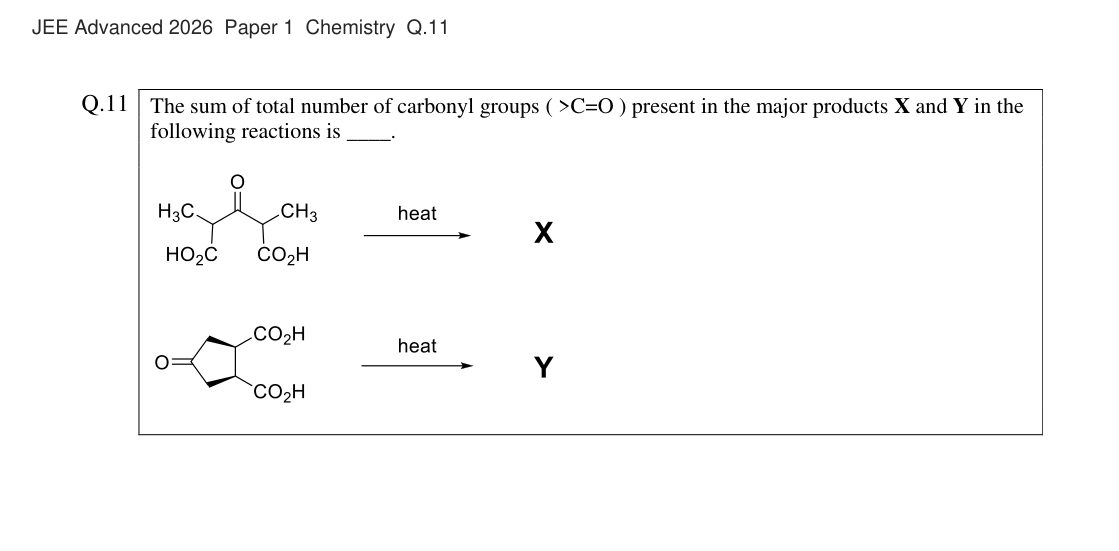
First reaction: 2,4-dimethyl-3-oxopentanedioic acid (a β-keto diacid) on heating undergoes decarboxylation of both β-keto acid groups, giving X = 3-pentanone (diethyl ketone), which has 1 carbonyl group. Second reaction: 4-oxocyclopentane-1,2-dicarboxylic acid. Here the carboxylic acids are γ to the ketone (not β), so no decarboxylation occurs. Instead, the cis-1,2-dicarboxylic acid on heating loses water to form a cyclic anhydride Y, which contains the ketone C=O plus two anhydride C=O groups = 3 carbonyl groups. Sum = 1 + 3 = 4.
GPT 6 Astra
OpenAI
4
GPT 6 Astra reasoning
No written reasoning was returned for this item.
GPT 5.5
OpenAI
4
GPT 5.5 reasoning
**Verifying ketone yields** I’m trying to figure out if the reaction yields methyl ethyl ketone. I know there’s a central carbonyl with two COOH groups. When heated, both β-keto acids can decarboxylate, releasing CO2. I need to determine the sum total of carbonyl groups in major products X and Y, probably not counting CO2. For product X, I might have one carbonyl group. Then there’s cyclopentanone, which has a ring with carboxylic acids next to it, and I want to clarify the stereochemistry of the structure. **Analyzing carbonyl structure** I'm looking at a drawing with the carbonyl carbon on the left and two carboxyl groups on adjacent ring carbons. I think it's a cis structure. I'm considering whether the groups are attached to the same side of the ring. It seems like I'm dealing with 3,4-dicarboxycyclopentanone, where the carboxyl groups at C3 and C4 are β to the ketone. When heated, these might form an intramolecular cyclic anhydride, giving me three carbonyl groups total when I include product X. So, X is 1, and I get a total of 4 carbonyl groups. **Exploring molecular transformations** I'm analyzing a chain involving carboxyl groups in a substituted succinic acid structure (HOOC-C-C-COOH). When heated, these substituted acids typically transform into cyclic anhydrides. The first substrate might include a vicinal dicarboxylic acid, which has carboxyl groups separated by three carbons and a ketone, possibly leading to β-keto dicarboxylic acid. I’m questioning the possibility of decarboxylation upon heating and whether intermediate products can continue to decarboxylate. Let’s carefully parse through this chemical reaction to find clarity! **Decarboxylation processes** I'm looking at the compound HOOC-CH(CH3)-CO-Et, where the carboxyl group is attached to the alpha carbon next to a ketone. Upon decarboxylation, it seems we get Et-CO-CH2CH3. So, starting with A (HOOC-CH(CH3)-CO-CH(CH3)-COOH), if we decarboxylate, I’m guessing the remaining structure after the first decarb yields CH3-CH2-CO-CH(CH3)-COOH. But I need to consider that the loss of the carboxyl will lead to tautomerization at the central ketone. Let's keep refining this analysis! **Analyzing dicarboxylic acids** So, I’m thinking about 1,5-dicarboxylic acid, which has three atoms between the carboxyls and relates to glutaric acid derivatives. I remember that glutaric acids can potentially form 6-membered cyclic anhydrides when heated, but maybe it's less common. I'm considering acetonedicarboxylic acid and whether it could decarboxylate to form acetone or create a cyclic anhydride too. Oh, and I need to keep in mind that the first substrate is a derivative of 3-oxoglutaric acid! **Analyzing chemical reactions** I'm considering why acetonedicarboxylic acid is unstable, as it decomposes to acetone and carbon dioxide over time. It could also form an anhydride in acetic anhydride. I should recall that 3-ketoglutaric acid decarboxylates to acetone, and heating likely leads to decarboxylation. The product has one carbonyl. However, I need to carefully assess carbonyl groups in the major organic products X and Y, including how CO2 fits into this. **Counting carbonyl groups** The task is to determine the total number of carbonyl groups in major products X and Y, which likely refer to organic products rather than CO2. When counting, I'll include carboxyl, ketone, and anhydride carbonyls, but CO2 doesn't count. If X is a cyclic anhydride, it might have three carbonyls, and similarly for Y, making a total of six. I need to explore the "heat" condition and consider whether the substrate undergoes decarboxylation or forms an anhydride during the reaction. **Analyzing carbonyl structure** I’m considering the carbonyl carbon as possibly being the leftmost ring vertex at coordinates (196, 362). From there, I think I should draw a line up and right to the top vertex at (208, 338). Then, I’m thinking a line from that top vertex to the right vertex at (237, 348) seems straightforward. The wedge along the first bond from the top vertex to the carbonyl might indicate its thickness. **Analyzing molecular structure** I’m considering a diamond shape with carbonyl (C) at the left and carboxyl groups at the top and bottom. The image suggests a five-membered ring instead. I’m noticing that there are indeed five vertices with two CO2H labels: one at the top right and one at the bottom right. Their connections indicate a cyclopentane edge, making this structure a 3,4-dicarboxycyclopentanone with adjacent substituents on the carbons. **Examining molecular transformations** I'm considering the implications of heat on a cis versus trans configuration. If it's cis, heat will likely produce an anhydride, but if it's trans, the reaction might not yield an anhydride and could lead to decarboxylation instead. The drawing of the CO2H substituents suggests they could be in the plane, possibly with one pointing up and the other down. In a flat representation of cis/trans, I’d need to use wedges and dashes to show those spatial arrangements. **Considering carbonyl groups** I'm analyzing the question about carbonyl groups, which likely includes aldehydes and ketones. It could ask about the number of C=O groups, so I need to consider if I should include the carbonyl in carboxylic acids, which, yes, I will. I suspect it incorporates all functional groups with C=O like ketones, carboxylic acids, and anhydrides. If Y is an anhydride with a ketone, I count three. But if I have 3-pentanone as the first product, I’ll just count one there. I need to be cautious not to include CO2 carbonyls released in the process. **Analyzing major products and reactions** I'm considering the "major product" X under heating, noting that CO2 isn't classified as X since it has the O=C=O structure, which differs from >C=O notation. I should dig into my memory since it's odd to see a JEE Advanced 2026 question. My focus needs to be on fundamental reaction mechanisms and possible products. The decarboxylation of β-keto acids could be a key reaction. Heating a specific β-keto acid might lead to an anhydride formation. If that happens, the product would contain three carbonyl groups. I also need to verify if acetonedicarboxylic acid is stable or decomposes under heat. **Exploring decarboxylation mechanisms** I'm recalling mechanisms involving a six-membered cyclic transition state. The carboxyl proton transfers to the keto oxygen, leading to the breaking of the C-C bond between the alpha and carboxyl positions, and subsequently the formation of a double bond with the release of CO2. The presence of an alpha hydrogen here is crucial, affecting tautomerization and product stability. I'm also curious about the potential for further decarboxylation in the anhydride formed from substituted succinic acid. **Analyzing stereochemical representation** I’m parsing a stereochemical representation from an image. There are two CO2H groups on the right side, one above the top carbon and one below the bottom carbon. In a planar cyclopentane, having substituents on adjacent carbons isn’t meaningful unless specified. The left ring bonds show a wedge, indicating that the top and bottom CH2 are on the same side. If the molecule is a "cis-1,2-disubstituted cyclopentanone," the connections may allow for anhydride formation. **Interpreting wedge bonds** I’m considering whether the use of wedge bonds on the left side of the ring indicates that the lower carboxyl on one carbon and the upper one on the adjacent carbon are in a cis configuration. This interpretation feels plausible. The wedge could be a visual cue meant to suggest that these groups are oriented similarly in space. It’s an interesting detail to think about while identifying the stereochemistry accurately! **Evaluating acid decarboxylation** I’m thinking about urtaric acid, which might decarboxylate due to β-keto acid. It could first dehydrate to form an anhydride, which may then decarboxylate. I recall 3-oxoglutaric acid decarboxylates to acetoacetic acid and subsequently acetone. This compound has two -CH2COOH groups and loses CO2 at room temperature to form acetoacetic acid. If not heated too long, acetoacetic acid is the intermediate, but heat will likely lead to acetone production. **Exploring cyclic enol lactones** I'm wondering if a stable cyclic enol lactone could form, especially one with two carbonyls. When heating a β-keto diacid, it might undergo dehydration or decarboxylation, potentially forming something like "angelica lactone." I think about citric acid, which when heated yields aconitic acid, though that's not directly related. I want to consider a substrate with a central ketone and two carboxylic acids. Heating could produce a stable cyclic anhydride, perhaps 2,4-dimethyl-3-oxoglutaric anhydride? This compound might act as a 1,3-dicarbonyl-type anhydride that could lose CO2. **Analyzing keto acids** I'm considering gamma-keto acids, particularly the structure HOOC-C3-C2-C(=O). It seems like γ- and δ-keto acids could cyclize or dehydrate to form lactones. There’s some complexity around 4- and 5-oxoacids that could decarboxylate when heated. For γ-keto acids, the transition state may not support decarboxylation as effectively. It's also intriguing that the carboxyl groups can interact in different ways, which affects products. I need to ensure I focus on the major final product, like 3-pentanone, derived from these processes. **Evaluating product formation** The developer clarified that I should reason through this step first, but the final message must only be in JSON. I think I should include commentary before that final JSON. I'm aiming for a numeric answer, specifically putting 4. If double decarboxylation leads to 3-pentanone, it has one carbonyl. For the sum total of carbonyls in products X and Y, if X includes the entire reaction mixture, there might be CO2 as a product, contributing two carbonyls. However, CO2 itself isn’t a carbonyl functional group due to its structure. Counting yields one from X and three from the anhydride, so the answer is 4. **Analyzing molecular structure** I'm considering a 1,2-dicarboxylic acid attached to cyclopentanone. When drawing it, if one carboxyl is positioned above and the other below on adjacent carbons, I wonder about their orientation in a flat ring representation. Can I determine cis/trans configurations from wedge/dash drawings? The structure shows filled wedges that might indicate that the bonds from the carbonyl carbon are protruding, but since carbonyls are planar, I think that could just be a drawing perspective. Maybe the author's bold bonds indicate the ring is puckered instead. **Evaluating molecular configurations** I’m considering the carboxyl substituents; if they're not drawn stereochemically, they might be intended as cis with both groups on the same side of the ring. If they were trans, heating likely wouldn't create an anhydride. So, compound Y would start with three carbonyl groups, leading to a total of four. If there’s no reaction, Y retains those three carbonyls, keeping our count steady. It seems even if we create an anhydride, the total remains three carbonyls, so the calculations stay intact. **Verifying anhydride formation** I’m considering that if the first product were an anhydride, X could be three, possibly leading to an answer of six. I need to decide whether this is correct. It's possible that the first product retains those three carbonyls through anhydride formation instead of decarboxylation, which would again suggest an answer of six. I want to carefully check the first reaction, starting with the molecule HOOC-CH(CH3)-CO-CH(CH3)-COOH, which has two carboxylic acid groups and a ketone. Let's see what happens when it’s heated. **Analyzing heat reactions** I'm contemplating whether the question is about "anhydride" or "ketone." It seems the expected reactions involve heating dicarboxylic acids; specifically, if both lower and upper are dicarboxylic, heating gives anhydrides. The upper component is a substituted glutaric acid, which complicates things. I need to figure out the reaction rules here. After verifying, it appears I have a β-keto acid on both sides and I’m considering how double decarboxylation might be affected by the resulting ketone. I'll check examples to see how similar cases behave. **Decarboxylation analysis** I'm figuring out that the compound readily decarboxylates to acetone when heated. For instance, "3-oxo-2,4-dimethylpentanedioic acid" decarboxylates to "3-pentanone," meaning that both β-keto acid centers are involved. So, for the product X, I see that it’s 3-pentanone, which counts as one carbonyl group. Then, considering product Y will be an anhydride with three carbonyls, the total adds up nicely to four. Now, I’ll prepare the final JSON output as instructed.
Claude Sonnet 5
Anthropic
3
Claude Sonnet 5 reasoning
This is 2,4-dimethyl-3-oxopentanedioic acid, a beta-ketodiacid with both COOH groups positioned beta to the central ketone — heating should trigger decarboxylation at both carboxyl groups. For the second reaction, I'm examining a cyclopentanone bearing two adjacent COOH groups at carbons 2 and 3, checking whether either qualifies as a true beta-keto acid arrangement relative to the ring carbonyl. Carbon 2's COOH sits alpha to the ketone carbon, so I need to verify whether that satisfies the 1,3-relationship that defines a beta-ketoacid rather than assuming it does. Confirming: acetoacetic acid has COOH-CH2-CO-CH3, so the carboxyl carbon attaches to a carbon alpha to the ketone carbonyl. That matches C2-COOH in our ring exactly, so C2's acid group should decarboxylate readily since it sits alpha to the ring carbonyl, while C3's acid is one carbon further removed and behaves differently. The six-membered cyclic transition state requires the carboxyl carbon directly attached to the alpha carbon next to the ring carbonyl, so only C2-COOH fits this arrangement and decarboxylates, while C3-COOH isn't positioned correctly for this mechanism. I'm identifying the actual compound: 4-oxocyclopentane-1,2-dicarboxylic acid, with the ketone at one ring position and two COOH groups on adjacent carbons. The carbon adjacent to the carbonyl (beta position) is the one positioned to decarboxylate via the classic beta-keto acid mechanism. So Y would be 3-oxocyclopentanecarboxylic acid, keeping the C3-COOH while losing the C2-COOH via decarboxylation, giving a molecule with one ketone and one acid carbonyl. I'm second-guessing whether both acids could decarboxylate symmetrically, but the diacid isn't symmetric since only one COOH sits adjacent to the ring carbonyl, so this actually reminds me of the classic 4-oxocyclopentane-1,2-dicarboxylic acid problem, related to camphoric acid chemistry. Tracing the structure carefully: the ring runs C1(=O)-C2(H)(COOH)-C3(H)(COOH)-C4(H2)-C5(H2)-back to C1, meaning C2's carboxyl sits alpha to the ketone, making it a β-keto acid setup that readily loses CO2 on heating. C3, being one carbon further from the carbonyl, has its carboxyl group arranged as a γ-keto acid instead - counting the carboxyl carbon as C1', C3 as alpha, C2 as beta, and the ring carbonyl as gamma. This distinction matters because γ-keto acids don't decarboxylate as easily as β-keto acids do. So only the C2-COOH group, positioned as the true β-keto acid, loses CO2. After decarboxylation, the carboxyl at C2 is replaced by hydrogen, with the resulting enol tautomerizing back to the ketone. That gives Y as 3-oxocyclopentanecarboxylic acid, still bearing both a ring ketone and a carboxylic acid — two carbonyl groups total. Meanwhile X, pentan-3-one, arises from a double decarboxylation since both its flanking COOH groups are simultaneously β to the central ketone, leaving it with just one carbonyl. Adding these up: 1 (X) + 2 (Y) = 3 carbonyl groups total. Let me verify X's precursor structure once more — 3-oxo-2,4-dimethylpentanedioic acid, with each carboxyl symmetrically positioned alpha to the central carbonyl. Both COOH groups decarboxylate independently since each is a beta-ketoacid relative to the central carbonyl, giving pentan-3-one after both losses. This is standard beta-ketoacid decomposition chemistry, and the symmetry means removing one COOH doesn't hinder the second decarboxylation. So the total count of carbonyls across all products is 3. Now I'm second-guessing the cyclopentane diacid case - I recall this specific substrate is documented as undergoing selective mono-decarboxylation because only one of the two carboxylic acids is positioned as a true beta-ketoacid relative to the ring ketone, while the other is not activated toward decarboxylation under the same mild conditions. Looking at this problem, I need to analyze thermal decarboxylation behavior of β-ketoacids. **Reaction 1 (→ X):** The substrate is 2,4-dimethyl-3-oxopentanedioic acid: CH₃-CH(COOH)-C(=O)-CH(COOH)-CH₃ Both carboxylic acid groups are attached to carbons **alpha** to the central ketone carbonyl — this is a classic symmetric β-ketoacid arrangement on both sides. Heating causes decarboxylation via the standard 6-membered cyclic transition state on **both** sides sequentially, expelling 2 CO₂ and giving: X = CH₃-CH₂-C(=O)-CH₂-CH₃ (pentan-3-one) → X contains **1** carbonyl group. **Reaction 2 (→ Y):** The substrate is a cyclopentanone bearing COOH groups on two adjacent ring carbons (C2 and C3), with the ketone at C1. - The COOH on **C2** is attached to the carbon directly **alpha** to the ring carbonyl (C1) — this is a genuine β-ketoacid arrangement, so it undergoes facile thermal decarboxylation (6-membered cyclic TS). - The COOH on **C3** is attached to a carbon that is **beta** to the ring carbonyl (i.e., a γ-ketoacid relative arrangement) — this does **not** satisfy the geometric requirement for the concerted decarboxylation mechanism, so this carboxylic acid survives heating. Thus only one CO₂ is lost, giving: Y = 3-oxocyclopentane-1-carboxylic acid (ketone at former C1, COOH retained at former C3) → Y contains **2** carbonyl groups (1 ketone C=O + 1 acid C=O). **Total sum = 1 (X) + 2 (Y) = 3** ```json