
2026 · Paper 1 · Mathematics
Question 9
The printed question, the official key, and each model’s JSON answer plus the reasoning it wrote.
Q09
Official 2520
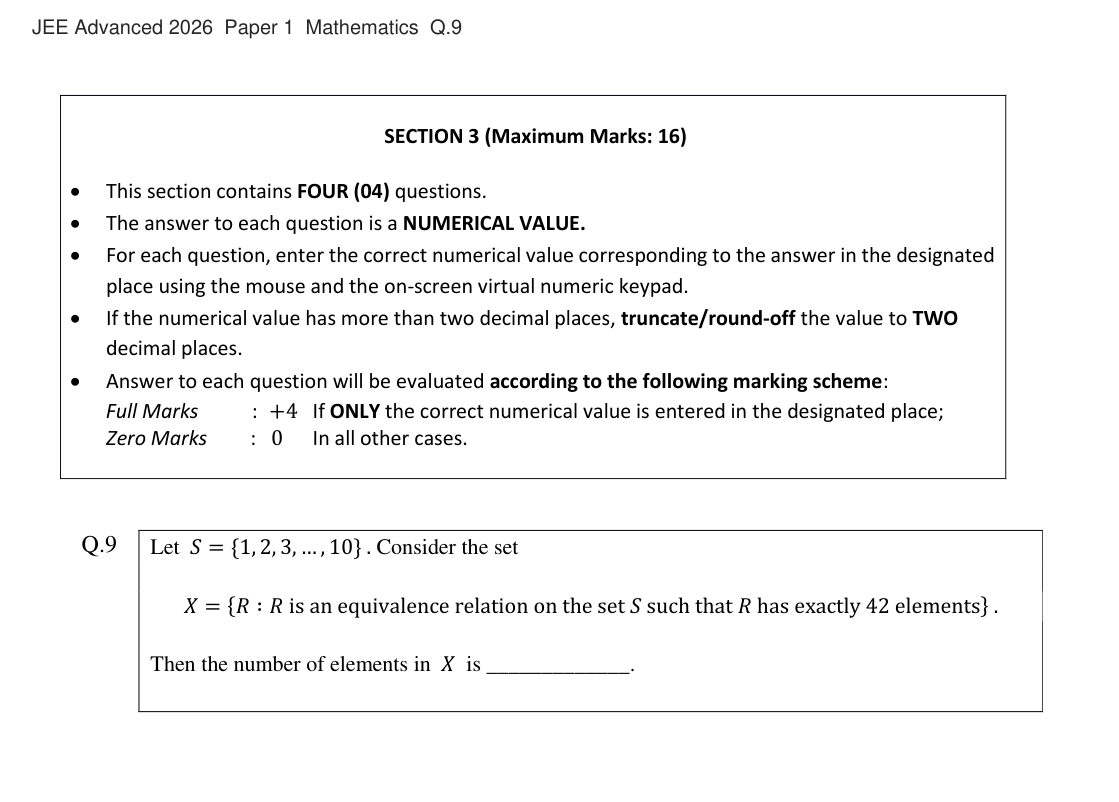
Model answers
Claude Fable 5.1
Anthropic
2520
Claude Fable 5.1 reasoning
I need equivalence relations on a 10-element set where the count of ordered pairs equals 42, which corresponds to partitions whose block sizes' squares sum to 42. I'm now working through possible partitions of 10, checking which combinations of block sizes give a sum of squares equal to 42. By checking cases by largest block size (6, 5, 4, 3, 2), I find only two valid partitions: {6,2,1,1} and {5,4,1}. Now I'm computing the number of set partitions corresponding to each, starting with the multinomial coefficient for {6,2,1,1}. Computing {6,2,1,1}: choosing 6 elements gives 210, choosing 2 of the remaining 4 gives 6, leaving the last two as fixed singletons, so 1260 total. For {5,4,1}, choosing 5 elements gives 252, then choosing 4 of the remaining 5 gives 5, so another 1260. Adding these gives 2520 as the final answer. **Setting up:** An equivalence relation on $S$ corresponds to a partition of $S$ into blocks of sizes $a_1,\dots,a_k$ with $\sum a_i = 10$, and the relation contains $\sum a_i^2$ ordered pairs. We need $\sum a_i^2 = 42$. **Finding valid block-size patterns:** - Largest block 7 or more: $49 > 42$, impossible. - Largest block 6: remaining 4 elements must contribute $6$ → $2+1+1$ ✓. Pattern $\{6,2,1,1\}$. - Largest block 5: remaining 5 elements must contribute $17$ → $4+1$ ✓. Pattern $\{5,4,1\}$. - Largest block 4: remaining 6 elements (parts ≤ 4) must contribute $26$; max possible is $4+2 \to 20$. Impossible. - Largest block ≤ 3: total at most $9+9+9+1 = 28 < 42$. Impossible. **Counting partitions:** - $\{6,2,1,1\}$: $\binom{10}{6}\binom{4}{2} = 210 \times 6 = 1260$ - $\{5,4,1\}$: $\binom{10}{5}\binom{5}{4} = 252 \times 5 = 1260$ **Total:** $1260 + 1260 = 2520$
GPT 6 Astra
OpenAI
2520
GPT 6 Astra reasoning
**Calculating partition counts** I’m trying to determine how many partitions of size 10 can be made using squares, specifically with side lengths. I start with the largest square size of 6, finding combinations that sum to 42. I discover cases for squares of sizes like 6, 5, and 4. After confirming counts for different configurations, it looks like I arrived at a total of 2520 partitions. Finally, I think it might be helpful to return the results in JSON format with 10 elements.
GPT 5.5
OpenAI
2520
GPT 5.5 reasoning
**Enumerating integer partitions** I need to find integer partitions of 10 that add up to a sum of 16. I keep considering the maximum block sizes, thinking about squares. For instance, if I take 7, the rest must be at least 49, which isn’t possible. When checking smaller block sizes, I consider combinations like (2,1,1) and others for 6, which worked. I realize I'll have to enumerate further to find all the valid partitions using those sizes.
Claude Sonnet 5
Anthropic
2520
Claude Sonnet 5 reasoning
For an equivalence relation, the number of ordered pairs in R equals the sum of squares of the block sizes, since each block of size n contributes n² pairs. So I need partitions of 10 whose part sizes squared sum to 42. Checking through partitions systematically, I find 6+2+1+1 gives 36+4+1+1=42, and 5+4+1 gives 25+16+1=42. I'm continuing to check other combinations to make sure I capture all valid partitions. I'm continuing to list out remaining partitions of 10 systematically, checking each for a sum of squares equal to 42, but none besides the two already found seem to match. Continuing through the remaining partitions of 10, checking sums of squares against target 42, I find only two partitions work: {6,2,1,1} and {5,4,1}. Now I need to count the actual number of set partitions corresponding to these integer partitions. For a partition with block sizes multiset, the count formula is n! divided by the product of factorials of each block size, further divided by the factorial of how many blocks share each distinct size — this accounts for indistinguishable blocks of equal size. For {6,2,1,1}: 10!/(6!·2!·1!·1!) gives 2520, then dividing by 2! for the two size-1 blocks gives 1260 distinct partitions of that type. For {5,4,1}: all block sizes distinct, so 10!/(5!·4!·1!) = 1260 as well. Adding both cases gives 1260+1260=2520 total. Looking at this problem, I need to find equivalence relations on S = {1,...,10} with exactly 42 ordered pairs. **Setting up the equation:** An equivalence relation partitions S into blocks of sizes n₁, n₂, ..., nₖ. The relation R (as a set of ordered pairs) contains all pairs within each block, so: $$|R| = \sum n_i^2 = 42, \quad \text{with } \sum n_i = 10$$ **Finding valid partitions of 10:** I need partitions of 10 whose sum of squares equals 42. Checking systematically through partitions of 10: - {6,2,1,1}: 36+4+1+1 = 42 ✓ - {5,4,1}: 25+16+1 = 42 ✓ All other partitions of 10 give sums of squares different from 42 (checked exhaustively: e.g., {6,3,1}→46, {6,2,2}→44, {5,5}→50, {5,3,2}→38, etc.) **Counting set partitions for each type:** The number of ways to partition an n-set into blocks with size multiset given is: $$\frac{n!}{\prod_i (n_i!) \cdot \prod_j (m_j!)}$$ where $m_j$ is the number of blocks of size $j$ (accounting for indistinguishable blocks of equal size). **Case 1: Partition type {6,2,1,1}** $$\frac{10!}{6!\cdot 2!\cdot 1!\cdot 1!} \div (2!) = \frac{3628800}{6!\cdot 2!} \div 2 = \frac{3628800}{1440} \div 2 = 2520 \div 2 = 1260$$ **Case 2: Partition type {5,4,1}** All block sizes distinct, so no extra division needed: $$\frac{10!}{5!\cdot 4!\cdot 1!} = \frac{3628800}{120\cdot 24} = \frac{3628800}{2880} = 1260$$ **Total count:** $$1260 + 1260 = 2520$$ ```json