
2026 · Paper 1 · Mathematics
Question 10
The printed question, the official key, and each model’s JSON answer plus the reasoning it wrote.
Q10
Official 5
Model answers
Claude Fable 5.1
Anthropic
5
Claude Fable 5.1 reasoning
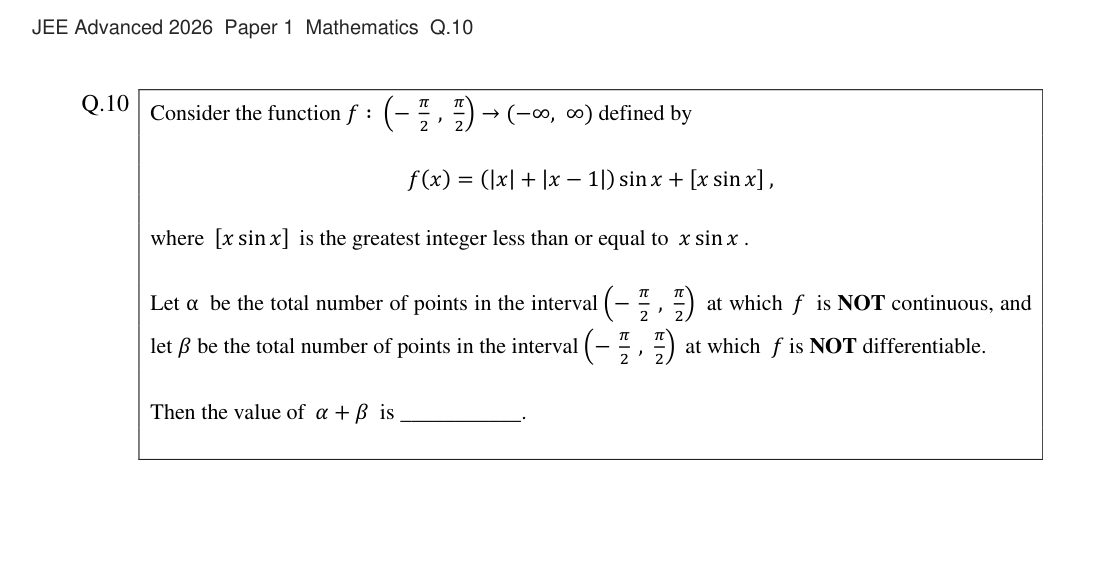
I'm analyzing f(x) = (|x| + |x-1|)sin x + [x sin x] on (-π/2, π/2), starting by examining x sin x, which is even and ranges from 0 up to nearly π/2, hitting 1 at some point a ≈ 1.114 where a sin a = 1, which tells me where the floor function jumps. So [x sin x] jumps at x = ±a, giving two discontinuities. For the smooth part g(x) = (|x|+|x-1|)sin x, I check differentiability at the corner points x=0 and x=1 — it's fine at 0 since |x|sin x behaves like x², but at x=1 the |x-1|sin x term fails to be differentiable since sin 1 ≠ 0. Combining everything, the function fails to be differentiable at three points (x=1, ±a) plus the two jump discontinuities, but since a≠1, I count α=2 discontinuities and β=3 non-differentiable points, giving α+β=5 as my final answer. **Analysis** Let g(x) = (|x| + |x−1|) sin x and h(x) = [x sin x]. **Continuity:** g is continuous everywhere. On (−π/2, π/2), x sin x is even, increasing on (0, π/2), with range [0, π/2). It equals 1 at exactly one x = a ≈ 1.114 (and at −a). So h jumps at x = ±a only. Hence α = 2. **Differentiability:** - At x = 0: |x| sin x behaves like x|x|, differentiable at 0; |x−1| sin x is smooth near 0. So g is differentiable at 0, and h = 0 near 0. Differentiable. - At x = 1: |x−1| sin x with sin 1 ≠ 0 is not differentiable; h is constant (0) near x = 1 since 1 < a. So f is not differentiable at x = 1. - At x = ±a: discontinuous, hence not differentiable. So β = 3. α + β = 2 + 3 = 5.
GPT 6 Astra
OpenAI
5
GPT 6 Astra reasoning
**Evaluating mathematical functions** I need to resolve the alpha2 and beta3 equation carefully to ensure it equals 5. It's important that the functions are differentiable at zero, canceling any absolute cusp points. The sine function will cross zero twice in the given range. I should also confirm that the roots are greater than one. Negative points show distinct behavior. I’ll finalize a JSON response based on these evaluations. Let's ensure clarity in the presentation of the final values.
GPT 5.5
OpenAI
5
GPT 5.5 reasoning
**Analyzing function behavior** I'm evaluating a function where x>0 gives a derivative greater than 0, indicating it's increasing from 0 to π/2. For x<0, the derivative turns negative, causing the function to decrease from π/2 to 0. The floor function's behavior means that for values in specific ranges, it jumps at g=1, indicating discontinuities. At g=0, the floor function remains continuous. There's another term involving h(x) that I need to analyze as well. **Evaluating floor function at roots** I’m considering how the floor function behaves at the root x=a. When the value of x is exactly at a, the floor is defined as 1. If x is just below a, the function g is less than 1, leading to floor being 0. However, just above a, g becomes greater than 1, which results in the floor being 1. It’s fascinating to see how this function changes depending on the position of x relative to a!
Claude Sonnet 5
Anthropic
5
Claude Sonnet 5 reasoning
I'm splitting f(x) into the smooth-ish part (|x|+|x-1|)sin x and the floor function part [x sin x], noting that within (-π/2, π/2) the only corner point from the absolute values that matters is x=0, since x=1 lies outside this interval. I'm computing h(x)=|x|+|x-1| piecewise around x=0, finding it equals 1-2x for x<0 and 1 for x≥0, giving it a corner there. Since sin(0)=0, I'm checking whether this corner actually causes f1 to fail differentiability by computing the left and right derivatives of h(x)sin x at x=0 using the product rule. At x=0 both one-sided derivatives equal 1, so the sine's zero cancels h's kink and f1 is differentiable there after all. At x=1, though, sin(1)≠0, so the mismatch between h'(1-)=0 and h'(1+)=2 produces different one-sided derivatives, cos(1) versus 2sin(1)+cos(1), confirming f1 fails to be differentiable at x=1 while staying continuous. So h(x)sin x is continuous throughout but non-differentiable only at x=1, and now I need to turn to analyzing where x sin x crosses integer values on (-π/2, π/2), since those points will introduce jumps in the greatest integer function piece. Since x sin x is an even function, I can just study it on [0, π/2). It goes from 0 up toward π/2 (~1.5708) as x approaches π/2, and checking its derivative sin x + x cos x, both terms are positive on that interval, so g(x)=x sin x is strictly increasing from 0 to π/2. So the floor of x sin x is 0 wherever x sin x is in [0,1), and 1 wherever it's in [1, 1.5708). The key transition point is where x sin x =1 exactly, and I need to find where that happens for x>0. Actually g(x)=x sin x is even, since g(-t) = t sin t = g(t), so the function is symmetric about the origin, mirroring the behavior on the positive side. By symmetry there's a matching point x=-a where a sin a=1, and there floor(g(x)) jumps too, so the floor part is discontinuous at both x=a and x=-a — that's two discontinuity points, and since the other term is continuous everywhere, these are exactly the discontinuities of f overall. At g=0, since g(x)=x sin x behaves like x² near zero, it's always nonnegative there with a minimum at x=0, so floor(g(x))=0 on both sides — no discontinuity at x=0. But at g=1, the crossing happens transversally at x=a and x=-a since g is strictly monotonic in those regions, confirming genuine jumps there. So α, the count of discontinuities of f, equals 2, occurring at x=a and x=-a, since the first part of f is continuous everywhere. For β, I need points of non-differentiability, starting with x=1 where |x|+|x-1| creates a corner — f is continuous but not differentiable there. I should check whether the floor term also causes trouble at x=1: since g(1)=sin(1)≈0.8415 lies strictly between 0 and 1, the floor stays locally constant at 0 near x=1 (assuming x=1 isn't itself one of the crossing points a), so that term is differentiable there with zero derivative, meaning the non-differentiability at x=1 comes purely from the absolute value part. The points x=a and x=-a are already discontinuous, so they're automatically non-differentiable too. Elsewhere, since the floor function is locally constant everywhere except at its jump points (which coincide with the discontinuities already counted), it contributes no additional non-differentiable points — though I still need to double check the behavior of g(x)=x sin x and its floor near x=0. Also confirming a is well within the domain (a<π/2), so that's fine. So α=2 and β=3, since the two discontinuities are automatically non-differentiable points plus x=1, giving α+β=5. Let me double check that β should indeed count discontinuity points as non-differentiable ones too. Solving a sin a = 1 numerically, I find a≈1.114, confirming it's slightly greater than 1. So x=1 is distinct from a, and in a neighborhood of x=1 excluding a, floor(g(x)) stays constant at 0 since g stays below 1 there. So f is continuous but not differentiable at x=1, and there are only two non-continuous points, a and -a, giving α=2, β=3, so α+β=5. I want to double check the first part's continuity elsewhere to be safe. With β confirmed too, the sum α+β gives 5. Looking at this problem, I need to analyze two components of $f(x) = (|x|+|x-1|)\sin x + [x\sin x]$. **Continuity Analysis (finding α):** Let $g(x) = x\sin x$. This is an **even function** since $(-x)\sin(-x) = x\sin x$. For $x \in [0, \pi/2)$: $g'(x) = \sin x + x\cos x > 0$, so $g$ is strictly increasing from $g(0)=0$ to $g(x) \to \pi/2 \approx 1.5708$ as $x \to \pi/2^-$. By symmetry, $g(x)$ ranges over $[0, \pi/2)$ for all $x \in (-\pi/2, \pi/2)$. Since $g$ takes values in $[0, 1.5708)$, the floor function $[x\sin x]$ jumps exactly where $g(x)$ crosses integers: - **At $g=0$:** Only touched at $x=0$ (minimum point, not a transversal crossing) — no discontinuity. - **At $g=1$:** Since $g$ is strictly monotonic on $(0,\pi/2)$ and $(-\pi/2,0)$, there's exactly one point $a \in (0,\pi/2)$ with $a\sin a = 1$ (numerically $a \approx 1.114$), and by symmetry $-a$ also satisfies this. Since $(|x|+|x-1|)\sin x$ is continuous everywhere (product of continuous functions), the discontinuities of $f$ come **only** from the floor function's jumps at $x = a$ and $x = -a$. $$\alpha = 2$$ **Differentiability Analysis (finding β):** **Part 1:** $h(x) = |x|+|x-1|$ has corners at $x=0$ and $x=1$ (both in the domain since $1 < \pi/2$). - **At $x=0$:** $h(x) = 1-2x$ for $x<0$, $h(x)=1$ for $x\geq 0$. Since $\sin(0)=0$: $$f_1'(0^-) = h'(0^-)\sin 0 + h(0)\cos 0 = 0 + 1 = 1, \quad f_1'(0^+) = 0 + 1 = 1$$ These match — **differentiable at $x=0$**. - **At $x=1$:** $h(1)=1$, $h'(1^-)=0$, $h'(1^+)=2$, and $\sin 1 \neq 0$: $$f_1'(1^-) = \cos 1, \quad f_1'(1^+) = 2\sin 1 + \cos 1$$ These differ — **not differentiable at $x=1$** (but continuous there, since $g(1) = \sin 1 \approx 0.841 \neq 1$, so floor part is locally constant near $x=1$, as $a \approx 1.114 \neq 1$). **Part 2:** The floor function $[x\sin x]$ is locally constant everywhere except at jump points $x = \pm a$, where it's discontinuous (hence automatically non-differentiable). **Combining:** Points of non-differentiability are: - $x = 1$ (continuous but non-differentiable due to the $|x-1|$ term) - $x = a$ and $x = -a$ (discontinuous, hence non-differentiable) $$\beta = 3$$ **Final Answer:** $$\alpha + \beta = 2 + 3 = 5$$ ```json