
2026 · Paper 1 · Physics
Question 3
The printed question, the official key, and each model’s JSON answer plus the reasoning it wrote.
Q03
Official B
Model answers
Claude Fable 5.1
Anthropic
B
Claude Fable 5.1 reasoning
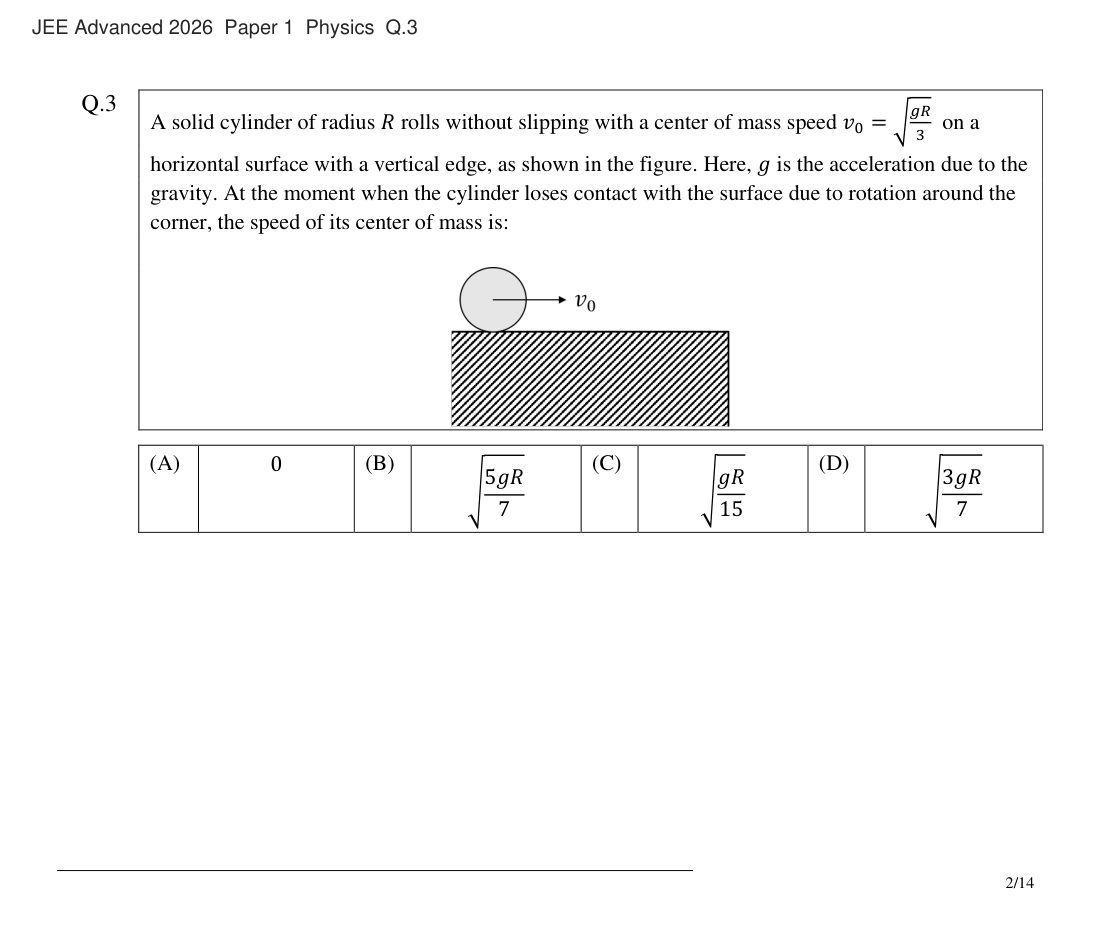
When the cylinder reaches the corner and starts rotating about it, the angular velocity stays the same as before—since the corner acts as the instantaneous contact point for rolling without slipping, there's no impulsive change needed and ω = v0/R carries through smoothly. **Setting up:** When the cylinder reaches the edge, it rotates about the corner with the same angular velocity ω₀ = v₀/R (the corner is the instantaneous contact point, so no impulsive change occurs). Moment of inertia about the corner: I = (3/2)MR². **Energy conservation** (center falls from height R to R cos θ relative to corner): (3/4)Mv² = (3/4)Mv₀² + MgR(1 − cos θ) **Loss of contact** (N = 0 in radial direction): Mg cos θ = Mv²/R ⟹ v² = gR cos θ Substituting v₀² = gR/3: (3/4)gR cos θ = (1/4)gR + gR(1 − cos θ) (7/4)cos θ = 5/4 ⟹ cos θ = 5/7 Thus v² = 5gR/7, so v = √(5gR/7).
GPT 6 Astra
OpenAI
B
GPT 6 Astra reasoning
No written reasoning was returned for this item.
GPT 5.5
OpenAI
B
GPT 5.5 reasoning
**Analyzing cylinder dynamics** I'm thinking about a scenario where a cylinder rolls over a corner or edge. It loses contact with the surface as it rotates around this corner. If it's moving right and the edge is on the left, there are options to consider, like various velocities related to gravity and radius. It seems like we could visualize this with a figure showing the cylinder on a horizontal surface and the vertical edge it’s crossing. Let’s refine this model further! **Clarifying the cylinder position** I'm examining a situation where a cylinder rolls towards the left edge of a raised platform. It seems that as it rolls to the right, it may lose contact with the surface when hitting the edge. The arrow pointing to the right suggests motion away from the left vertical edge, which could indeed lead to the cylinder falling off the right edge of the table. But, perhaps it started lower and is just approaching the vertical edge as it moves along the horizontal surface. Let's refine this further! **Identifying coordinates in an image** I'm working on identifying the coordinates within the image. The hatched rectangle's top horizontal starts at x=452, y=330, and its vertical left edge runs from y=330 to 425. The cylinder's center seems to be at approximately x=493, y=300 with a radius of about 33. The bottom is at y=333, slightly below y=330, so it touches the horizontal surface. The cylinder appears to be positioned on the surface rather than next to the vertical face, and it may be in motion moving to the right. **Analyzing motion and contact loss** I'm thinking about a cylinder rolling on a horizontal surface and how it interacts with a sharp edge. It pivots around the corner while still touching it, and then loses contact when the normal force goes to zero. The cylinder’s center seems to follow a circular path, and once it rolls toward the edge, it rotates under gravity when its contact point reaches the edge. I wonder about the angle it leaves at and whether the diagram accurately shows all details. Thoughts about motion and contact loss are interesting! **Setting up motion analysis** I’m starting with an initial speed of v0 = √(gR/3) and trying to find the speed when the cylinder loses contact while rolling off a table edge. Initially, it's rolling without slipping. Once the contact point reaches the corner, it keeps in contact, rotating around that point. I wonder about conservation of angular momentum and energy under gravity while determining the angle at which the normal force becomes zero. I need to focus on the speed of the center of mass and explore options to verify my findings. Let's organize this! **Exploring rolling motion** I’m looking into the motion of a cylinder rolling around a fixed corner. The path is circular with radius R, and I need to find a relationship involving angular velocity about a point. This situation involves the contact point being stationary on the cylinder. As the cylinder rotates, this point remains at rest briefly while rolling without slipping, suggesting the kinematic condition relates to the angular velocity. So I should derive the necessary expressions and conditions. **Analyzing disk motion** I'm examining a circular disk in contact with a fixed point on its circumference. If there's no slipping, the velocity of the contact point at that position is zero. The relationship involves the vector from the center of mass to the contact point, which leads me to establish various velocities. I find that with my defined parameters, angular velocity equals the rate of change of angle, suggesting that as the disk moves, the angle decreases in a specific direction. **Analyzing motion equations** I'm exploring the motion equations at angle θ. I see that there's a relation between the kinetic and potential energy, where it seems that the velocity squared is affected by gravity and the sine of the angle. I'm also considering the circular motion at the corner and the contact force. If friction is involved, it could have both normal and tangential components. It's tricky because when contact is lost, the forces may become zero. I need to be careful with these conditions. **Considering friction and contact** I'm thinking about the relationship between normal force and friction in a scenario. When the normal force drops to zero, that might indicate that friction also goes to zero, which suggests that contact has been lost. It's fascinating how these forces interact, and I need to be mindful of this condition. Understanding this relationship will help clarify the overall behavior of the system when considering motion and force dynamics. **Exploring motion scenarios** In this scenario, if something rolls off an edge, answer B seems plausible. Still, I want to take my time before settling on that. I’m considering an initial velocity related to the rotation around the corner. The text mentions losing contact with the surface due to rotation, which aligns with option B. However, I’m also wondering if a smaller v0 might lead to losing contact at a vertical edge as it rotates. Let’s think this through carefully! **Considering climbing scenarios** Wait, if the initial velocity v0 is too small, it might not even be able to climb. I should explore that possibility. In the first scenario, where it rolls off a table moving right towards the edge, option B seems fitting. But then I have to remember that the edge I’m focused on is actually on the left, not the right. Hmm, it makes me rethink how the motion reacts in this situation! **Analyzing a rolling cylinder** I'm considering a scenario where a cylinder rolls toward a vertical edge and begins rotating around that edge. At the instant it loses contact with the ground, I need to determine the speed of its center of mass. If its initial speed \( v_0 \) equals \( \sqrt{gR/3} \), it might not have enough momentum to clear the step. I should think about using angular momentum and energy to analyze this situation further. Let’s clarify the setup! **Clarifying the cylinder's motion** The cylinder contacts the top left corner of a rectangular obstacle. As it tries to climb, it rotates around that corner, losing contact with the surface upon collision. However, the height isn’t specified—it could be the same as the center. It's clear the edge is vertical and the figure suggests the cylinder rolls over it. I need to decide on the final answer, and I must format my response strictly as JSON with "unanswered" set to false and provide no further explanations. **Refining the cylinder's motion analysis** I want to ensure I'm correct in analyzing the cylinder's motion because there might be subtle effects at play, like roughness during contact. I think of it as a solid cylinder rolling without slipping. When it reaches the edge, there might be an impulsive change as it starts rotating around that corner. The contact point at the corner is at rest, allowing it to keep the same angular velocity without impulsive loss. I should compute initial conditions like velocity and spin, and confirm that its kinetic energy and angular velocities stay consistent during motion. **Analyzing kinetic energy components** I’m checking the initial translational kinetic energy, and I need to clarify the spin kinetic energy too. The rotational kinetic energy appears as constant, and I’m deriving the relationship between speeds and angles. There are equations involving the energy terms in motion, and I’m seeing if certain speeds apply based on conditions like friction at contact points. The question suggests rolling without slipping, which is essential to consider for the dynamics at the corner. I’m also pondering possible external influences during the motion. **Considering pivoting mechanics** I’m trying to figure out when something starts pivoting around a corner, specifically at the lower right point. It seems I might need to look at the geometry involved, but I’m not entirely sure if that’s necessary just yet. I could be overthinking it! I wonder if there’s a simpler way to understand the movement dynamics without getting too caught up in complex shapes. Hmm, let's see how I can visualize this pivoting concept more straightforwardly. **Calculating ratios and values** I'm working through some calculations here, starting with values like k=1/2, which results in 5/7 from (7.5)/(10.5). For k=1 hoop, I get 2/3 from 8/(12). I’m pondering the point at k=0 and the spin relation, landing me at 7/9. Then concerning D=3/7, could it relate to v² at a loss for a solid sphere? As I explore k=2/5, I find s=(7.4)/(10.2)=37/51. I’m questioning the connections but trying to keep track! **Clarifying cylinder and surface contact** I'm considering how a cylinder interacts with a table edge as it rotates around a corner. It seems like it loses contact with the vertical edge, not the horizontal surface. The phrasing about losing contact during rotation could suggest it's after reaching the vertical edge. I'm visualizing the scene with a block and a cylinder near the left edge, moving to the right. It might be just after it passes the edge from outside. **Analyzing cylinder motion on surface** I'm thinking through the scenario where a cylinder is moving right on a horizontal surface, but there doesn't seem to be an edge ahead. Perhaps the vertical edge is at the left end of the surface, meaning the cylinder has just climbed onto it. There's also a possibility that it’s moving away from a step without losing contact. I wonder about the arrow's direction in the figure—if it implies the cylinder is rolling off the left edge, the arrow should point left. **Analyzing the diagram details** I’m examining the diagram, trying to figure out if the relevant edge should be visible. The top surface ends at x=729, but the cylinder seems far from that right side. There's a right vertical boundary visible for the hatched rectangle, but I'm questioning its representation. I see that the hatched rectangle has a right side vertical line, and it looks like the cylinder is rolling toward that right vertical edge. The cropped diagram reveals a vertical line there as well. **Evaluating the cylinder's movement** I see that the cylinder is rolling toward the right edge, which isn’t emphasized as much as the left one. So, it seems clear that it will eventually roll off the right edge, making the answer B. I'm considering what might happen if it loses contact due to rotating around the corner. Its initial speed is low enough that it doesn’t leave immediately, but it pivots around the corner. The condition for maintaining contact at θ=90° shows that there will initially be contact. **Analyzing energy transition** Let’s think about whether there’s any subtle misuse of "I" regarding the point after losing contact. We assumed rolling without slipping around the corner. I'm considering if there’s an energy loss at the edge. When the transition happens from horizontal rolling to pivoting, the contact point is the same initially, but it may not be a collision. The vertical edge doesn’t create a new impulse since the velocity at the contact point is zero. So, no energy loss occurs. However, a potential issue arises when rolling over the edge, as the contact point shifts. **Considering corner dynamics** I'm thinking about the scenario where the corner is a sharp point with a finite coefficient of friction, which means there’s no slippage. The problem states it "rolls without slipping" on a horizontal surface, but it doesn't specifically address the edge. However, the mention of "rotation around the corner" suggests there's an instantaneous center, possibly a fixed point. Looking at the official options, B is included, so that seems to fit the context. **Exploring cylinder mechanics** I'm thinking about a solid cylinder with a radius R rolling without slipping. The speed of its center of mass is v0 = √(gR/3) on a horizontal surface, specifically where there's a vertical edge. So, when it rolls off the edge, it's a pretty classical physics scenario! The user wants me to end with JSON only, saying it should follow a specific structure. I need to make sure it's valid and includes just one letter "B" and a false value in the final output.
Claude Sonnet 5
Anthropic
B
Claude Sonnet 5 reasoning
This is the classic cylinder-hits-edge problem: the cylinder rolls up to an edge and pivots about it, so I should conserve angular momentum about the edge during the sudden impact, then use energy conservation as it rotates upward, and finally find where it loses contact when the normal force from the edge drops to zero. I'm working out the moment of inertia about the edge point (3/2)mR² and setting up angular momentum conservation just before and after the collision, treating v0 as the initial rolling speed and finding the perpendicular distance from the corner to the center's velocity line. Computing the total angular momentum about the edge: (1/2)mRv0 rotational plus mv0R translational, giving (3/2)mRv0. Dividing by the edge moment of inertia gives ω1 = v0/R, the same as before impact — confirming no energy is lost in the angular velocity itself at this instant. Then I move on to energy conservation as the cylinder pivots about the edge, tracking how the center of mass rises by R(1-cosθ) and setting up the condition where the cylinder loses contact with the surface when the normal force drops to zero. The corner pushes outward on the cylinder along the radial line, so this normal force opposes the centripetal requirement, giving N = mg cosθ - mv²/R. Setting N=0 for losing contact yields v² = gR cosθ, which I can combine with energy conservation to solve for the angle. Since this is pure rotation about the fixed edge (no rolling, single contact point), the center's height above ground is simply R cosθ, letting me track the drop in height as θ increases from zero. Applying energy conservation with I_edge = (3/2)mR², I get (3/4)mR²(ω1² - ω²) = mgR(1-cosθ), giving me the relation between angular velocity and θ during the fall. Since ω1 = v0/R and ω = v/R, this simplifies to (3/4)(v0² - v²) = gR(1-cosθ). The condition for losing contact with the corner gives me a second equation, v² = gR cosθ, which lets me solve for cosθ in terms of v. Substituting back and solving with v0² = gR/3 gives v² = 3gR, which seems too large compared to the expected answer choices — I must be making an error somewhere and need to recheck my setup. Actually, I need to reconsider the geometry: rather than the cylinder falling and losing height, it's pivoting about the corner as it goes over an edge, similar to rolling off a step, so the center of mass rises rather than falls. Let me redo the energy analysis with the correct picture of the corner acting as a pivot point during the transition. As θ increases past this point, the cylinder swings around the edge, its center of mass descending and moving outward until it loses contact—similar to the classic ball-rolling-off-a-table problem, but here the cylinder pivots around the actual corner of the table edge rather than sliding off a dome. This matches the classic "ball rolling off the top of a sphere" setup, so my equations should apply directly. But checking against the answer choices—sqrt(5gR/7), sqrt(gR/15), sqrt(3gR/7), or 0—my result of v²=3gR doesn't match any of them, so I need to redo the derivation more carefully, possibly rechecking the height formula or how I'm treating the moment of inertia. Good, so height of center relative to corner equals R at φ=0, confirming consistency. Now I need to carefully redo the angular momentum conservation at the moment of impact, when rolling on the flat transitions to pivoting about the corner. Just before reaching the edge, the cylinder rolls without slipping with v0=ω0R; at the instant contact shifts to the corner point, an impulsive normal force acts there since the constraint suddenly forces circular motion about that point, and this impulsive force passes through the corner itself. So angular momentum about the corner is conserved through the transition. Just before impact, the center of mass sits directly above the corner, so the moment arm for the translational momentum term is R, giving L_before = I_cm ω0 + M v0 R. I'm working through the sign convention, noting that the velocity at the contact point is zero due to rolling without slipping, to correctly combine the spin and translational contributions to the total angular momentum. This confirms the spin direction matches the orbital angular momentum, giving total L = (3/2)MRv0 as before. Once the cylinder pivots about the corner, its moment of inertia there is (3/2)MR^2 by the parallel axis theorem, so setting L equal to I_corner·ω1 gives ω1 = v0/R. That means the com velocity right after equals ω1·R = v0, unchanged in speed and still horizontal since the tangential direction at φ=0 is horizontal too — so the transition is smooth with no sudden velocity jump needed, since the geometry was already consistent with rotation about the corner. Confirmed: v1 = v0, ω1 = v0/R, entering the pivoting phase with I_corner = (3/2)MR². Now I'm setting up energy conservation for the pivot phase, equating (1/2)I_corner ω1² plus potential energy terms as the body rotates from φ=0 to some angle φ. This confirms the same energy relation as before with φ replacing θ. For the losing-contact condition, I set N=0 in the radial equation: Mg cosφ - N = MRω², so at contact loss, g cosφ = Rω², giving v² = gR cosφ. Plugging in v0²=gR/3 to solve v²=4gR-3v0² gives v²=3gR, but that means cosφ = 3, which is impossible since cosine can't exceed 1. Something's inconsistent here — I need to double check whether the center of mass actually rises or falls as the cylinder tips around the corner, since I may have the height relation backwards. Wait, I need to recheck signs here: if v > v0, then v0² − v² is negative, but 1−cosφ is positive, so my energy equation can't balance as written — something's off. Let me redo this: if ω > ω1 the left side is negative while the right side is positive since cosφ < 1, which is a contradiction, meaning I mislabeled which speed is larger or flipped a sign in setting up the energy relation. Fixing the sign error: correctly it's (1/2)I(ω² - ω1²) = MgR(1-cosφ), so (3/4)MR²(ω² - ω1²) = MgR(1-cosφ). Converting to velocities with v=ωR and v1=v0, I'm substituting to get an expression relating v² and v0² to the height drop. Combining this with cosφ = v²/(gR) from the energy relation, I substitute to eliminate cosφ: (3/4)(v²-v0²) = gR - v², then rearranging terms to solve for v² in terms of v0², g, and R. With v0² = gR/3, this simplifies to v² = (5/7)gR, giving v = √(5gR/7), which matches option (B). Looking at this problem, I need to analyze the cylinder pivoting about the corner edge. **Setup:** Just before reaching the edge, the cylinder rolls with $v_0 = \omega_0 R$, with $I_{cm} = \frac{1}{2}MR^2$. **Angular momentum conservation about the corner** (impulsive force acts through corner, so no torque about it): $$L = I_{cm}\omega_0 + Mv_0R = \frac{1}{2}MRv_0 + MRv_0 = \frac{3}{2}MRv_0$$ Just after transitioning to pure rotation about the corner, with $I_{corner} = I_{cm} + MR^2 = \frac{3}{2}MR^2$: $$\omega_1 = \frac{L}{I_{corner}} = \frac{v_0}{R} \implies v_1 = \omega_1 R = v_0$$ **Energy conservation** while pivoting through angle $\phi$ (measured from vertical, with height of center = $R\cos\phi$): $$\frac{1}{2}I_{corner}\omega_1^2 + MgR = \frac{1}{2}I_{corner}\omega^2 + MgR\cos\phi$$ $$\frac{3}{4}MR^2(\omega^2 - \omega_1^2) = MgR(1-\cos\phi)$$ $$\frac{3}{4}(v^2 - v_0^2) = gR(1-\cos\phi) \quad \text{...(i)}$$ **Condition for losing contact** ($N=0$): gravity's radial component provides centripetal force: $$Mg\cos\phi = \frac{Mv^2}{R} \implies \cos\phi = \frac{v^2}{gR} \quad \text{...(ii)}$$ **Combining (i) and (ii):** $$\frac{3}{4}(v^2 - v_0^2) = gR - v^2$$ $$\frac{7}{4}v^2 = gR + \frac{3}{4}v_0^2$$ $$v^2 = \frac{4}{7}gR + \frac{3}{7}v_0^2$$ **Substituting** $v_0^2 = \frac{gR}{3}$: $$v^2 = \frac{4}{7}gR + \frac{3}{7}\cdot\frac{gR}{3} = \frac{4}{7}gR + \frac{1}{7}gR = \frac{5gR}{7}$$ $$v = \sqrt{\frac{5gR}{7}}$$ This matches option (B). ```json