
2026 · Paper 1 · Physics
Question 4
The printed question, the official key, and each model’s JSON answer plus the reasoning it wrote.
Q04
Official A (also accepts B)
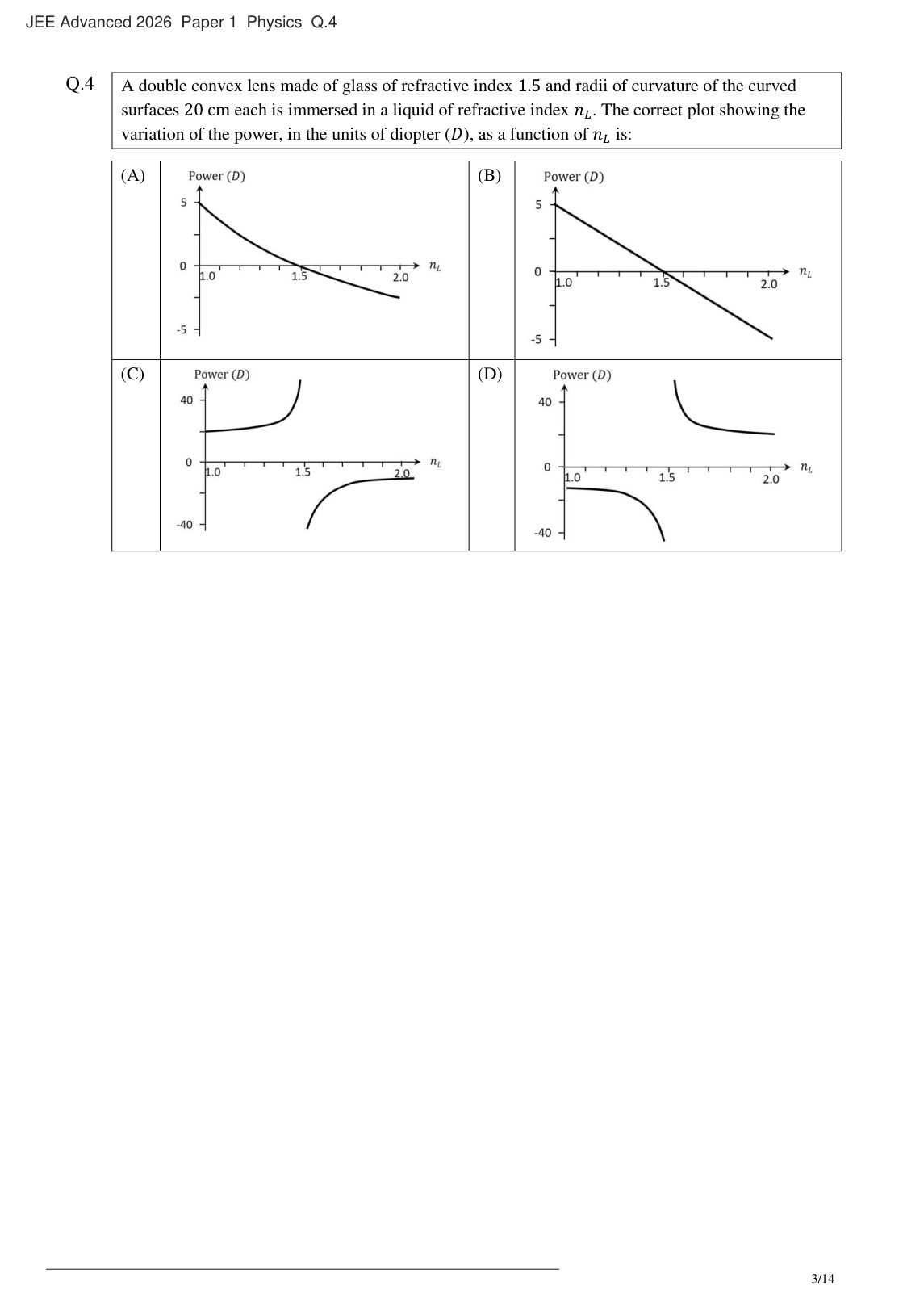
Official key accepts A or B.
Model answers
Claude Fable 5.1
Anthropic
A
Claude Fable 5.1 reasoning
Lens maker's formula in a medium: P = 1/f = (n_g/n_L − 1)(1/R₁ − 1/R₂) = (1.5/n_L − 1)(2/0.20 m) = 10(1.5/n_L − 1) D At n_L = 1: P = 5 D. At n_L = 1.5: P = 0. At n_L = 2: P = 10(0.75 − 1) = −2.5 D. The dependence is 1/n_L, so the curve is not a straight line; it decreases with decreasing slope (magnitude), passes through zero at 1.5 and reaches −2.5 D at n_L = 2 — matching plot (A).
GPT 6 Astra
OpenAI
A
GPT 6 Astra reasoning
**Solving lensmaker's equation** I need to solve this straightforward lensmaker's equation, which is 1/f = (1.5/nL - 1)*10 => 15/n - 10. I've got values 5, 0, and -2.5 for A. It’s important to consider the ambiguity around the actual power n/f, but I know that in JEE, the common power is 1/f. They just want a JSON answer at the end, so I’ll focus on providing that shape while including some reasoning.
GPT 5.5
OpenAI
A
GPT 5.5 reasoning
**Clarifying lens power calculations** I need to solve a question about the power of a double convex lens with a refractive index of n=1.5 and curved surfaces of 20 cm radii, immersed in a liquid with refractive index n_L. I should plot the power in diopters as a function of n_L. Options include a curved line, a straight line, or hyperbolic behavior with a potential discontinuity around 1.5. I should be careful with the formulas used and definitions of power in a medium versus air. **Exploring lens focal length** I’m figuring out the focal length of a lens when the object and image are in the same medium. I think the formula is P = 1/f = (n_l/n_m - 1)(1/R1 - 1/R2). With R1 and R2 both set to +20 cm and -20 cm, I’m getting (1/R1 - 1/R2) = 10 m^-1. This leads me to a function for power that decreases as liquid refractive index n_L increases, and the shape of that plot appears hyperbolic. I’ll confirm that behavior and the derivatives are consistent.
Claude Sonnet 5
Anthropic
A
Claude Sonnet 5 reasoning
I'm applying the lensmaker's formula for a lens in a medium, with power depending on the refractive index ratio and the curvature radii. For a double convex lens with R1=+20cm and R2=-20cm, I'm computing 1/R1-1/R2, converting to meters for consistent units. I get P(n_L) = 15/n_L - 10, giving P=5D at n_L=1 (matches air case), zero at n_L=1.5, and negative values beyond that — a smooth, continuous, monotonically decreasing curve, not a divergent one. This rules out any answer choices showing asymptotic blow-up at n_L=1.5, since the actual function is just a decaying hyperbola shape without singularities for physical n_L values. Checking the answer options: Option A shows a decreasing curve from 5, crossing zero around n_L≈1.4-1.5, flattening as it approaches about -2.5 at n_L=2 — matching the concave-up, flattening shape. Option B is a straight line, but the actual function isn't linear, so B doesn't fit. The answer is A. Looking at this problem, I need to find how the power of the lens varies with the liquid's refractive index. **Setting up the formula:** Using the lensmaker's equation for a lens immersed in a medium: $$P = \left(\frac{n_{lens}}{n_L} - 1\right)\left(\frac{1}{R_1} - \frac{1}{R_2}\right)$$ For a double convex lens: R₁ = +20 cm = 0.2 m, R₂ = -20 cm = -0.2 m $$\frac{1}{R_1} - \frac{1}{R_2} = \frac{1}{0.2} + \frac{1}{0.2} = 10 \text{ m}^{-1}$$ With n_lens = 1.5: $$P = 10\left(\frac{1.5}{n_L} - 1\right) = \frac{15}{n_L} - 10$$ **Checking key points:** - At n_L = 1.0: P = 15 - 10 = **5 D** (matches starting point in A and B) - At n_L = 1.5: P = 10 - 10 = **0 D** (power vanishes — lens acts like flat glass in same-index medium) - At n_L = 2.0: P = 7.5 - 10 = **-2.5 D** **Analyzing the nature of the curve:** Since $P = 15/n_L - 10$, this is **not a straight line** — it's a hyperbolic-type curve. Taking derivatives: $$\frac{dP}{dn_L} = -\frac{15}{n_L^2}, \quad \frac{d^2P}{dn_L^2} = \frac{30}{n_L^3} > 0$$ The function is smooth, continuous, and monotonically decreasing for all n_L > 0, with **no divergence** at n_L = 1.5 — the power just smoothly passes through zero there (since the lens simply stops acting as a lens, it doesn't blow up). **Eliminating options:** - **Options C and D** show divergent (asymptotic) behavior near n_L = 1.5, jumping between +40 D and -40 D. This is incorrect since P(n_L) is finite and continuous everywhere; there's no physical reason for power to diverge here. - **Option B** shows a straight-line relationship, but P = 15/n_L − 10 is not linear in n_L. - **Option A** shows a smooth, continuously decreasing curve starting at 5 D (n_L=1), crossing zero near n_L≈1.5, and flattening out as n_L increases — consistent with the concave-up, monotonically decreasing hyperbolic function derived above. This matches the correct behavior of the power function. ```json