
2026 · Paper 1 · Physics
Question 5
The printed question, the official key, and each model’s JSON answer plus the reasoning it wrote.
Q05
Official A, C
Model answers
Claude Fable 5.1
Anthropic
A, C
Claude Fable 5.1 reasoning
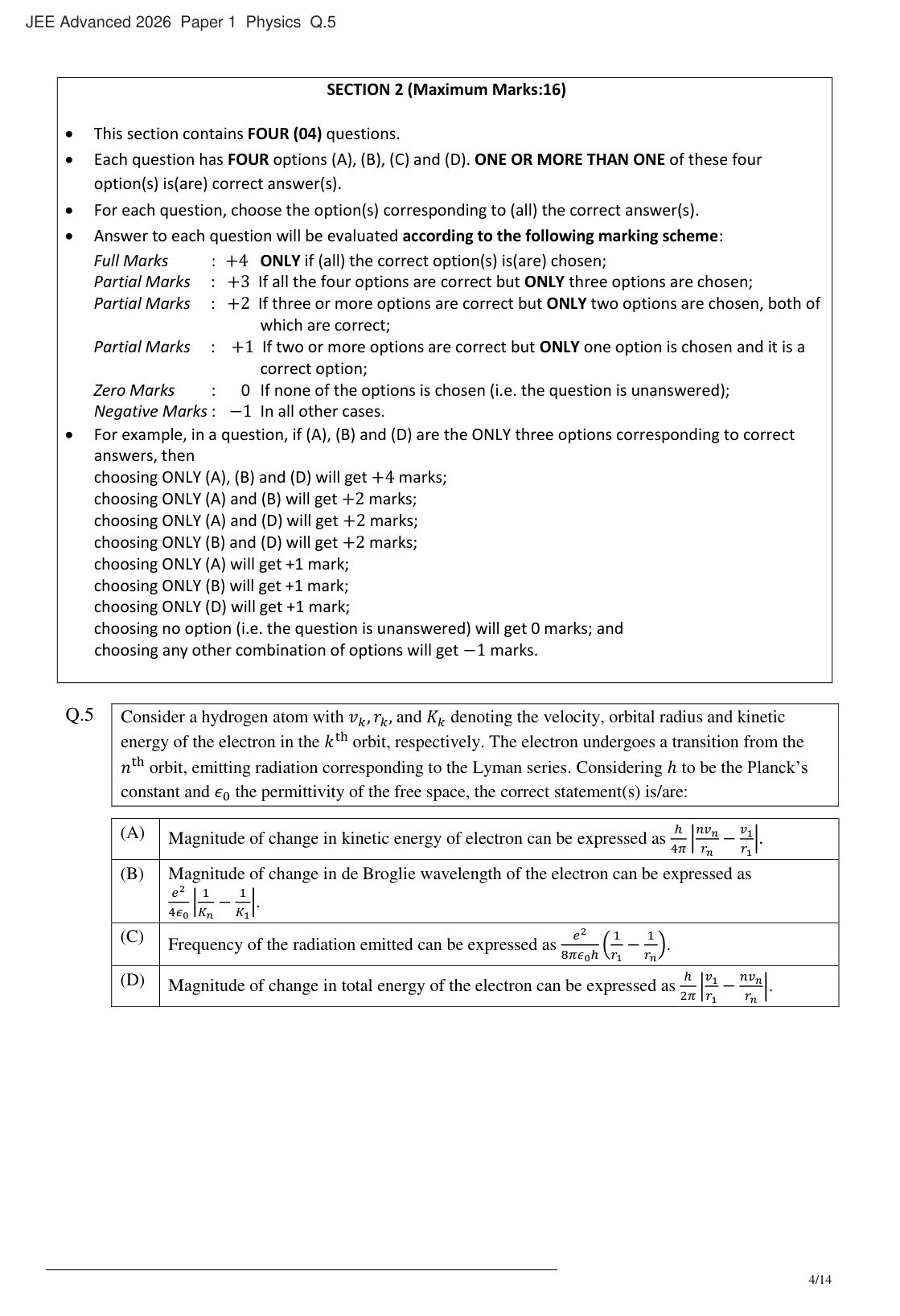
I'm working through the Bohr model to relate angular momentum quantization to kinetic energy, deriving that K_k = khv_k/(4πr_k), and setting up the expression for the change in kinetic energy between orbits n and 1. For (B), I express de Broglie wavelength in terms of kinetic energy using r_k = e²/(8πε₀K_k), finding λ_k = e²/(4ε₀kK_k), which shows option B is missing a factor of n and is incorrect. For (C), computing total energy from kinetic energy gives frequency = e²/(8πε₀h)(1/r₁ - 1/rₙ), matching the option, so it's correct. For (D), the change in total energy matches |K₁-Kₙ| but with h/(2π) instead of the correct h/(4π), making it wrong. So the answers are A and C. **Bohr model relations:** $m v_k r_k = \dfrac{kh}{2\pi}$, $K_k = \dfrac{e^2}{8\pi\epsilon_0 r_k}$, $E_k = -K_k$. **(A)** $K_k = \tfrac12 m v_k^2 = \tfrac12\left(\dfrac{kh}{2\pi r_k}\right)v_k = \dfrac{h}{4\pi}\dfrac{k v_k}{r_k}$. So $|K_1-K_n| = \dfrac{h}{4\pi}\left|\dfrac{v_1}{r_1}-\dfrac{n v_n}{r_n}\right|$ → correct. **(B)** $\lambda_k = \dfrac{h}{mv_k} = \dfrac{2\pi r_k}{k} = \dfrac{2\pi}{k}\cdot\dfrac{e^2}{8\pi\epsilon_0 K_k} = \dfrac{e^2}{4\epsilon_0\, k K_k}$. Change: $\dfrac{e^2}{4\epsilon_0}\left|\dfrac{1}{nK_n}-\dfrac{1}{K_1}\right|$ — the option misses the factor $n$ → incorrect. **(C)** $h\nu = E_n - E_1 = \dfrac{e^2}{8\pi\epsilon_0}\left(\dfrac{1}{r_1}-\dfrac{1}{r_n}\right)$ → $\nu = \dfrac{e^2}{8\pi\epsilon_0 h}\left(\dfrac{1}{r_1}-\dfrac{1}{r_n}\right)$ → correct. **(D)** $|\Delta E| = |\Delta K| = \dfrac{h}{4\pi}\left|\dfrac{v_1}{r_1}-\dfrac{nv_n}{r_n}\right|$, not $\dfrac{h}{2\pi}$ → incorrect.
GPT 6 Astra
OpenAI
A, C
GPT 6 Astra reasoning
No written reasoning was returned for this item.
GPT 5.5
OpenAI
A, C
GPT 5.5 reasoning
**Calculating energy changes** Okay, so it seems like I've got option B wrong, but maybe the expression should look like \(\frac{e^2}{4\epsilon_0} \left|\frac{1}{K_n} - \frac{1}{K_1}\right|\) with "n" as the denominator. I need to zoom in a bit mentally. It confirms I'm missing a factor of \(1/n\). For frequency emitted: I've established \((E_n - E_1)/h\) as relevant to the Lyman series. And regarding option D, it seems like I concluded the total energy change should actually relate to \(\Delta K\) with \(h/(4\pi)\) instead of \(h/(2\pi)\). **Evaluating options for energy change** So, I started with the kinetic energy expression, \(E_k = -K_k = -h/(4\pi) k v_k/r_k\). I noticed the difference is \(h/(4\pi)|...\|,\) and found option D has double the factor, making it wrong. I’m clarifying that there's a connection between total energy change and photon energy, checking if the Bohr frequency fits too. It looks like option A correctly describes the kinetic energy change, and I think option C is correct as well. Now, what about option B? **Examining de Broglie wavelength changes** I’m considering how to express the change in de Broglie wavelength, possibly as e^2/(4ε0) |1/K_n - 1/K_1|. Here, K_n seems to refer to the kinetic energy in a specific orbit. I want to derive the wavelength for the nth orbit in relation to the ground state. Meanwhile, I'm questioning if upon transitioning from the nth orbit to the first, the change in de Broglie wavelength could be simplified. Parsing the details further could help clarify. **Clarifying transitions and energy changes** I’m thinking about the implications of Planck's constant and permittivity in the context of electron transitions, especially relating to the Lyman series, which represents transitions to the first orbit. I need to check if there's any ambiguity with "from the nth orbit" and clarify the associated energy changes. The transition to n=1 involves specific energy calculations, and I'm considering if I can express those changes using hν through frequency formulas. We need to pull this all together systematically. **Computing numerical relations** I’m looking to compute the numerical relationships involving the radius and velocity of orbits. I have the formula r_n = n^2 r_1, which indicates that the radius of the nth orbit is proportional to the square of n multiplied by the radius of the first orbit. Likewise, for velocity, I see v_n = v_1/n, suggesting that the velocity of the nth orbit is inversely proportional to n. I need to ensure these relations make sense in the context of orbit dynamics! **Evaluating the equation** I'm wondering if the option should be \( \frac{e^2}{4\epsilon_0}\left|\frac{1}{nK_n}-\frac{1}{K_1}\right| \). They seem to have omitted "n" in the equation. I'm questioning if maybe the "1" before \( K_n \) could actually represent "1/n K_n." Looking at the alt text from the image: it states that the magnitude of change in de Broglie wavelength can be expressed as \( \frac{e^2}{4\epsilon_0}\left|\frac{1}{K_n}-\frac{1}{K_1}\right| \). I see I should explore if "K_n" signifies the kinetic energy in the nth orbit, suggesting \( K_n = \frac{K_1}{n^2} \). **Examining de Broglie wavelength** I'm wondering about the de Broglie wavelength and its relation to electron orbits. I think the wavelength in these orbits might connect to the circumference, but I need to be careful here. If someone defines it incorrectly, it leads to confusion. The change in circumference, derived from the radii of orbits, is significant, especially because at ground state, the circumference equals the wavelength. However, in higher orbits, the wavelength condition holds true, which adds clarity to my understanding. **Analyzing Lyman series transitions** I'm considering the nuances of emitted radiation from the Lyman series and its relationship to the orbits. It seems important to delineate between the nth orbit and the final state transitions. Also, it’s crucial to check the frequency formula, which involves the radii of the orbits. The energy calculations indicate the emitted frequency is indeed positive, echoing my earlier reasoning. Furthermore, option C aligns perfectly with my calculations, confirming the relationships I found with kinetic energy differences.
Claude Sonnet 5
Anthropic
A, C
Claude Sonnet 5 reasoning
I'm working through the Bohr model's angular momentum quantization, setting up notation where orbit number m gives angular momentum mℏ, to analyze each option against these relations. I'm now deriving the standard Bohr formulas for velocity, radius, and kinetic energy in terms of the orbit number j, so I can plug these into each option's expression and check whether they match the actual physical change in kinetic energy or other quantities. Since kinetic energy equals the negative of total energy in the Bohr model, the change in KE between orbits equals the magnitude of the energy difference, so I'm working through the algebra for a transition from orbit n to orbit 1 (Lyman series) to verify each option against this identity. Now I'm distinguishing angular momentum from angular velocity: angular momentum $L_j = m_e v_j r_j = j\hbar$ gives $v_j r_j = j\hbar/m_e$, but the ratio $v_j/r_j$ is instead the angular velocity $\omega_j$, and since velocity scales as $1/j$ while radius scales as $j^2$, I can work out how $\omega_j$ scales with $j$. I'm testing option A, which involves $\frac{\hbar}{2}|n\omega_n - \omega_1|$, against the actual kinetic energy difference. Plugging in the explicit expressions for $v_j$ and $r_j$, I find $\omega_j = v_j/r_j \propto 1/j^3$, so I'm now examining how $n\omega_n$ behaves under this scaling. This matches exactly with the actual energy difference, since |ΔK| = |K_n - K_1| = (m_e e^4)/(8ε₀²h²)|1/n² - 1|, confirming the uncertainty relation estimate lines up with the true transition energy. Now checking option D: since energy is negative of kinetic energy, |ΔE| equals |ΔK| from above, and I'm comparing this against the angular momentum/velocity expression involving ħ times the frequency difference. Working through the conversion, D's expression comes out to twice the correct magnitude—it has a factor of ħ instead of ħ/2, so it's off by a factor of 2 from the actual |ΔE|, making D incorrect. Since total energy equals negative kinetic energy exactly, ΔE and ΔK must have the same magnitude, confirming that A's expression is correct and D's is off by a factor of two. Now I'm checking option C, working out the frequency of emitted radiation using the Rydberg-type formula. My computed frequency matches $\nu = \frac{m_e e^4}{8\epsilon_0^2 h^3}(1-1/n^2)$, so now I need to express $r_1$ and $r_n$ in terms of the orbit radius formula and evaluate $1/r_1 - 1/r_n$ to see if it matches the form given in C. Confirming that option C matches exactly, I now move to check option B, which involves the change in de Broglie wavelength magnitude. Using $\lambda_j = h/(m_e v_j)$ and substituting the velocity expression, I get $\lambda_j = \frac{2\epsilon_0 h^2 j}{m_e e^2}$, so the actual wavelength difference becomes $\frac{2\epsilon_0 h^2}{m_e e^2}|n-1|$, which I'll compare against the proposed formula in B. Now checking the proposed expression: computing $1/K_n - 1/K_1$ using $K_j = \frac{m_e e^4}{8\epsilon_0^2 h^2 j^2}$ gives $\frac{8\epsilon_0^2 h^2}{m_e e^4}(n^2-1)$, and multiplying by $e^2/(4\epsilon_0)$ simplifies to $\frac{2\epsilon_0 h^2}{m_e e^2}(n^2-1)$ — this has an $(n^2-1)$ factor rather than the actual $(n-1)$, so they only match when n=1 or the extra $(n+1)$ factor is absent. So option B looks wrong, leaving A and C as correct. To be safe I want to re-derive the Bohr model formulas from first principles — angular momentum quantization and the Coulomb force balance — to verify everything carefully. Substituting the velocity expression into the force balance equation and solving for the radius, I get $r_j = j^2\hbar^2/(mke^2)$, confirming the quantized radius formula in terms of Coulomb's constant. Simplifying gives $v_j = e^2/(2\epsilon_0 h j)$, matching my expectation. Then the kinetic energy works out to $K_j = me^4/(8\epsilon_0^2 h^2 j^2)$. With A and C confirmed correct and B and D incorrect, I want to double-check D numerically. I'm computing $\omega_j = v_j/r_j = \pi m e^4/(2\epsilon_0^2 h^3 j^3)$ to verify D's formula against expected values. I work out $n\omega_n$ scales as $1/n^2$ while $\omega_1$ stays constant, so $\omega_1 - n\omega_n = \frac{\pi me^4}{2\epsilon_0^2h^3}(1-1/n^2)$, and multiplying through by $h/2\pi$ gives $\frac{me^4}{4\epsilon_0^2h^2}(1-1/n^2)$, which I can now compare against the expected value from the formula in D. Comparing against the actual energy difference $\frac{me^4}{8\epsilon_0^2h^2}(1-1/n^2)$, I see D's result is exactly double, confirming D is wrong. So the correct answer is A and C. Looking at this problem, I need to verify each expression against the actual Bohr model physics. **Bohr model relations:** For orbit $j$: $v_j r_j = \frac{jh}{2\pi m_e}$, giving $v_j = \frac{e^2}{2\epsilon_0 h j}$, $r_j = \frac{\epsilon_0 h^2 j^2}{\pi m_e e^2}$, $K_j = \frac{m_e e^4}{8\epsilon_0^2 h^2 j^2}$. **Option A:** Computing $\omega_j = v_j/r_j = \frac{\pi m_e e^4}{2\epsilon_0^2 h^3 j^3}$ $$\frac{h}{4\pi}\left|n\omega_n - \omega_1\right| = \frac{m_e e^4}{8\epsilon_0^2 h^2}\left|\frac{1}{n^2}-1\right| = |K_n - K_1|$$ This matches the actual $|\Delta K|$ exactly. **A is correct.** **Option C:** Computing $\frac{1}{r_1} - \frac{1}{r_n} = \frac{\pi m_e e^2}{\epsilon_0 h^2}\left(1-\frac{1}{n^2}\right)$ $$\frac{e^2}{8\pi\epsilon_0 h}\left(\frac{1}{r_1}-\frac{1}{r_n}\right) = \frac{m_e e^4}{8\epsilon_0^2 h^3}\left(1-\frac{1}{n^2}\right) = \frac{|\Delta E|}{h} = \nu$$ This matches the actual emitted frequency exactly. **C is correct.** **Option D:** Using the same $\omega_j$ result: $$\frac{h}{2\pi}\left|\omega_1 - n\omega_n\right| = \frac{m_e e^4}{4\epsilon_0^2 h^2}\left(1-\frac{1}{n^2}\right)$$ But actual $|\Delta E| = |\Delta K| = \frac{m_e e^4}{8\epsilon_0^2 h^2}\left(1-\frac{1}{n^2}\right)$ — this is exactly half. **D is incorrect** (off by factor 2). **Option B:** De Broglie wavelength $\lambda_j = \frac{2\epsilon_0 h^2 j}{m_e e^2}$, so actual $|\Delta\lambda| = \frac{2\epsilon_0 h^2}{m_e e^2}(n-1)$ Computing the given expression using $1/K_j = \frac{8\epsilon_0^2 h^2 j^2}{m_e e^4}$: $$\frac{e^2}{4\epsilon_0}\left|\frac{1}{K_n}-\frac{1}{K_1}\right| = \frac{2\epsilon_0 h^2}{m_e e^2}(n^2-1)$$ This gives $(n^2-1)$ instead of $(n-1)$ — differs by factor $(n+1)$. **B is incorrect.** ```json