
2026 · Paper 1 · Physics
Question 6
The printed question, the official key, and each model’s JSON answer plus the reasoning it wrote.
Q06
Official A, B
Model answers
Claude Fable 5.1
Anthropic
A, B
Claude Fable 5.1 reasoning
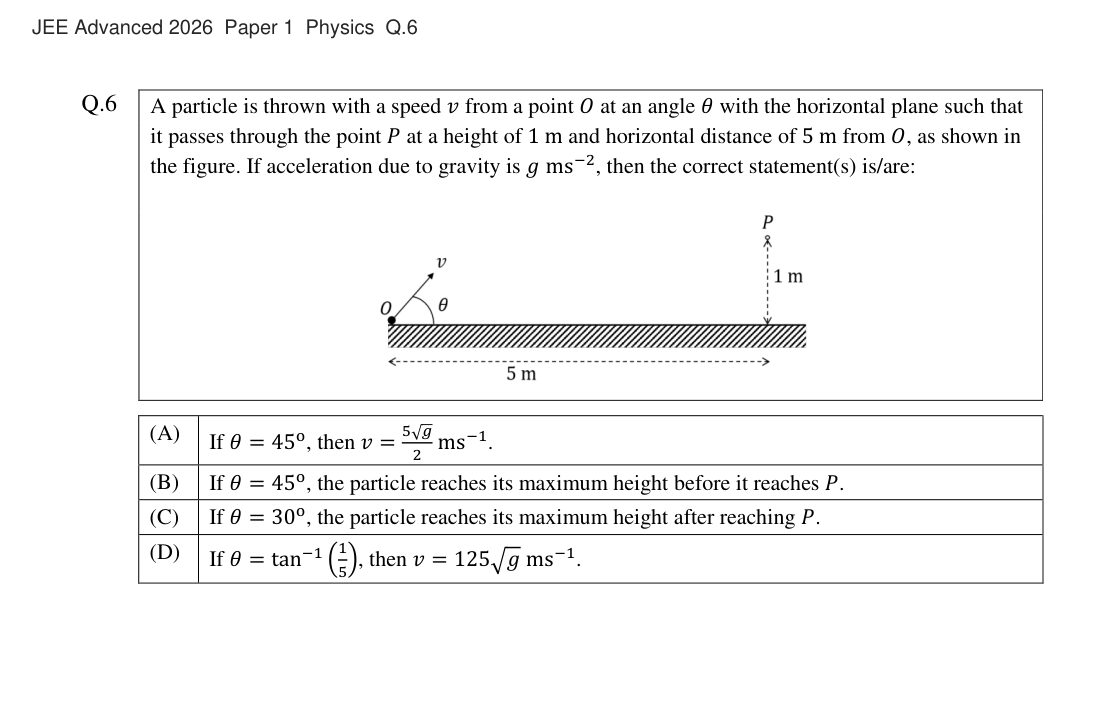
Plugging in x=5, y=1 for option A with θ=45° gives v² = 25g/4, matching that answer as correct. For option B, I'm computing the range with these values, getting R = 6.25 m and checking whether the peak height occurs before x=5. Then for option C with θ=30°, solving for v² gives about 8.83g, and computing R/2 shows the peak occurs at x≈3.82m, which is before P, contradicting C's claim of "after" — so C is false. For D, tanθ=1/5 forces y=1 exactly at x=5 with no vertical drop, which would require infinite v, making D impossible too. So the correct answers are A and B. **Trajectory:** y = x tanθ − g x² / (2v² cos²θ), with x = 5 m, y = 1 m. **(A)** θ = 45°: 1 = 5 − 25g/v² ⇒ v² = 25g/4 ⇒ v = 5√g/2. ✔ **(B)** θ = 45°: Range R = v²/g = 6.25 m, so maximum height occurs at x = 3.125 m < 5 m, i.e., before P. ✔ **(C)** θ = 30°: 1 = 5/√3 − 50g/(3v²) ⇒ v² ≈ 8.83g. Range R = v² sin60°/g ≈ 7.65 m, so peak at x ≈ 3.82 m < 5 m — max height before P. ✘ **(D)** tanθ = 1/5 makes x tanθ = 1 exactly, so the straight line from O passes through P; a projectile would need infinite speed to reach P. ✘
GPT 6 Astra
OpenAI
A, B
GPT 6 Astra reasoning
**Solving a formula problem** I need to work through a math problem involving several parts. First, I confirm a formula, checking if v equals 5 times the square root of g/2. When I rearrange, it looks like v squared equals 25g/4. Then I check the apex and find it's less than 5. Regarding angles, I check if the slope at point P is descending. It seems like a direct line is impossible. My conclusion is that A and B are the answers, and I can output this in JSON format.
GPT 5.5
OpenAI
A, B
GPT 5.5 reasoning
No written reasoning was returned for this item.
Claude Sonnet 5
Anthropic
A, B
Claude Sonnet 5 reasoning
Plugging θ=45°, x=5, y=1 into the trajectory equation gives 25g/v²=4, so v²=25g/4, matching option A. Now I'm checking option B by examining whether the projectile reaches maximum height before passing through point P. Computing time to reach P versus time to reach max height, I find t_max ≈ 1.768/√g is less than t ≈ 2.828/√g, confirming the particle reaches its peak before P, so B holds. For option C with θ=30°, I'm solving the trajectory equation again with y=1, x=5 to find v², getting v² ≈ 4.416g after working through the tan30° and cos²30° terms. Then I compute t_max ≈ 1.05/√g versus the arrival time t ≈ 2.75/√g at P, confirming max height comes before P — so C's claim of "after" is wrong. Moving to option D, I'm setting up θ = tan⁻¹(1/5), giving sinθ = 1/√26 and starting to work out cosθ. Interesting - x tanθ at x=5 gives exactly 1, meaning point P sits precisely on the straight-line path of the initial velocity direction, before accounting for gravity's drop. That forces the quadratic gravity term to vanish, which is impossible for any finite v and g, so this angle can't actually work. So statement D fails for any v, including v = 125√g. That leaves A and B as the correct answers. Looking at this projectile problem, I need to use the trajectory equation: $$y = x\tan\theta - \frac{gx^2}{2v^2\cos^2\theta}$$ with x = 5 m, y = 1 m. **Checking (A): θ = 45°** $$1 = 5(1) - \frac{25g}{2v^2(1/2)} = 5 - \frac{25g}{v^2}$$ $$\frac{25g}{v^2} = 4 \implies v^2 = \frac{25g}{4} \implies v = \frac{5\sqrt{g}}{2}$$ This matches (A) exactly. **A is correct.** **Checking (B): θ = 45°, v = 5√g/2** - Time to reach P: $t_P = \dfrac{x}{v\cos\theta} = \dfrac{5}{(5\sqrt g/2)(1/\sqrt2)} = \dfrac{2\sqrt2}{\sqrt g} \approx \dfrac{2.83}{\sqrt g}$ - Time to max height: $t_{max} = \dfrac{v\sin\theta}{g} = \dfrac{(5\sqrt g/2)(1/\sqrt2)}{g} = \dfrac{5}{2\sqrt2\sqrt g} \approx \dfrac{1.77}{\sqrt g}$ Since $t_{max} < t_P$, the particle reaches max height **before** reaching P. **B is correct.** **Checking (C): θ = 30°** Using trajectory equation with tan30° = 1/√3, cos²30° = 3/4: $$1 = \frac{5}{\sqrt3} - \frac{25g}{2v^2(3/4)} = \frac{5}{\sqrt3} - \frac{50g}{3v^2}$$ Solving: $v^2 = \dfrac{25g}{3(5/\sqrt3 - 1)} \approx 4.42g$, so $v \approx 2.10\sqrt g$ - $t_{max} = \dfrac{v\sin30°}{g} = \dfrac{v}{2g} \approx \dfrac{1.05}{\sqrt g}$ - $t_P = \dfrac{5}{v\cos30°} = \dfrac{10}{v\sqrt3} \approx \dfrac{2.75}{\sqrt g}$ Since $t_{max} < t_P$, the max height is reached **before** P, not after. **C is incorrect.** **Checking (D): θ = tan⁻¹(1/5)** Here tanθ = 1/5, so cos²θ = 25/26. Note that $x\tan\theta = 5 \times \frac{1}{5} = 1 = y$ This means the straight line (no-gravity path) already passes through P! Substituting into the trajectory equation: $$1 = 1 - \frac{g(25)}{2v^2(25/26)} = 1 - \frac{13g}{v^2}$$ $$0 = -\frac{13g}{v^2}$$ This equation has **no finite solution** for v (impossible unless g = 0). Therefore no value of v (including 125√g) satisfies this condition. **D is incorrect.** ```json