
2026 · Paper 1 · Physics
Question 7
The printed question, the official key, and each model’s JSON answer plus the reasoning it wrote.
Q07
Official A, B, C
Model answers
Claude Fable 5.1
Anthropic
A, B, C
Claude Fable 5.1 reasoning
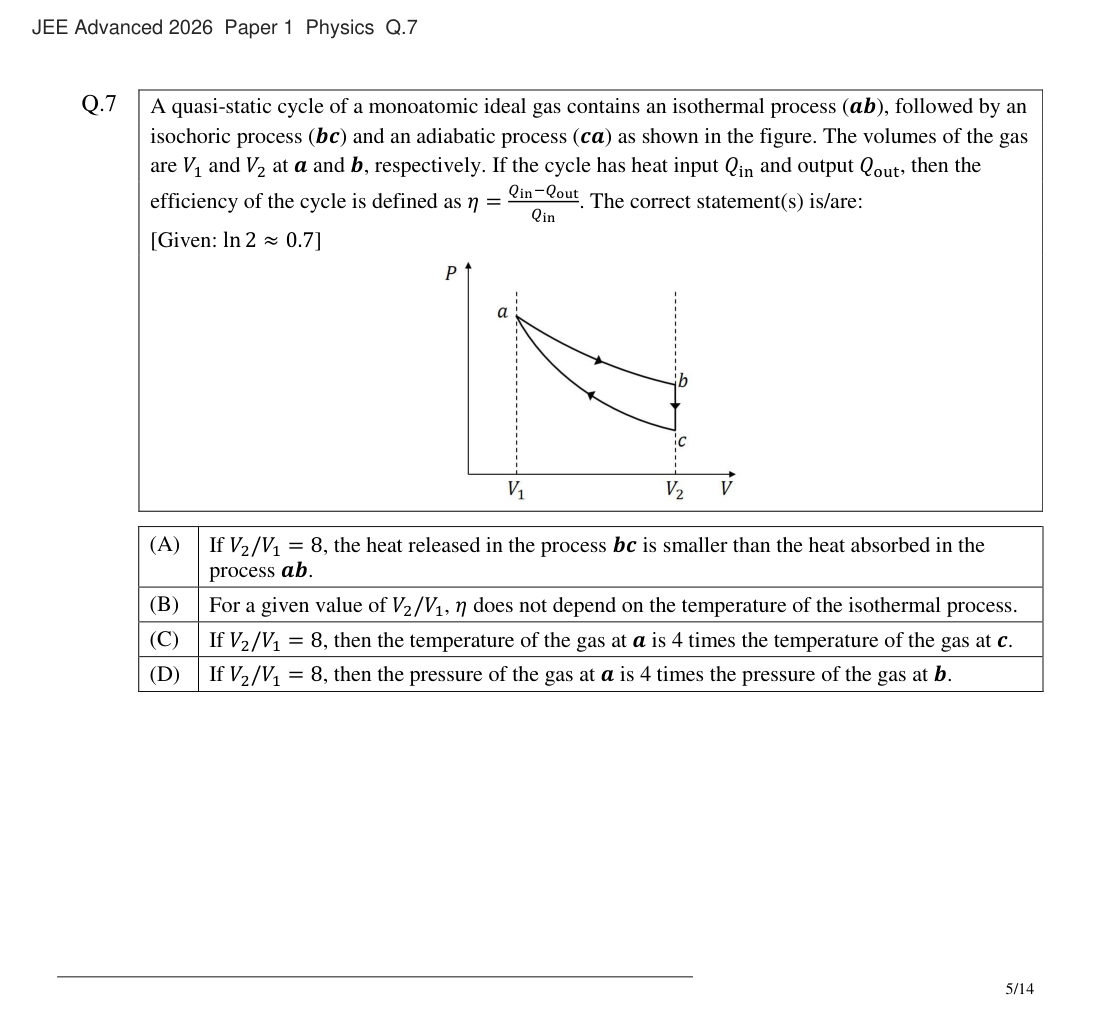
The cycle goes isothermal expansion a→b at T_a, isochoric cooling b→c at V2, then adiabatic compression c→a back to V1. Using γ=5/3 for a monoatomic gas, the adiabatic relation gives T_a/T_c = (V2/V1)^(2/3) = 8^(2/3) = 4. This confirms option C. Computing Q_in for the isothermal leg gives 3ln2·nRT_a ≈ 2.1nRT_a, while Q_out for the isochoric leg gives (9/8)nRT_a, which is smaller, confirming A. For efficiency, T_a cancels out of the expression entirely, showing η is temperature-independent, confirming B. But checking D, the pressure ratio P_a/P_b equals V2/V1 = 8, not 4, so D is wrong — leaving A, B, C as the correct answers. **Analysis** - a→b isothermal (T_a), b→c isochoric (V₂), c→a adiabatic, monoatomic γ = 5/3. **(C):** Adiabatic c→a: T_c V₂^(γ−1) = T_a V₁^(γ−1) ⇒ T_a/T_c = (V₂/V₁)^(2/3) = 8^(2/3) = 4. ✔ **(A):** Q_ab = nRT_a ln 8 = 3(0.7) nRT_a ≈ 2.1 nRT_a. Q_bc = nC_v(T_a − T_c) = (3/2)nR·(3/4)T_a = 1.125 nRT_a < Q_ab. ✔ **(B):** η = 1 − Q_out/Q_in = 1 − [C_v(1 − (V₁/V₂)^(γ−1))]/[R ln(V₂/V₁)] — T_a cancels, so η depends only on V₂/V₁. ✔ **(D):** Isothermal a→b: P_a/P_b = V₂/V₁ = 8, not 4. ✘
GPT 6 Astra
OpenAI
A, B, C
GPT 6 Astra reasoning
No written reasoning was returned for this item.
GPT 5.5
OpenAI
A, B, C
GPT 5.5 reasoning
No written reasoning was returned for this item.
Claude Sonnet 5
Anthropic
A, B, C
Claude Sonnet 5 reasoning
I'm setting up this gas cycle with isothermal expansion from a to b, isochoric cooling from b to c, then adiabatic compression back to a, using a monoatomic gas with γ=5/3 and volume ratio 8, and now applying the adiabatic relation between c and a to connect their temperatures. This gives T_a = 4T_c, confirming statement C. For pressures, since a and b share the same isothermal temperature, P_aV1 = P_bV2, so P_a/P_b = 8, meaning statement D (which claims 4) is incorrect. Now I'm working through the heat exchanges: Q_ab is positive heat absorbed during isothermal expansion equal to nRT1·ln8, and Q_bc is the heat released during isochoric cooling from T1 down to T1/4, which I'm calculating using the constant-volume heat capacity for a monoatomic gas. Comparing magnitudes, the heat released in bc (1.125 nRT1) is indeed less than heat absorbed in ab (2.1 nRT1), confirming statement A is true since ca is adiabatic with no heat exchange. Now I'm checking statement B by expressing efficiency in terms of the volume ratio and seeing whether it depends on T1 or just on the ratio r = V2/V1. Solving through the algebra, efficiency ends up depending only on r, not on the initial temperature, so B is true. Verifying statement C, with r=8, T_a/T_c = 8^(2/3) = 4, confirming T_a = 4T_c, so C is correct too. For D, checking the pressure ratio P_a/P_b gives 8, not 4, so D is false — meaning A, B, and C are the correct answers. Looking at this problem, I need to analyze a Carnot-like cycle with isothermal (ab), isochoric (bc), and adiabatic (ca) processes for a monoatomic ideal gas (γ = 5/3). **Setting up relations for V₂/V₁ = 8:** **Adiabatic process (c→a):** T_c V₂^(γ-1) = T_a V₁^(γ-1) So T_a/T_c = (V₂/V₁)^(γ-1) = 8^(2/3) = 4 **This confirms statement (C) is correct:** T_a = 4T_c ✓ **Isothermal process (a→b):** Since T_a = T_b, we have P_a V₁ = P_b V₂ So P_a/P_b = V₂/V₁ = 8 (not 4) **Statement (D) is incorrect** since the ratio is 8, not 4. **Checking heat quantities (Statement A):** Let T₁ = T_a = T_b. From above, T_c = T₁/4. Heat absorbed in ab (isothermal expansion): $$Q_{ab} = nRT_1 \ln(V_2/V_1) = nRT_1 \ln 8 = 3nRT_1\ln 2 \approx 2.1\, nRT_1$$ Heat released in bc (isochoric cooling from T₁ to T₁/4): $$|Q_{bc}| = \frac{3}{2}nR(T_1 - T_1/4) = \frac{9}{8}nRT_1 = 1.125\, nRT_1$$ Since 1.125 < 2.1, the heat released in bc is indeed smaller than heat absorbed in ab. **Statement (A) is correct.** ✓ **Checking temperature dependence of efficiency (Statement B):** For general ratio r = V₂/V₁: - T_c/T₁ = r^(-2/3) (from adiabatic relation) - Q_in = nRT₁ ln(r) - Q_out = (3/2)nRT₁(1 - r^(-2/3)) $$\eta = 1 - \frac{Q_{out}}{Q_{in}} = 1 - \frac{(3/2)(1 - r^{-2/3})}{\ln r}$$ This expression depends **only on r = V₂/V₁**, with all T₁ factors canceling out. The efficiency is independent of the isothermal temperature for a fixed volume ratio. **Statement (B) is correct.** ✓ **Summary:** - (A) Correct — heat released in bc < heat absorbed in ab - (B) Correct — efficiency depends only on volume ratio, not temperature - (C) Correct — T_a = 4T_c when V₂/V₁ = 8 - (D) Incorrect — P_a/P_b = 8, not 4 ```json