
2026 · Paper 1 · Physics
Question 8
The printed question, the official key, and each model’s JSON answer plus the reasoning it wrote.
Q08
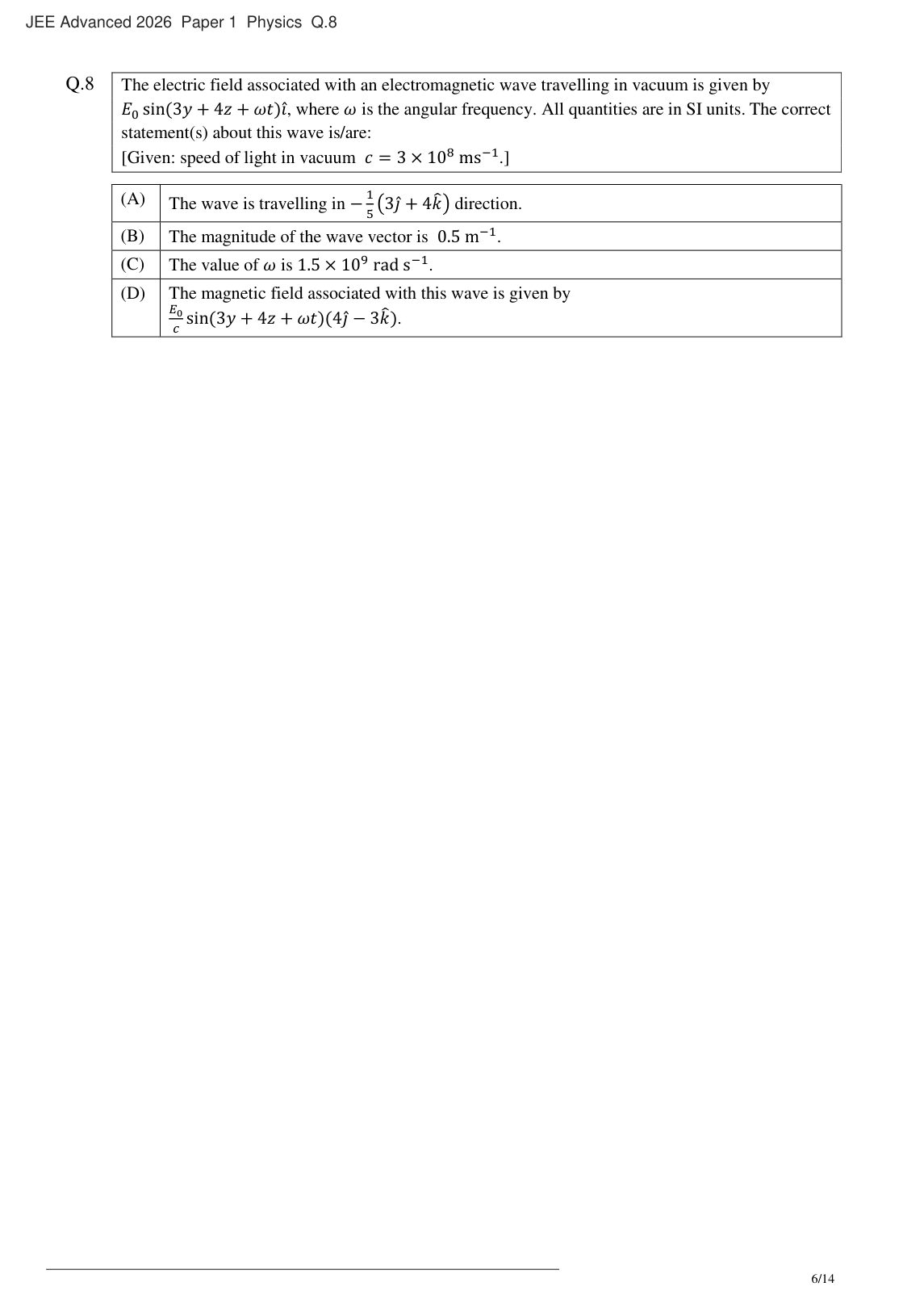
Official A, C
Model answers
Claude Fable 5.1
Anthropic
A, C
Claude Fable 5.1 reasoning
The wave vector is (0,3,4) with magnitude 5, so propagation is along −(3ĵ+4k̂)/5, confirming statement A. Statement B is wrong since the magnitude is 5 not 0.5, while C checks out since ω = kc gives 1.5×10^9. Now I'm working out the direction of B based on the propagation direction. For B, checking whether the cross product of E and B gives the propagation direction, testing B ∝ (4ĵ − 3k̂) gives E × B along +(3ĵ+4k̂), opposite to propagation, so the correct B must be along (−4ĵ+3k̂)/5 instead. Statement D also fails to include the 1/5 normalization factor, giving the wrong magnitude, so D is incorrect—leaving A and C as the correct answers. **Analysis** Phase: $3y + 4z + \omega t$ → wave vector $\vec k = 3\hat j + 4\hat k$, $|\vec k| = 5\ \text{m}^{-1}$. Since the phase is $\vec k\cdot\vec r + \omega t$, the wave propagates along $-\hat k$ direction: $-\frac{1}{5}(3\hat j + 4\hat k)$. **(A) correct.** $|\vec k| = 5\ \text{m}^{-1}$, not 0.5. **(B) incorrect.** $\omega = kc = 5 \times 3\times10^8 = 1.5\times10^9$ rad/s. **(C) correct.** Magnetic field: $\vec B = \frac{1}{c}\,\hat n \times \vec E$ with $\hat n = -\frac{1}{5}(3\hat j+4\hat k)$: $\hat n \times \hat i = -\frac15(3\hat j\times\hat i + 4\hat k\times \hat i) = -\frac15(-3\hat k + 4\hat j) = \frac{1}{5}(3\hat k - 4\hat j)$. So $\vec B = \frac{E_0}{5c}\sin(3y+4z+\omega t)(-4\hat j + 3\hat k)$. Option (D) has wrong sign (would give $\vec E\times\vec B$ along $+(3\hat j+4\hat k)$, opposite to propagation) and wrong magnitude (missing factor 1/5). **(D) incorrect.**
GPT 6 Astra
OpenAI
A, C
GPT 6 Astra reasoning
No written reasoning was returned for this item.
GPT 5.5
OpenAI
A, C
GPT 5.5 reasoning
**Analyzing electromagnetic wave statements** I need to carefully solve this. The text describes the electric field of an EM wave traveling in a vacuum. I’ve got to identify correct statements regarding the wave's direction, wave vector magnitude, and frequency. I realize the wave is traveling in the negative direction of the vector (3j + 4k). I determine that statement A is true, but statement B about the magnitude is false—it's actually 5 m^-1, not 0.5. As for statement C, it checks out. I’ll keep deriving the B field. **Calculating magnetic field direction** I see that for the wave traveling, the propagation direction \( \hat{n} \) is given by \(-(3j + 4k)/5\) and the electric field \(E\) is along the \(i\) direction. In an electromagnetic wave, the magnetic field \(B\) is calculated as \(B = (1/c) \hat{n} \times E\). Here, I need to determine \(n \times i\). This results in \(-(3/5)(j \times i) - (4/5)(k \times i)\). Using the right-hand rule, I find \(B\) as \((-4j + 3k)/5\). **Analyzing electromagnetic equation** I’m examining the equations, checking if they involve K=(3j+4k) with time included, and B might be K×E/ω. After calculating K×i, I get -3k+4j, which simplifies to 4j-3k. Then for B, it looks like B=(E0/ω)(K×i) sin needs to be reevaluated as E0/(5c)(4j-3k). I should also remember to factor in Faraday's law with the sign change: E=E0 sin(K·r+ωt). **Deriving Maxwell's equations** I'm trying to derive Maxwell's equations directly. It seems that when I express \(E\) with positive coefficients, it represents a wave traveling in the negative direction. I start with Faraday's law and put \(E = E_0 \sin(\phi)\) where \(\phi = 3y + 4z + \omega t\). The curl of \(E\) leads to specific terms that simplify nicely, ultimately linking \(E\) to \(B\). I'll go ahead from here to ensure I have the correct expressions.
Claude Sonnet 5
Anthropic
A, C
Claude Sonnet 5 reasoning
The phase is sin(3y+4z+ωt), giving wave vector k=(0,3,4). Since this matches sin(k·r+ωt) rather than the standard sin(k·r−ωt) form, the wave must be traveling in the −k direction. I'm computing |k|=5, so ω=ck=1.5×10⁹ rad/s, confirming option C and ruling out B (since |k|=5, not 0.5). Then I check the E×B direction condition: with E along x̂ and propagation along n̂=−(3ĵ+4k̂)/5, I need to find B's components so that E×B points along n̂, using x̂×ĵ=k̂ and x̂×k̂=−ĵ to set up the proportionality −bĵ+ak̂ ∝ −3ĵ−4k̂. Solving gives (a,b) ∝ (−4,3), so B should point along −4ĵ+3k̂, which is opposite in sign to what option D claims (4ĵ−3k̂), so D appears incorrect — I want to double-check the cross product signs to be sure. So D has the sign flipped and is wrong, meaning the correct answers should be A and C. Let me verify A by checking the standard wave convention: for phase sin(k·r + ωt), tracking how the phase argument evolves confirms which direction the wave actually propagates. The propagation direction is -1/5(3ĵ+4k̂), since the negative sign just flips the amplitude convention rather than the direction itself. This confirms option A, so the answer is A, C. Looking at this problem: **Wave vector and direction:** The phase is (3y + 4z + ωt), which has the form (k·r + ωt) — this represents a wave moving in the **negative** k-direction, where k = 3ĵ + 4k̂, |k| = 5 m⁻¹. - Direction of propagation: n̂ = -(3ĵ+4k̂)/5 → **(A) is correct** - |k| = √(3²+4²) = 5 m⁻¹, not 0.5 m⁻¹ → **(B) is incorrect** **Angular frequency:** Since ω = c|k| = (3×10⁸)(5) = 1.5×10⁹ rad/s → **(C) is correct** **Magnetic field direction:** For an EM wave, E × B must point along the propagation direction n̂ = -(3ĵ+4k̂)/5. With E along x̂, let B = B₀(a ĵ + b k̂): E × B ∝ a(x̂×ĵ) + b(x̂×k̂) = a k̂ - b ĵ This must be proportional to -(3ĵ+4k̂), giving: - -b = -3λ → b = 3λ - a = -4λ So B ∝ (-4ĵ + 3k̂), **not** (4ĵ - 3k̂) as stated in option D. The sign is opposite to what's required by the E×B propagation condition → **(D) is incorrect** ```json