
2026 · Paper 2 · Chemistry
Question 15
The printed question, the official key, and each model’s JSON answer plus the reasoning it wrote.
Q15
Official 1991 – 2053
Model answers
Claude Fable 5.1
Anthropic
2000
Claude Fable 5.1 reasoning
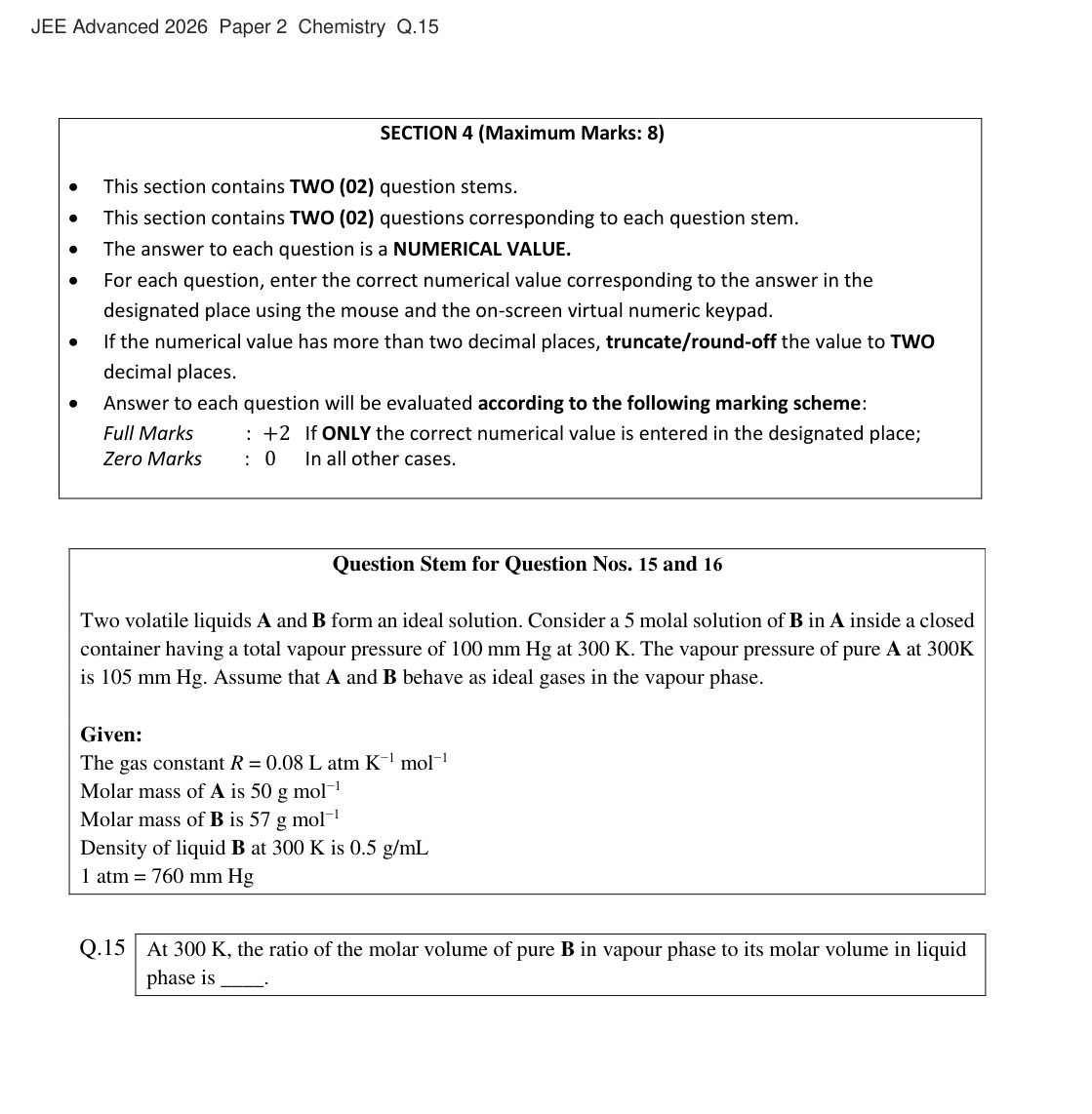
With 5 mol B in 1000 g A (20 mol A), mole fraction of B is 0.2 and A is 0.8. Using total pressure 100 mmHg with A's vapor pressure 105, I solve for B's pure vapor pressure and get 80 mmHg. Now I'm setting up to find the molar volume of pure B vapor at 300 K using the ideal gas relation. Converting 80 mmHg to atm gives about 228 L for the vapor's molar volume. Comparing this to the liquid molar volume of B (57 g at density 0.5, giving 114 mL), the ratio of vapor to liquid molar volume comes out to 2000. **Solution** 5 molal solution of B in A: 5 mol B per 1000 g A → moles of A = 1000/50 = 20 mol. x_B = 5/25 = 0.2, x_A = 0.8 Total pressure: 100 = 0.8(105) + 0.2 P°_B → P°_B = 80 mm Hg Molar volume of pure B vapour at 300 K, 80 mm Hg: V = RT/P = (0.08 × 300)/(80/760) = 228 L Molar volume of liquid B = 57/0.5 = 114 mL = 0.114 L Ratio = 228/0.114 = 2000
GPT 6 Astra
OpenAI
2000
GPT 6 Astra reasoning
No written reasoning was returned for this item.
GPT 5.5
OpenAI
2000
GPT 5.5 reasoning
No written reasoning was returned for this item.
Claude Sonnet 5
Anthropic
2000
Claude Sonnet 5 reasoning
I need the vapor pressure of pure B first, using the 5 molal solution with Raoult's law. With 1000g A (molar mass 50, so 20 mol) and 5 mol B, mole fractions come out to 0.8 for A and 0.2 for B, so total vapor pressure equals x_A·P_A° + x_B·P_B°. Solving 0.8(105) + 0.2·P_B° = 100 gives P_B° = 80 mmHg. Now I'm finding the molar volume of B vapor at 300K using ideal gas law: RT/P = (0.08×300)/(80/760) = 228 L/mol, or 228000 mL/mol. Comparing this to the liquid molar volume (57/0.5 = 114 mL/mol), the ratio comes out cleanly to 2000. Looking at this problem, I need to find the vapor pressure of pure B first, then compare molar volumes. **Step 1: Find mole fractions in solution** 5 molal solution means 5 mol B per 1 kg (1000 g) of A. - mol A = 1000/50 = 20 mol - mol B = 5 mol - Total = 25 mol x_A = 20/25 = 0.8, x_B = 5/25 = 0.2 **Step 2: Find P°_B using Raoult's Law** Total vapor pressure = x_A·P°_A + x_B·P°_B 100 = (0.8)(105) + (0.2)(P°_B) 100 = 84 + 0.2·P°_B P°_B = 16/0.2 = 80 mm Hg **Step 3: Molar volume of B vapor (pure B, ideal gas)** Convert P°_B to atm: 80/760 atm V_m(vapor) = RT/P = (0.08 × 300)/(80/760) = 24 × (760/80) = 24 × 9.5 = 228 L/mol = 228000 mL/mol **Step 4: Molar volume of liquid B** Density = 0.5 g/mL, Molar mass = 57 g/mol V_m(liquid) = 57/0.5 = 114 mL/mol **Step 5: Ratio** Ratio = 228000/114 = 2000 ```json