
2026 · Paper 2 · Chemistry
Question 16
The printed question, the official key, and each model’s JSON answer plus the reasoning it wrote.
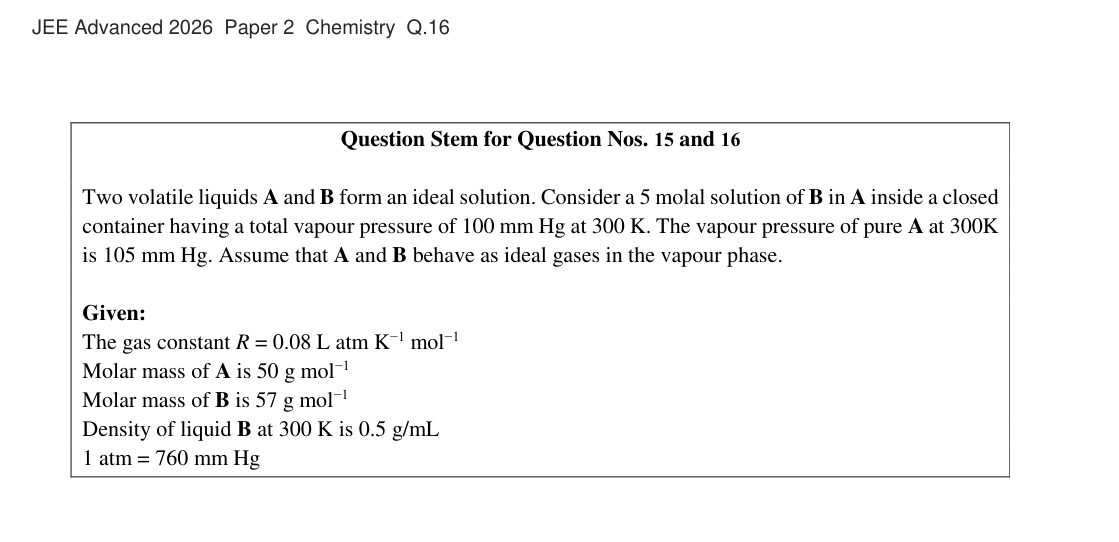
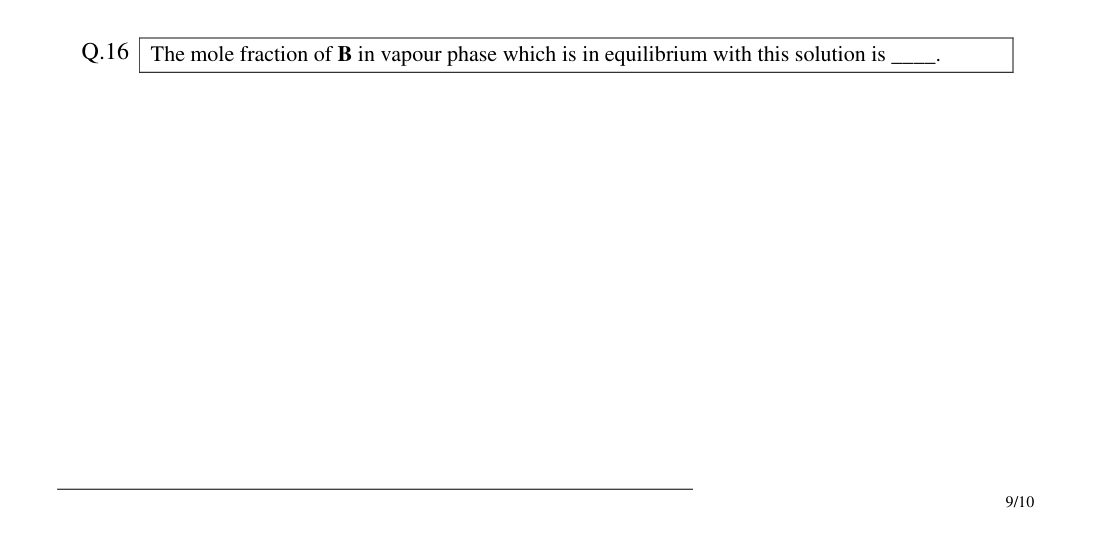
Q16
Official 0.16
Model answers
Claude Fable 5.1
Anthropic
0.16
Claude Fable 5.1 reasoning
5 molal solution of B in A: 5 mol B per 1000 g A → moles of A = 1000/50 = 20. Mole fraction of B in liquid: x_B = 5/25 = 0.2, x_A = 0.8. Total pressure: P = x_A P_A° + x_B P_B° → 100 = 0.8(105) + 0.2 P_B° → 100 = 84 + 0.2 P_B° → P_B° = 80 mm Hg. Partial pressure of B = 0.2 × 80 = 16 mm Hg. Mole fraction of B in vapour = 16/100 = 0.16.
GPT 6 Astra
OpenAI
0.16
GPT 6 Astra reasoning
**Calculating fractions** I need to calculate the fraction involving nA20, nB5, xA.8, pA84, and pB16, and it seems like finalizing the output in a JSON format might be best. I want to verify there's no catch with the molality of 5. It's essential to ensure my calculations and formatting are correct for clarity and accuracy. I just want to make sure everything is precise before I wrap this up!
GPT 5.5
OpenAI
0.16
GPT 5.5 reasoning
**Parsing solution details** I need to focus on solving this problem and producing the final JSON output. The task involves a 5 molal solution of volatile liquids A and B in a closed container, with a total vapor pressure of 100 mm Hg at 300 K. The vapor pressure of pure A is 105 mm Hg. In this case, I should find the mole fraction of B in the vapor phase, which requires careful consideration. A means 5 moles of B in 1 kg of A! **Calculating vapor pressures** I need to apply Raoult's law, where p_A equals x_A times the vapor pressure of pure A. I have a 5 molal solution of B in A, so I should calculate x_B from the molality. Given 1 kg of A, with a molar mass of 50 g/mol, I find n_A is 20 moles and n_B is 5 moles. This gives me x_B as 0.2 and x_A as 0.8, leading to a vapor pressure of A at 84 mmHg and B at 16 mmHg. However, since it's in a closed container, I wonder about possible changes in composition due to vaporization. **Determining vapor compositions** Given the total vapor pressure of the solution at equilibrium, I can calculate x_B using the formula for total pressure. I know p_total equals x_A times the vapor pressure of pure A plus x_B times the vapor pressure of B, which I need to find. Since I have x_B from the molality as 0.2, I can work backward. This means I have a solid starting point, but deriving PB* is still an unknown that I'll need to consider for the final answer. **Calculating equilibrium properties** I'm working through some calculations related to a 5 molal solution. It seems I should focus on the mole fraction of B in the vapor phase at equilibrium, using the formula P_B/P_total. I also need to ensure I deliver my final answer strictly as a JSON object, with an answer of 0.16. I should pay attention to numerical formatting since it’s asking for a mole fraction. Let's finalize this! {"mole_fraction": 0.16} **Analyzing vapor pressure** I'm examining the total vapor pressure, which is actually lower than that of pure A at 105 mmHg, even though B is volatile. Adding B decreases A's partial pressure by 21 mmHg to 84, and B contributes 16, resulting in a total depression of 5. This means B is less volatile, and its \( P_B^* \) is 80. The question mentions that A and B act as ideal gases in the vapor phase, which is essential for calculating the mole fraction via Dalton's law. I'm ready to finalize my answer!
Claude Sonnet 5
Anthropic
0.16
Claude Sonnet 5 reasoning
I'm calculating the mole fractions from the molality: 20 mol solvent A and 5 mol solute B give x_A = 0.8 and x_B = 0.2, then using Raoult's law with P_A° = 105 mmHg and total pressure 100 mmHg to find P_A from x_A times P_A°. So P_B = 100 - 84 = 16 mmHg, giving mole fraction of B in vapor as 16/100 = 0.16. Using Raoult's law: x_A(liquid) = 20/25 = 0.8, x_B(liquid) = 5/25 = 0.2 P_A = x_A × P_A° = 0.8 × 105 = 84 mm Hg P_B = P_total − P_A = 100 − 84 = 16 mm Hg Mole fraction of B in vapor phase = P_B / P_total = 16/100 = 0.16 ```json