
2026 · Paper 2 · Mathematics
Question 5
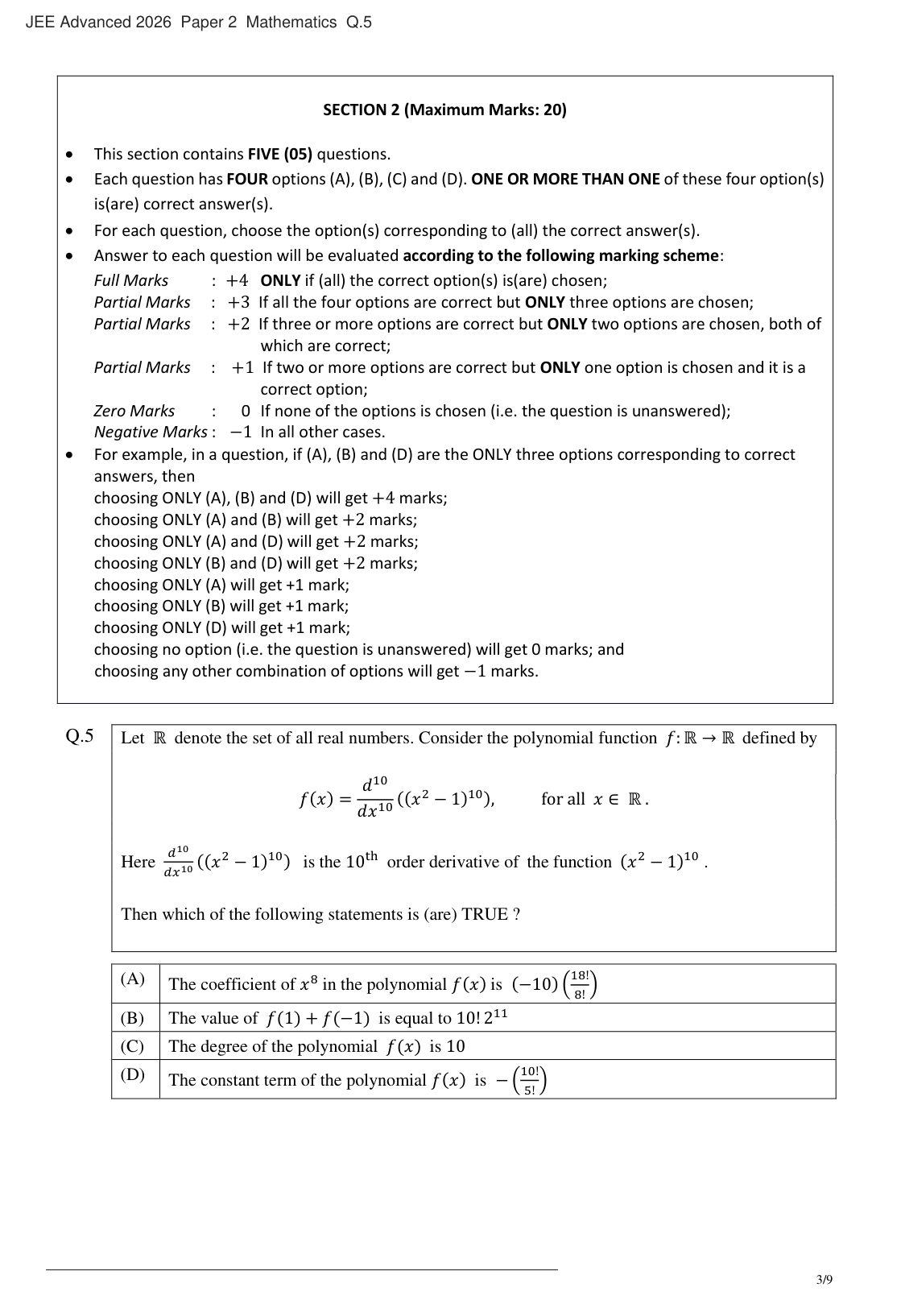
The printed question, the official key, and each model’s JSON answer plus the reasoning it wrote.
Q05
Official A, B, C
Model answers
Claude Fable 5.1
Anthropic
A, B, C
Claude Fable 5.1 reasoning
Using Rodrigues' formula, f(x) equals 2^10·10! times the Legendre polynomial P_10(x), confirming degree 10 checks out for (C). Since P_10 is even, f(1) equals f(-1) equals 2^10·10!, so their sum is 2^11·10!, confirming (B). Now I'm working out the coefficient of x^8 in this expansion. Expanding (x^2-1)^10 as a binomial sum and applying the 10th derivative to each x^{2k} term, I find that x^8 arises from k=9, giving a coefficient of -10·18!/8!, which confirms (A). For the constant term (k=5), I get -252·10!, which doesn't match option D's claimed value of -10!/5!, so (D) is false. That leaves A, B, and C as the correct answers. **Solution.** $(x^2-1)^{10}=\sum_{k=0}^{10}\binom{10}{k}(-1)^{10-k}x^{2k}$. Differentiating 10 times, the $x^{2k}$ term gives $\binom{10}{k}(-1)^{10-k}\frac{(2k)!}{(2k-10)!}x^{2k-10}$ for $k\ge5$. - Degree: from $k=10$, term $x^{10}$ survives → degree 10. **(C) true.** - Coefficient of $x^8$: $k=9$: $\binom{10}{9}(-1)^1\frac{18!}{8!}=-10\cdot\frac{18!}{8!}$. **(A) true.** - Constant term: $k=5$: $\binom{10}{5}(-1)^5\cdot 10! = -252\cdot 10!\neq -\frac{10!}{5!}$. **(D) false.** - By Rodrigues' formula, $f(x)=2^{10}\,10!\,P_{10}(x)$, so $f(1)=f(-1)=2^{10}\cdot 10!$, giving $f(1)+f(-1)=10!\,2^{11}$. **(B) true.**
GPT 6 Astra
OpenAI
A, B, C
GPT 6 Astra reasoning
No written reasoning was returned for this item.
GPT 5.5
OpenAI
A, B, C
GPT 5.5 reasoning
**Analyzing constant term and derivatives** I see that the constant term corresponds to \(2j-10=0\), which gives \(j=5\). The coefficient calculation leads to a huge value, but there's a claim involving \(-(10!/5!)\). That seems ambiguous because saying "constant term is \(-(10!/5!)\)" isn’t exactly correct. I also consider the 10th derivative normalized, realizing \(-252*10!\) seems to be a right direction. There may be a misunderstanding on the constants, and I need more details about the differentiation at specific points. **Calculating function values at specific points** At \(x=1\), the term \(d^r(x-1)^{10}\) simplifies, indicating it’s nonzero only when \(r=10\). The value calculated here gives \(10! h(1) = 10! \cdot 2^{10}\), so \(f(1) = 10! \cdot 2^{10}\). The same applies to \(f(-1)\), resulting in \(f(-1) = 10! \cdot 2^{10}\) as well. Adding these gives \(10! \cdot 2^{11}\). I’ll ensure everything is correct and ready for the final output in JSON format.
Claude Sonnet 5
Anthropic
A, B, C
Claude Sonnet 5 reasoning
I recognize this as related to the Legendre polynomial: f(x) equals the 10th derivative of (x²-1)^10, which connects to P_10(x) via the standard Rodrigues formula, giving f(x) = 2^10·10!·P_10(x). I'm now expanding (x²-1)^10 using the binomial theorem to compute the derivative term by term. Only terms with x^{2k} where k≥5 survive the 10th derivative, and I derive the general formula for each surviving coefficient. Checking degree confirms it's 10 (matching option C), and computing the x^8 coefficient at k=9 gives -10·(18!/8!), matching option A. I then work out the constant term at k=5, getting -252·10!, and I'm comparing this against option D's claimed value. This doesn't match option D's form of -(10!/5!), so D appears false since 252 = 10!/(5!5!) rather than just 10!/5!. Now I want to check f(1)+f(-1), noting that since f is the 10th derivative of (x²-1)^10, and (x²-1)^10 has a zero of order 10 at both x=1 and x=-1, I need to think about what value the 10th derivative takes at these endpoints. Recognizing that f(x) = 2^10·10!·P_10(x) where P_10 is the Legendre polynomial, and using P_n(1)=1, P_n(-1)=(-1)^n, I get f(1)=2^10·10! and f(-1)=2^10·10!, so their sum is 2^11·10! -- matching option B exactly. So A, B, and C are all true, D is false, confirming my final answer as A, B, C. Looking at this problem, I need to analyze f(x) = d¹⁰/dx¹⁰[(x²-1)¹⁰], which is related to the Legendre polynomial: f(x) = 2¹⁰·10!·P₁₀(x). **Expanding using binomial theorem:** (x²-1)¹⁰ = Σₖ₌₀¹⁰ C(10,k)(-1)^(10-k) x^(2k) Taking the 10th derivative, only terms with 2k ≥ 10 (i.e., k ≥ 5) survive: f(x) = Σₖ₌₅¹⁰ C(10,k)(-1)^(10-k) · [(2k)!/(2k-10)!] · x^(2k-10) **Checking (C): Degree of f(x)** Maximum k=10 gives x^10 term, so degree = 10. **TRUE** **Checking (A): Coefficient of x⁸** Need 2k-10 = 8, so k = 9. Coefficient = C(10,9)·(-1)^(1)·(18!/8!) = 10·(-1)·(18!/8!) = -10(18!/8!) This matches option A. **TRUE** **Checking (D): Constant term** Need 2k-10 = 0, so k = 5. Coefficient = C(10,5)·(-1)^5·(10!/0!) = 252·(-1)·10! = -252·10! = -(10!)²/(5!5!) Option D claims this equals -(10!/5!) = -30240, but the actual value -252·10! is vastly different (since 252 = 10!/(5!5!), giving -(10!)²/(5!)²). **FALSE** **Checking (B): f(1) + f(-1)** Using the Legendre polynomial connection: f(x) = 2¹⁰·10!·P₁₀(x) Known properties: P₁₀(1) = 1 and P₁₀(-1) = (-1)¹⁰ = 1 So: - f(1) = 2¹⁰·10!·1 = 2¹⁰·10! - f(-1) = 2¹⁰·10!·1 = 2¹⁰·10! Therefore f(1) + f(-1) = 2·2¹⁰·10! = 2¹¹·10! This matches option B exactly. **TRUE** **Verification via direct computation:** At x=1: (x²-1)¹⁰ = (x-1)¹⁰(x+1)¹⁰. Using Leibniz rule for 10th derivative, only the term where all 10 derivatives hit (x-1)¹⁰ survives at x=1, giving 10!·(x+1)¹⁰ evaluated at x=1 = 10!·2¹⁰. Similarly at x=-1, only derivatives hitting (x+1)¹⁰ survive: 10!·(x-1)¹⁰ at x=-1 = 10!·(-2)¹⁰ = 10!·2¹⁰. Sum = 2·10!·2¹⁰ = 2¹¹·10! ✓ Confirms **TRUE** **Conclusion:** Statements A, B, and C are true; D is false. ```json