
2026 · Paper 2 · Mathematics
Question 6
The printed question, the official key, and each model’s JSON answer plus the reasoning it wrote.
Q06
Official A, B, C
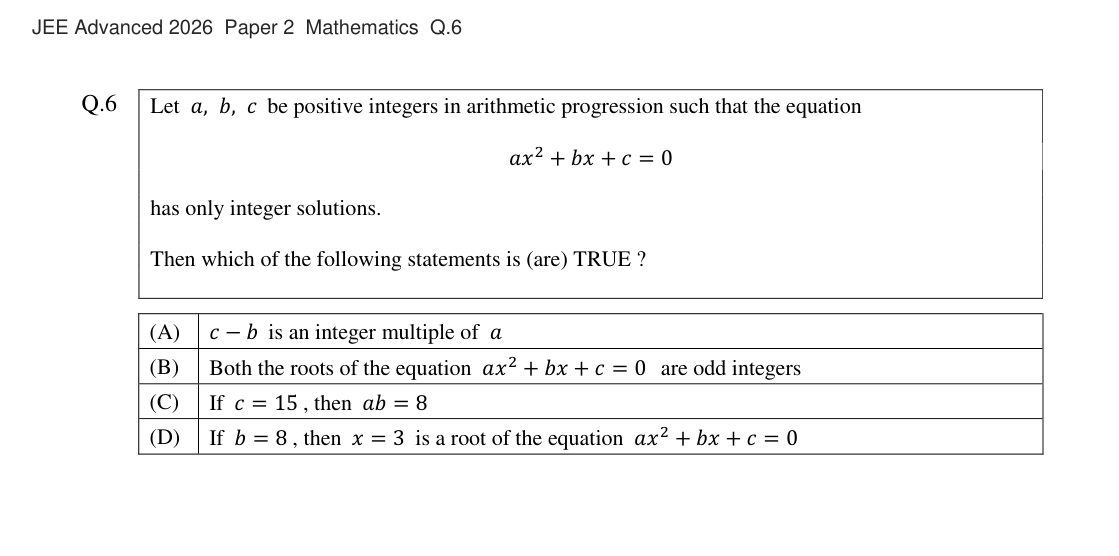
Model answers
Claude Fable 5.1
Anthropic
A, B, C
Claude Fable 5.1 reasoning
Setting a, b, c as an arithmetic progression with b = a+d, c = a+2d, I note that since the quadratic ax²+bx+c=0 has integer roots, both b/a and c/a must be integers, meaning a divides b and c, and therefore a divides d. Writing b = a·m and c = a·n gives the relation n = 2m - 1. Solving x² + mx + (2m-1) = 0 for integer roots, I set the discriminant equal to a perfect square k², which factors as (m-4-k)(m-4+k) = 12. Checking valid same-parity factor pairs, only m = 8 gives a positive b, yielding x² + 8x + 15 = 0 with roots -3 and -5. Testing each option against a=1, b=8, c=15: (A) c-b=7a holds, (B) both roots are odd, (C) ab=8 checks out, but (D) fails since x=3 isn't a root — so the answer is A, B, C. **Setting up:** Since the roots are integers, $r+s=-b/a$ and $rs=c/a$ are integers, so $a\mid b$ and $a\mid c$. Write $b=am,\ c=an$. The AP condition $2b=a+c$ gives $n=2m-1$. So the equation reduces to $x^2+mx+(2m-1)=0$ with integer roots, requiring the discriminant $m^2-8m+4=(m-4)^2-12$ to be a perfect square $k^2$: $(m-4-k)(m-4+k)=12$ with both factors of the same parity → pairs $(2,6)$ or $(-6,-2)$, giving $m=8$ or $m=0$. Since $b>0$, $m=8$. Hence $b=8a,\ c=15a$, and the equation is $a(x^2+8x+15)=0$ with roots $x=-3,\,-5$. - (A) $c-b=7a$ → multiple of $a$. **True** - (B) Roots $-3,-5$ are odd integers. **True** - (C) $c=15\Rightarrow a=1,\ b=8$, so $ab=8$. **True** - (D) $b=8\Rightarrow a=1$, roots are $-3,-5$; $x=3$ is not a root. **False**
GPT 6 Astra
OpenAI
A, B, C
GPT 6 Astra reasoning
No written reasoning was returned for this item.
GPT 5.5
OpenAI
A, B, C
GPT 5.5 reasoning
**Analyzing integer roots** I need to be careful to find the right answer for the problem involving a, b, and c, which are positive integers in an arithmetic progression. I'm thinking that the statement “has only integer solutions” means the roots must be integers. Since a, b, and c are positive, it seems like the roots of the quadratic equation would be negative integers. I need to explore more about the relationship between the roots and coefficients. Let’s see if that leads me to the right conclusion! **Deriving integer solutions** I’m looking into the arithmetic progression condition, where I have 2b = a + c. This leads to some rearranging and I find that (m-2)(n-2) = 3. I realize I need to consider the positive integer factors of 3. So it seems m and n could be 3 and 5, making the roots -3 and -5. That confirms the coefficients as b = 8a and c = 15a. Everything checks out, and yes, the equation has only integer solutions! **Examining integer solutions** I’m looking into some assumptions around a quadratic equation. For part (B), both roots being odd integers, -3 and -5, seems true. In (C), if c=15, then a=1 and b=8, which checks out. But in (D), saying x=3 is not a root makes me rethink; I realize that a quadratic with positive coefficients cannot yield a positive root. I need to clarify what “only integer solutions” really means in this context; it likely indicates all integer roots. **Analyzing the equation requirements** I want to verify the official intent behind the roots being integers, as the options are testing that aspect. Before I finalize, I need to focus on producing only the JSON format for my answer, since that's a specific requirement from the developer. I notice there might be potential pitfalls since the attached image references a future exam paper, which needs careful consideration. The statement about positive integers and the arithmetic progression is crucial for understanding the roots and their relationships. **Verifying option (C)** I need to check option (C) closely: if c=15, then I’m considering the general coefficients as (a, b, c) equal to k(1, 8, 15). This means I'm examining the relationship between k and how it scales the integers in the equation. It’s crucial to ensure that this setup holds true and fits the established rules of the problem regarding integers and their relationships in this context. Let's keep digging!
Claude Sonnet 5
Anthropic
A, B, C
Claude Sonnet 5 reasoning
Since a, b, c form an arithmetic progression, b - a = c - b, so c - a is twice the common difference. Given the quadratic has positive coefficients, both roots must be negative, so I'll write them as -p and -q for positive integers p, q. Factoring the quadratic gives b = a(p+q) and c = apq, and plugging into the AP condition 2b = a+c leads to (p-2)(q-2) = 3. Testing integer factor pairs of 3, only p=3, q=5 (or swapped) gives valid positive integers, so the roots are -3 and -5, yielding b = 8a and c = 15a for any positive integer a — which I verify does satisfy the AP condition since both differences equal 7a. Checking each option: (A) c-b = 7a is indeed a multiple of a, so true. (B) the roots -3 and -5 are both odd integers, true. (C) if c=15 then a=1, giving b=8, so ab=8, true. (D) if b=8 then a=1, c=15, giving equation x²+8x+15=0 with roots -3,-5 — testing x=3 shows it doesn't satisfy the equation, so this option is false. Looking at this problem, since a, b, c are positive integers with a, b, c > 0, both roots must be negative (product = c/a > 0, sum = -b/a < 0). **Setting up:** Let roots be -p, -q where p, q are positive integers. Then: - b = a(p+q) - c = apq **Using AP condition** (2b = a+c): $$2a(p+q) = a + apq \implies 2(p+q) = 1 + pq$$ This gives (p-2)(q-2) = 3, so factor pairs of 3 with p,q positive integers force p=3, q=5 (other factorizations give negative p or q). **Conclusion:** Roots are -3, -5, and: - b = 8a - c = 15a **Checking options:** **(A)** c - b = 7a, which is a multiple of a. **TRUE** **(B)** Roots are -3 and -5, both odd integers. **TRUE** **(C)** If c=15, then 15a=15 ⟹ a=1, so b=8a=8, giving ab = 8. **TRUE** **(D)** If b=8, then a=1, c=15. Equation: x²+8x+15=0 has roots -3, -5. Testing x=3: 9+24+15=48≠0. **FALSE** ```json