
2026 · Paper 2 · Mathematics
Question 7
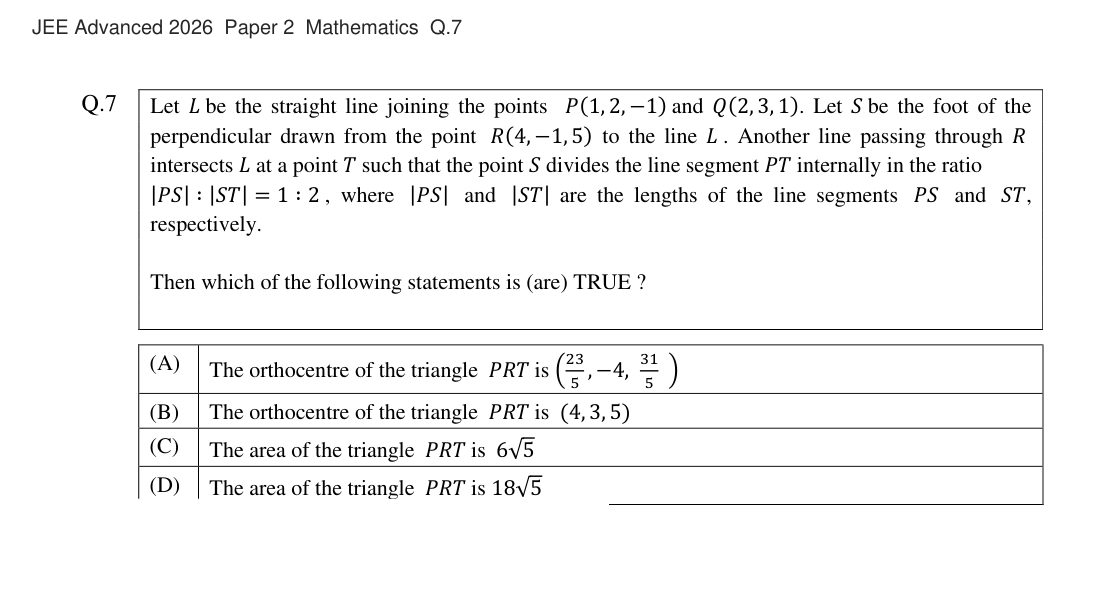
The printed question, the official key, and each model’s JSON answer plus the reasoning it wrote.
Q07
Official A, D
Model answers
Claude Fable 5.1
Anthropic
A, D
Claude Fable 5.1 reasoning
I set up the line through P and Q with direction (1,1,2), then found the foot of perpendicular S from R by projecting R-P onto the direction vector, getting t=2 and S=(3,4,3). Now I'm computing the vector PS = (2,2,4) to relate S's position along PT. Since S divides PT internally in ratio 1:2, T = (7,8,11). Using the perpendicularity condition for the orthocentre H lying on altitude RS combined with altitude from P perpendicular to RT, I solve for λ=8/5 and get H = (23/5, -4, 31/5), confirming option A is correct. I also cross-check using the geometric relation HS·SR = PS·ST as an alternative verification method. Since PS·ST = 48 exceeds RS² = 30, angle PRT is obtuse, meaning the orthocentre lies beyond R, consistent with λ = 8/5 > 1. Computing the area as (1/2)|PT||RS| gives 18√5, confirming option D as correct, so the final answer is A and D. **Setting up:** Line L has direction d = (1,1,2). Foot of perpendicular from R(4,−1,5): with P + t·d, t = (R−P)·d/|d|² = (3−3+12)/6 = 2, so S = (3, 4, 3). **Finding T:** S divides PT in ratio 1:2, so T = P + 3(S − P) = (7, 8, 11). **Orthocentre:** RS ⊥ PT, so the orthocentre H lies on line RS: H = S + λ(R − S) = (3,4,3) + λ(1,−5,2). Require (H − P) ⊥ (T − R) = (3, 9, 6): (2,2,4)·(3,9,6) + λ(1,−5,2)·(3,9,6) = 48 − 30λ = 0 ⇒ λ = 8/5. H = (23/5, −4, 31/5). ✔ (A) **Area:** |PT| = |(6,6,12)| = 6√6, |RS| = √(1+25+4) = √30. Area = ½ · 6√6 · √30 = 3√180 = 18√5. ✔ (D)
GPT 6 Astra
OpenAI
A, D
GPT 6 Astra reasoning
No written reasoning was returned for this item.
GPT 5.5
OpenAI
A, D
GPT 5.5 reasoning
**Finalizing calculations** I'm wrapping up my calculation. I've evaluated the components and found that the magnitude equals 36√5. By breaking it down, I see that sqrt(6480) is indeed 36√5, and half of that gives me 18√5. Now, I just need to ensure that the JSON object is correctly formatted before concluding. I want to make sure the last characters adhere to JSON standards, avoiding any extraneous markdown.
Claude Sonnet 5
Anthropic
A, D
Claude Sonnet 5 reasoning
I need to find the foot of perpendicular from R(4,-1,5) to line L through P(1,2,-1) and Q(2,3,1), with direction d=(1,1,2). I'm setting up a point X on the line, computing the vector RX, and preparing to dot it with d to solve for the parameter t where RX is perpendicular to the line. Since S lies on PT with RS perpendicular to it, RS serves as the altitude from R in triangle PRT. Computing the area using base |PT|=6√6 and height |RS|=√30 gives area = (1/2)(6√6)(√30). That simplifies to 18√5, matching option D. Now I need the orthocentre of triangle PRT with vertices P(1,2,-1), R(4,-1,5), T(7,8,11) — I have one altitude already, the line through R and S(3,4,3), so I need to find a second altitude to intersect it with. I'll compute the foot of the perpendicular from P onto line RT, solving for the parameter s that makes the projection orthogonal to RT's direction vector, giving s = -1/7 and pinpointing the foot point F. Now I have the second altitude direction (from P through F), simplified to (3,-5,6), so I'll set up the two altitude lines parametrically—one from R with direction (-1,5,-2), one from P with direction (3,-5,6)—and equate their coordinates to find the intersection point, which will be the orthocenter. Solving the resulting system, I get t = -3/5 and s = 6/5, consistent across all three coordinate equations. Now I'll substitute t back into line1's parametrization to get the actual orthocenter coordinates. Plugging t=-3/5 gives (23/5, -4, 31/5), which matches option A exactly, confirming the answer includes A and D. Looking at this problem, I need to find the foot of perpendicular S, then determine T using the ratio condition, and finally analyze triangle PRT. **Setting up the line L:** Direction vector d = Q - P = (1,1,2) **Finding S (foot of perpendicular from R to L):** Parametrize points on L as (1+t, 2+t, -1+2t). Setting (R - point)·d = 0: - (t-3) + (t+3) + 2(2t-6) = 0 → 6t - 12 = 0 → t = 2 So S = (3, 4, 3). **Finding T:** Since S divides PT with PS:ST = 1:2, we have S = P + (1/3)(T-P), so T = P + 3(S-P): - T = (1,2,-1) + 3(2,2,4) = (7, 8, 11) Checking: T lies on L with parameter t=6, consistent with direction (1,1,2). ✓ **Key observation:** Since T is on line L, and S is the foot of perpendicular from R to L, S lies on segment PT with RS ⊥ PT. This means **RS is the altitude from R** in triangle PRT. **Computing Area of Triangle PRT:** - PT = T - P = (6,6,12), so |PT| = √(36+36+144) = √216 = 6√6 - RS = S - R = (-1,5,-2), so |RS| = √(1+25+4) = √30 Area = (1/2)|PT|·|RS| = (1/2)(6√6)(√30) = 3√180 = 3(6√5) = **18√5** This confirms **option D** is true, and rules out C. **Finding the Orthocentre:** Altitude from R: passes through R(4,-1,5) and S(3,4,3), direction (-1,5,-2) Line: (4-t, -1+5t, 5-2t) Altitude from P: need foot of perpendicular from P to line RT. RT direction = T - R = (3,9,6) Parametrize RT: (4+3s, -1+9s, 5+6s). Setting (X-P)·RT = 0: - 3(3+3s) + 9(-3+9s) + 6(6+6s) = 0 - 9+9s-27+81s+36+36s = 0 - 18 + 126s = 0 → s = -1/7 Foot F = (25/7, -16/7, 29/7) Direction from P to F: (18/7, -30/7, 36/7) ∝ (3, -5, 6) Altitude from P: (1+3s, 2-5s, -1+6s) **Solving intersection of two altitudes:** Set (4-t, -1+5t, 5-2t) = (1+3s, 2-5s, -1+6s) From equations: - 3 - t = 3s - t + s = 3/5 - s = (3-t)/3 Substituting: t + (3-t)/3 = 3/5 → 15t + 5(3-t) = 9 → 10t = -6 → t = -3/5 Computing orthocentre using t = -3/5: - x = 4-(-3/5) = 23/5 - y = -1+5(-3/5) = -1-3 = -4 - z = 5-2(-3/5) = 5+6/5 = 31/5 **Orthocentre = (23/5, -4, 31/5)** — this matches **option A**. **Verification:** Option B gives (4,3,5) which doesn't match our calculation, so B is false. ```json