
2026 · Paper 2 · Mathematics
Question 8
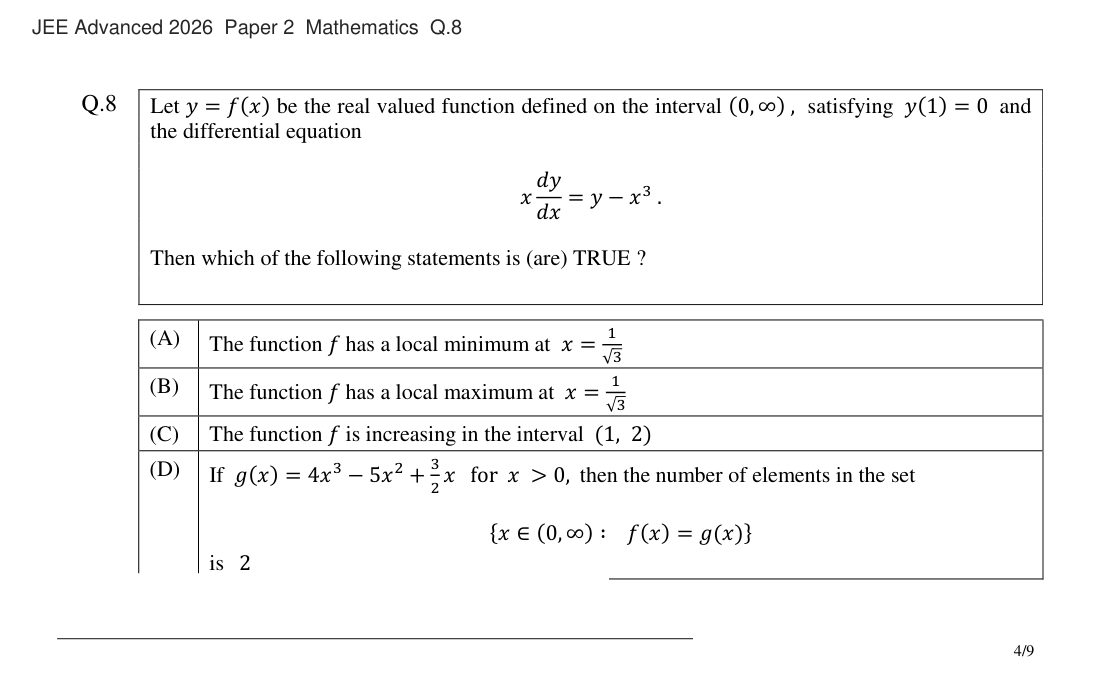
The printed question, the official key, and each model’s JSON answer plus the reasoning it wrote.
Q08
Official B, D
Model answers
Claude Fable 5.1
Anthropic
B, D
Claude Fable 5.1 reasoning
This is a linear ODE; using the integrating factor 1/x gives y = -x³/2 + Cx, and applying y(1)=0 gives C=1/2, so f(x) = (x-x³)/2. Taking the derivative and setting it to zero shows a critical point at x=1/√3, and since f'' is negative there, it's a local maximum. So B is true, A is false. Checking option C on (1,2), f' is negative there, meaning f is decreasing, so C is false. For D, I set f(x)=g(x), simplified to x(9x²-10x+2)=0, and since the discriminant is positive with both roots positive, there are 2 solutions in (0,∞), making D true. Final answer: B and D. **Solving the ODE:** $x\,y' = y - x^3 \Rightarrow \left(\frac{y}{x}\right)' = -x \Rightarrow y = -\frac{x^3}{2} + Cx$. With $y(1)=0$: $C=\tfrac12$, so $$f(x)=\frac{x-x^3}{2}.$$ **(A)/(B):** $f'(x)=\frac{1-3x^2}{2}=0$ at $x=\frac{1}{\sqrt3}$, and $f''(x)=-3x<0$ there → local maximum. So (B) true, (A) false. **(C):** On $(1,2)$, $f'(x)<0$, so $f$ is decreasing. False. **(D):** $\frac{x-x^3}{2}=4x^3-5x^2+\frac32 x \Rightarrow 9x^3-10x^2+2x=0 \Rightarrow x(9x^2-10x+2)=0$. Discriminant $=100-72=28>0$, roots $\frac{10\pm\sqrt{28}}{18}$, both positive. Since $x=0$ is excluded, exactly 2 solutions in $(0,\infty)$. True.
GPT 6 Astra
OpenAI
B, D
GPT 6 Astra reasoning
No written reasoning was returned for this item.
GPT 5.5
OpenAI
B, D
GPT 5.5 reasoning
**Solving a cubic equation** I'm multiplying and simplifying to solve the equation. I want to ensure I get the cubic in a factorable form. The discriminant is key for determining the roots, and I've found two positive roots after checking the calculations. It looks solid, but I need to confirm there are no subtleties, especially about the interval being open and ensuring the function is uniquely differentiable. I'm double-checking all my steps!
Claude Sonnet 5
Anthropic
B, D
Claude Sonnet 5 reasoning
This is a linear ODE with integrating factor 1/x, giving y/x = -x²/2 + C, and applying y(1)=0 yields C=1/2, so f(x) = (x - x³)/2. Now I'm differentiating to get f'(x) = (1 - 3x²)/2. The critical point is at x = 1/√3, and checking f'' confirms it's a local maximum, so statement B holds and A fails. Since f is increasing only for x < 1/√3 ≈ 0.577, it's actually decreasing on (1,2), making C false. For D, I set f(x) equal to the given g(x), simplify to a cubic 9x³-10x²+2x=0, factor out x, and solve the quadratic 9x²-10x+2=0 with positive discriminant, finding two positive roots — so D is true. My final answer: B and D. Looking at this problem, I need to solve the linear differential equation: **Solving the ODE:** $$x\frac{dy}{dx} = y - x^3 \implies \frac{dy}{dx} - \frac{y}{x} = -x^2$$ Using integrating factor $1/x$: $$\frac{d}{dx}\left(\frac{y}{x}\right) = -x$$ Integrating: $\frac{y}{x} = -\frac{x^2}{2} + C$, so $y = -\frac{x^3}{2} + Cx$ Applying $y(1) = 0$: $-\frac{1}{2} + C = 0 \implies C = \frac{1}{2}$ **Therefore:** $f(x) = \frac{x - x^3}{2}$ **Checking (A) and (B):** $$f'(x) = \frac{1 - 3x^2}{2}$$ Setting $f'(x) = 0$: $x = \frac{1}{\sqrt{3}}$ (taking positive root since domain is $(0,\infty)$) $$f''(x) = -3x$$ At $x = \frac{1}{\sqrt{3}}$: $f''\left(\frac{1}{\sqrt{3}}\right) = -\sqrt{3} < 0$ This confirms a **local maximum** at $x = \frac{1}{\sqrt{3}}$. So (B) is TRUE, (A) is FALSE. **Checking (C):** $f'(x) > 0 \iff 1 - 3x^2 > 0 \iff x < \frac{1}{\sqrt{3}} \approx 0.577$ Since $\frac{1}{\sqrt{3}} < 1$, on the interval $(1,2)$ we have $f'(x) < 0$, so $f$ is **decreasing**, not increasing. (C) is FALSE. **Checking (D):** Setting $f(x) = g(x)$: $$\frac{x-x^3}{2} = 4x^3 - 5x^2 + \frac{3}{2}x$$ Multiply by 2: $$x - x^3 = 8x^3 - 10x^2 + 3x$$ $$0 = 9x^3 - 10x^2 + 2x$$ $$x(9x^2 - 10x + 2) = 0$$ Since $x > 0$, we need $9x^2 - 10x + 2 = 0$. Discriminant: $\Delta = 100 - 72 = 28 > 0$ $$x = \frac{10 \pm \sqrt{28}}{18} = \frac{5 \pm \sqrt{7}}{9}$$ Both roots are positive: - $x_1 = \frac{5+\sqrt{7}}{9} \approx 0.849$ - $x_2 = \frac{5-\sqrt{7}}{9} \approx 0.266$ Both values lie in $(0, \infty)$, giving **2 solutions**. So (D) is TRUE. **Conclusion:** Statements (B) and (D) are true. ```json