
2026 · Paper 2 · Mathematics
Question 9
The printed question, the official key, and each model’s JSON answer plus the reasoning it wrote.
Q09
Official B, D
Model answers
Claude Fable 5.1
Anthropic
B, D
Claude Fable 5.1 reasoning
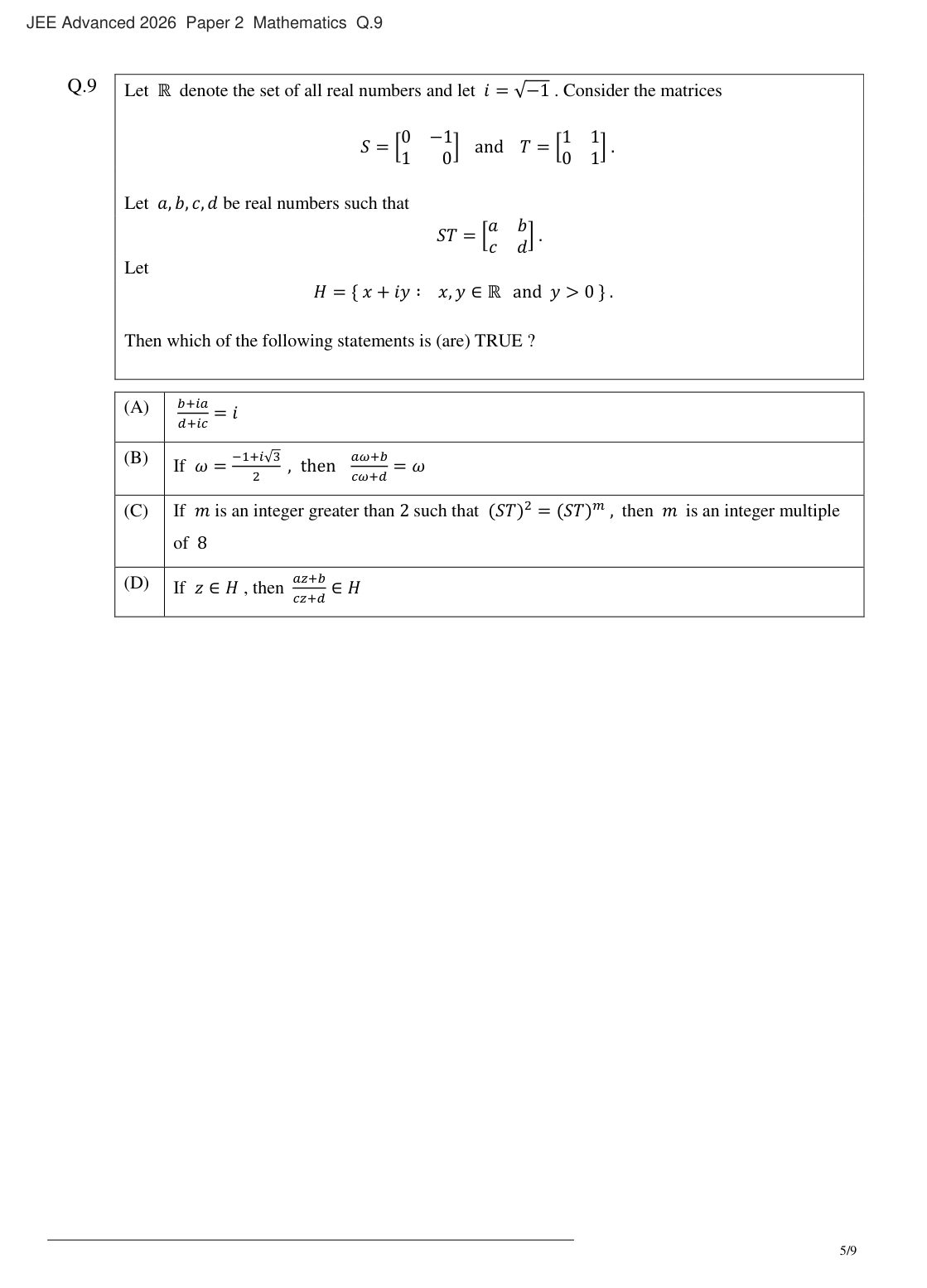
I compute ST by multiplying the two matrices, getting a=0, b=-1, c=1, d=1, then start evaluating (b+ia)/(d+ic) with these values, which simplifies to -1/(1+i). This gives (-1+i)/2, not equal to i, so (A) is false. For (B), checking (aω+b)/(cω+d) with ω a cube root of unity simplifies to 1/ω² = ω, so (B) is true. For (C), ST has trace 1 and determinant 1, so its eigenvalues are e^{±iπ/3}, giving order 6; since 6 doesn't divide (m-2) for m=14, (C) is false. For (D), the imaginary part formula (ad-bc)Im(z)/|cz+d|² becomes Im(z)/|z+1|², which is positive whenever Im(z)>0, so (D) is true — the answer is B and D. **Computing ST:** ST = [[0,−1],[1,1]], so a=0, b=−1, c=1, d=1. **(A)** (b+ia)/(d+ic) = −1/(1+i) = (−1+i)/2 ≠ i. False. **(B)** (aω+b)/(cω+d) = −1/(ω+1) = −1/(−ω²) = 1/ω² = ω. True. **(C)** ST has trace 1, det 1, eigenvalues e^{±iπ/3}, so (ST)^6 = I and order is 6. (ST)^2 = (ST)^m ⇔ 6 | (m−2), e.g. m = 14 works but isn't a multiple of 8. False. **(D)** Im((az+b)/(cz+d)) = (ad−bc)·Im z/|cz+d|² = Im z/|z+1|² > 0. True.
GPT 6 Astra
OpenAI
B, D
GPT 6 Astra reasoning
No written reasoning was returned for this item.
GPT 5.5
OpenAI
B, D
GPT 5.5 reasoning
No written reasoning was returned for this item.
Claude Sonnet 5
Anthropic
B, D
Claude Sonnet 5 reasoning
I'm multiplying S and T to get the matrix ST = [[0,-1],[1,1]], giving me a=0, b=-1, c=1, d=1, and now checking this against condition (A). I compute (b+ia)/(d+ic) = -1/(1+i) = (-1+i)/2, which isn't equal to i, so I conclude A is false. Let me double-check the matrix multiplication order to be sure — verifying row by row that S*T indeed gives [[0,-1],[1,1]], which confirms my values for a, b, c, d, and I'm about to translate this into the Möbius transformation form. So that's not equal to i, meaning (A) is false with a=0, b=-1, c=1, d=1 confirmed from the matrix. Now checking (B) with ω, the primitive cube root of unity satisfying ω²+ω+1=0, I'm computing (aω+b)/(cω+d) = -1/(ω+1). Using ω+1 = -ω², this simplifies to 1/ω² = ω, since ω³=1. So (B) actually holds true, and my earlier computation for (A) using b+ia over d+ic gives (i-1)/2, still not matching i, so (A) remains false. Now I move to checking (C), computing ST as the matrix [[0,-1],[1,1]] and looking at its powers to find whether (ST)² equals (ST)^m for some multiple of 8. So M^3 = -I, meaning M^6 = I, and since M^2 isn't the identity, M has exact order 6. So M^2 = M^m holds exactly when m ≡ 2 mod 6. Checking whether such m must always be multiples of 8: valid m values are 8, 14, 20, 26, 32... but 14 isn't a multiple of 8, so the claim that m must be a multiple of 8 fails in general. So statement C is false, and I'm now moving on to examine statement D. Since M has determinant ad-bc = 1 > 0, it belongs to SL(2,R), meaning its Möbius transformation should map the upper half plane to itself by the standard theorem, suggesting D is true. To confirm directly, I'm computing f(z) = -1/(z+1) for z=x+iy with y>0, working through the algebra by writing w=z+1 and rationalizing to find the imaginary part of f(z). The imaginary part comes out to y/|w|² which is positive since y>0, confirming f(z) stays in the upper half plane, so D is indeed true. That means my final answers are B and D. Let me double-check A once more just to be safe, revisiting the formula and noticing that (b+ia) is actually the same as (ai+b) just written with terms reordered. So A is essentially claiming f(i)=i. Using my derived formula f(z)=-1/(z+1), computing f(i) gives -1/(i+1), which simplifies to (i-1)/2 — not equal to i. So A is false, which matches what I expected. Final answer: B, D. Looking at this problem, I need to compute $ST$ first. **Computing ST:** $$ST = \begin{bmatrix} 0 & -1 \\ 1 & 0 \end{bmatrix}\begin{bmatrix} 1 & 1 \\ 0 & 1 \end{bmatrix} = \begin{bmatrix} 0 & -1 \\ 1 & 1 \end{bmatrix}$$ So $a=0, b=-1, c=1, d=1$, and $\det(ST) = ad-bc = 0-(-1) = 1$. **Checking (A):** $\dfrac{b+ia}{d+ic} = \dfrac{-1+0}{1+i} = \dfrac{-1}{1+i} = \dfrac{-(1-i)}{2} = \dfrac{-1+i}{2} \neq i$. **False.** **Checking (B):** With $\omega = \frac{-1+i\sqrt3}{2}$ (primitive cube root of unity, $\omega^3=1$, $1+\omega+\omega^2=0$): $$\frac{a\omega+b}{c\omega+d} = \frac{-1}{\omega+1} = \frac{-1}{-\omega^2} = \frac{1}{\omega^2} = \omega$$ since $1/\omega^2 = \omega$ (as $\omega^3=1$). **True.** **Checking (C):** Let $M = ST$. Compute powers: - $M^2 = \begin{bmatrix} -1 & -1 \\ 1 & 0 \end{bmatrix}$ - $M^3 = \begin{bmatrix} -1 & 0 \\ 0 & -1 \end{bmatrix} = -I$ - $M^6 = I$ Since $M^2 \neq I$ and $M^3 = -I \neq I$, the exact order of $M$ is 6. Thus $M^2 = M^m$ requires $m \equiv 2 \pmod 6$, giving $m = 8, 14, 20, 26, 32, \dots$ Not all these values are multiples of 8 (e.g., $m=14$ satisfies $M^2=M^{14}$ but $14$ is not a multiple of 8). **False.** **Checking (D):** Since $ad-bc=1>0$ and $a,b,c,d\in\mathbb{R}$, the map $z \mapsto \frac{az+b}{cz+d} = \frac{-1}{z+1}$ is a real Möbius transformation with positive determinant, known to preserve the upper half-plane. Direct verification: for $z=x+iy$ with $y>0$, let $w = z+1$: $$f(z) = \frac{-1}{w} = \frac{-\bar w}{|w|^2} = \frac{-(x+1)+iy}{|w|^2}$$ so $\text{Im}(f(z)) = \dfrac{y}{|w|^2} > 0$. Thus $f(z) \in H$. **True.** **Final Answer:** ```json