
2026 · Paper 2 · Physics
Question 12
The printed question, the official key, and each model’s JSON answer plus the reasoning it wrote.
Q12
Official 60
Model answers
Claude Fable 5.1
Anthropic
60
Claude Fable 5.1 reasoning
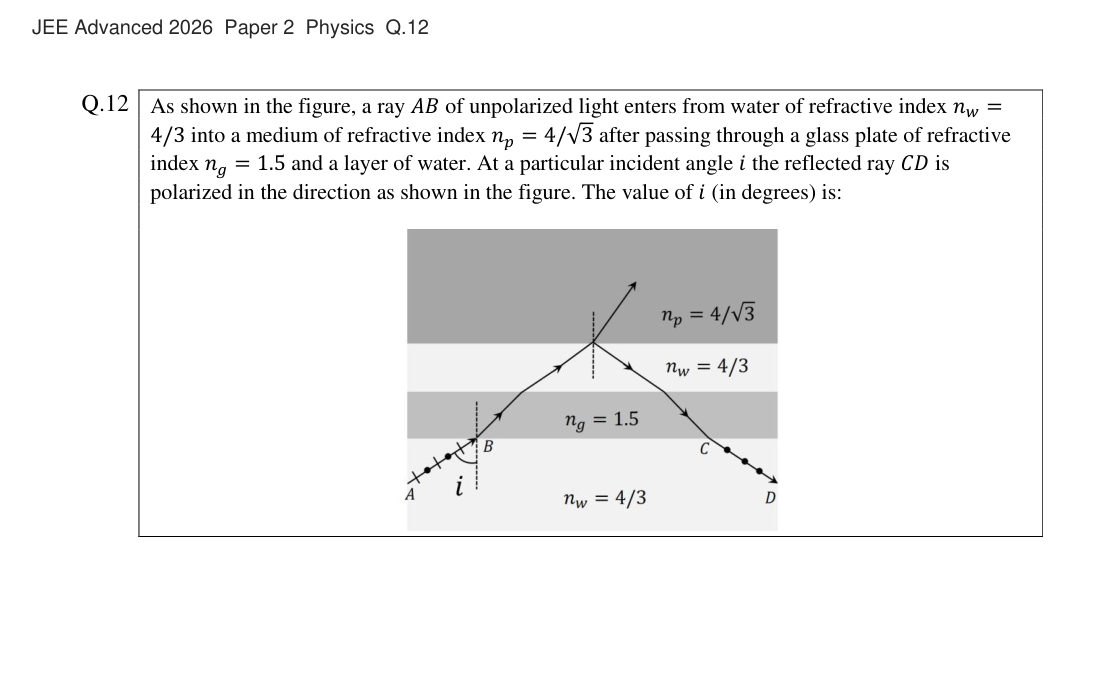
Since the reflected ray is polarized with vibrations only perpendicular to the plane of incidence, this must be Brewster's angle at the water-glass interface: tan θ_B = n_p/n_w = (4/√3)/(4/3) = √3, giving θ_B = 60°. Now I need to apply Snell's law across the parallel layers, noting that the intermediate glass plate doesn't affect the overall relationship between the incident angle in air and this Brewster angle in water. So sin i = sin 60°, giving i = 60°, since the parallel layered geometry preserves the angle relationship going in and coming back out. The answer is 60°. **Analysis** The reflected ray *CD* is fully polarized (only dots shown, i.e. polarization perpendicular to the plane of incidence). This happens when the ray hits the water/medium (*n_p*) interface at Brewster's angle: tan θ_B = n_p / n_w = (4/√3)/(4/3) = √3 ⇒ θ_B = 60° Since all interfaces are parallel, Snell's law gives a conserved quantity n sin θ through the layers: n_w sin i = n_g sin θ_g = n_w sin θ_B ⇒ sin i = sin 60° ⇒ i = 60°
GPT 6 Astra
OpenAI
60
GPT 6 Astra reasoning
No written reasoning was returned for this item.
GPT 5.5
OpenAI
60
GPT 5.5 reasoning
**Analyzing light behavior** I’m trying to understand if the setup indicates something polarized or unpolarized. I think the text suggests it’s unpolarized, but I’m looking at paths outside of the electric field. There might be layers at play, possibly including Brewster's angle. The incidence angles seem tricky because they involve bending at interfaces. But, if the layers are parallel, should the angles match? I need to consider the effects of the refractive index here too. There’s a lot to untangle! **Examining ray polarization** When the ray enters medium n_p, it reflects at the top interface, leading to the reflected ray CD. I think that at the water-to-p interface, Brewster's angle gives θ_B = 60°, which means the reflected ray is polarized perpendicular to the plane. But the problem states the reflected ray is in a different direction—maybe that's in the plane? Also, the angle "i" is potentially measured with respect to the surface rather than the normal, which could influence the answer I’m trying to calculate. **Clarifying the angle of incidence** I'm visualizing the scenario where the normal at point B is vertical, and the incident ray AB approaches from the bottom left. I believe the arc drawn between the ray and the dotted vertical normal indicates the angle of incidence, labeled as "i" to the left. The text specifies "incident angle i" means it's measured from the normal. If the arc correctly represents that from the vertical normal downward to the ray, then it makes sense for the answer to be 60° if Brewster's angle is involved at the top. **Examining polarization in layers** I'm thinking about how the black dots and short strokes on a CD may relate to polarization. The text mentions that the reflected ray CD is polarized in a specific direction. The dots on AB might come from scanned text, which is interesting. If the reflection happens at the Brewster angle at the top interface, glass might not be necessary. But there could be reflections from multiple interfaces, so I need to explore if polarization requires a specific multilayer setup. **Analyzing reflected ray polarization** I'm considering how at a specific incident angle, the reflected ray CD is noted as polarized. The text mentions that this ray is reflected from the p interface and passes through layers, but it's important that CD is a result of final reflection. The reflected coefficient being zero at Brewster means no change in polarization from transmission through isotropic layers. I wonder if the entire path of the "reflected ray CD" comes from reflections at the glass plate, especially since ray AB enters water into glass at B. **Analyzing angles in optics** I'm working through the angles involved here, with the reflected angle being 60 degrees and the transmitted angle at 30 degrees, which gives me a 90-degree angle between them. I’m noting that the figure may depict the transmitted ray as steeper. My guess for the answer is 45 degrees. However, the incidence angle at point B for polarization due to Brewster's law complicates things, leading to some not-so-nice calculations. I’ll need to clarify the ray paths. **Considering light polarization** I'm thinking about how, at a specific incident angle, the reflected ray CD becomes polarized. It seems like the incident ray AB enters the entire system, and then CD reflects after passing through. I need to confirm that this polarization occurs due to reflection at the specific interface. It's like figuring out how light behaves in different media, and I want to ensure that I understand the mechanics thoroughly to get this right! **Analyzing refracted angles and polarization** I'm working through a scenario where the angle measured in water is 60 degrees, and the refracted ray has an angle of 30 degrees. If someone incorrectly applies the formula tan i = n_w/n_p, that could lead to confusion. I need to consider Brewster's law, especially regarding the reflected ray being completely polarized in the plane of the interface. It's important to identify which components vanish and how the electric field is oriented in relation to the incident ray and the plane of incidence. **Clarifying polarization and reflections** I'm analyzing how the E vector appears in the plane of incidence — it should be shown as double-headed arrows perpendicular to the ray line. I notice there are dots indicating the polarization direction. There’s a potential complication at the water-glass interface where an incident angle of 60 degrees results in a partially polarized reflected component traveling in a different direction. I’m finalizing an analysis based on Snell's law to show that the angle of reflection aligns, and I’ll format the response in JSON as specified. **Ensuring valid JSON output** I need to make sure the JSON response is valid and that the answer is a number, not a string. No extra characters are allowed after the JSON object. It seems like the expected answer might be "60," which should be presented as an integer. However, if numerical precision is important, it could also be "60.0." I'll finalize the output as a JSON object containing just the answer, ensuring it meets all specified requirements.
Claude Sonnet 5
Anthropic
60
Claude Sonnet 5 reasoning
Tracing the ray's path through water, glass, water, and the plastic medium np, I realize the Brewster's angle condition for reflection CD must apply at the topmost interface, between water (n_w=4/3) and np (4/√3), since that's where the final reflection occurs. Computing tan(theta_B) = np/nw = √3 gives theta_B = 60°. Since parallel-sided layers preserve the invariant n·sin(θ) across the whole system, and both bounding media are water, the original angle of incidence i must equal 60° as well. Looking at this problem, I need to find the Brewster's angle condition at the top interface where reflection CD occurs (water to medium np interface), since polarization of reflected light occurs at Brewster's angle. **Setting up Brewster's condition at the water-np interface:** At the top interface, the ray travels from water (n_w) into medium n_p. For the reflected ray to be completely polarized: tan(θ_B) = n_p/n_w = (4/√3)/(4/3) = 12/(4√3) = 3/√3 = √3 So θ_B = 60° **Relating θ_B to the original incidence angle i:** Since all interfaces are parallel (glass plate and water layers are parallel slabs), Snell's law gives an invariant: n_w sin(i) = n_g sin(θ_g) = n_w sin(θ_B) The glass plate refractive index cancels out because the ray re-enters the same water medium (n_w) after passing through it — this is the standard parallel-slab result: for light passing through several parallel-sided media and returning to the original medium's refractive index, the product n·sin(θ) is conserved between the initial and final same-medium angles. Therefore: n_w sin(i) = n_w sin(θ_B) sin(i) = sin(60°) **i = 60°** ```json