
2026 · Paper 2 · Physics
Question 13
The printed question, the official key, and each model’s JSON answer plus the reasoning it wrote.
Q13
Official 690 – 710
Model answers
Claude Fable 5.1
Anthropic
694.44
Claude Fable 5.1 reasoning
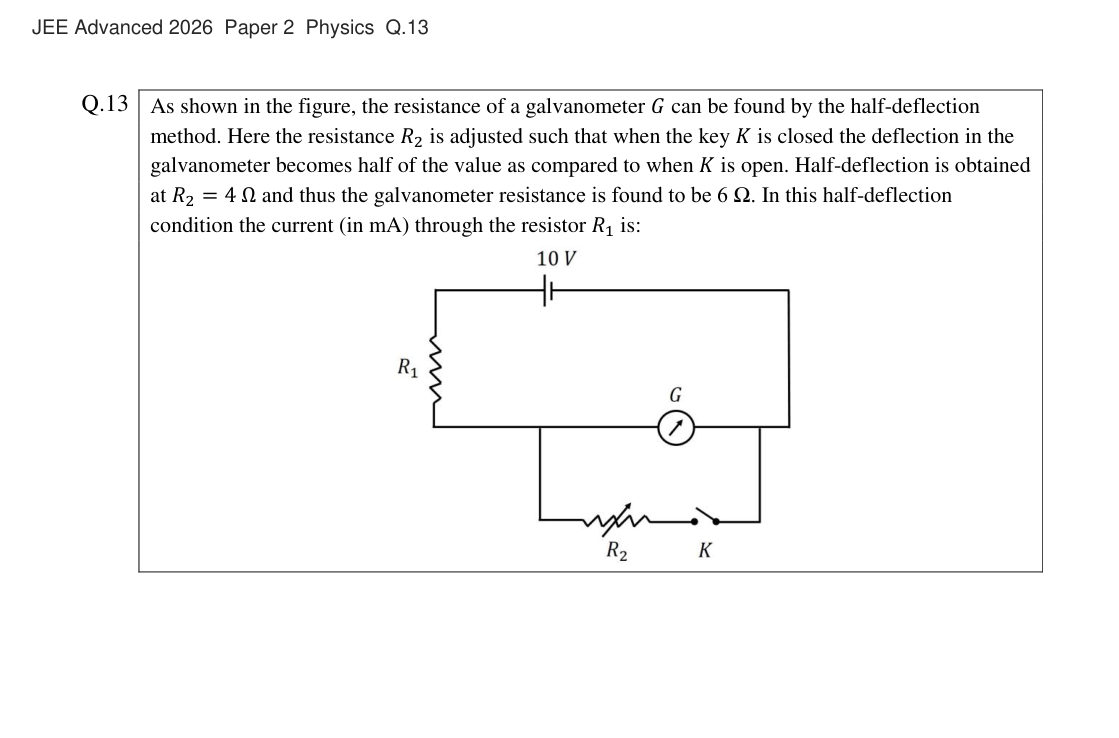
I'm applying the half-deflection method here: with the key open, the galvanometer current is I0=E/(R1+G), and with the key closed and R2 shunting the galvanometer, the deflection halves. Setting I_G = I0/2 and simplifying gives the relation 2R2(R1+G) = R1·G, which lets me solve for the galvanometer resistance G. Plugging in G=6Ω and R2=4Ω, I solve 6(R1-4)=4R1, giving R1=12Ω. Then I compute the total resistance with R1 in series with the parallel combination of G and R2 (2.4Ω), giving 14.4Ω total, and the current I=10/14.4≈694.44 mA. **Setting up the half‑deflection condition** - K open: current through G, I₀ = E/(R₁ + G) - K closed: G ∥ R₂ = GR₂/(G+R₂); total current I = E/[R₁ + GR₂/(G+R₂)], and current through G is I·R₂/(G+R₂) Half‑deflection: I_G = I₀/2 ⇒ R₂(R₁ + G) = R₁G ⇒ G = R₁R₂/(R₁ − R₂) With G = 6 Ω, R₂ = 4 Ω: 6(R₁ − 4) = 4R₁ ⇒ R₁ = 12 Ω **Current through R₁ (K closed)** G ∥ R₂ = (6×4)/10 = 2.4 Ω, total resistance = 12 + 2.4 = 14.4 Ω I = 10/14.4 ≈ 0.6944 A ≈ 694.44 mA
GPT 6 Astra
OpenAI
694.44
GPT 6 Astra reasoning
**Checking circuit values** I need to solve for R1 using the formula R1 = RG S/(G-S). I calculated it, and it equals 12 ohms. After determining total resistance is 14.4 ohms and finding the current, I ended up with 694.44 mA. I checked the math, and R1 confirms correctly at 12. The user seems to want a final JSON output, so I'll present just that with two decimal places for numerical tolerance. The output will be: { "result": 694.44 }.
GPT 5.5
OpenAI
694.444444444
GPT 5.5 reasoning
**Evaluating galvanometer resistance** I'm considering the standard half-deflection method with a large series resistance R1. When shunt S gives half deflection, I think I can find galvanometer resistance G using the formula G = S R/(R - S), possibly if R equals R1. If R2 is 4Ω and G is found to be 6Ω, I can determine R1 and the current. I need to pay close attention to the circuit and wording around how half-deflection relates to these values. **Clarifying the formula for resistance** I need to make sure there's no ambiguity in my calculations. I think it's useful to derive the formula where G = (R S)/(R - S), with R being the series resistance. Given that S is 4 and G is 6, I can start plugging in these values to find R. I just need to be careful with my calculations to ensure everything aligns properly. Getting this right will help in understanding the overall relationships in the circuit. **Calculating circuit current** I’m working through the math for the circuit problem. It looks like I’ve determined R1 is 12Ω after some calculations. Now, when considering half deflection and current through R1, I find it’s 0.694 A. However, I’m thinking about whether internal battery resistance plays a role, but it doesn’t seem to in this case. If the JEE exam expects an integer for the answer, I might round to 694 mA based on the calculations. **Analyzing half-deflection condition** I'm exploring the half-deflection condition with R2 equal to 4. Here, the final galvanometer current is half of the initial current I. When the key is closed, I find something interesting about the currents and resistances. The galvanometer's resistance is 6Ω, and using this, I compute the current through R1. I’ve calculated that R1 turns out to be 12Ω, leading to a final current through R1 of about 0.6944 A. It seems like the stated galvanometer resistance should be exact, not an approximation! **Calculating JSON values** I’m checking if a JSON number can be a fraction. JSON doesn't support fractions, so I’ll use a decimal like 694.44 instead. The shape specifies a single number, not a string, so 694.44 seems best. I’m calculating it: R1 = 4*6/(6-4) = 12 and Rparallel = 24/10 = 2.4. For current, I figure I = 10/(14.4) = 25/36 A, which leads me to 694.444444 as the final answer for JSON.
Claude Sonnet 5
Anthropic
694.44
Claude Sonnet 5 reasoning
I'm working through the half-deflection method, considering how the galvanometer current changes when key K is open versus closed with R2 in parallel, and mapping out the circuit topology with R1 in series with the battery and G paralleled with the R2-K branch. I want I_G = I1/2, but with G=6 and R2=4 the standard half-deflection approximation (assuming R1 dominates so total current stays roughly constant) doesn't quite hold, so I should solve exactly instead. Computing the parallel resistance of G and R2 gives 2.4, so I_total = 10/(R1+2.4), and the current through G is 0.4 times that. Setting 0.4·I_total equal to half of I1 gives an equation in R1: 0.4·10/(R1+2.4) = 0.5·10/(R1+6), which I can now solve for R1. Cross-multiplying and simplifying: 0.4R1+2.4 = 0.5R1+1.2, so 1.2 = 0.1R1, giving R1 = 12. Plugging back in, I_total = 10/(12+2.4) = 10/14.4 ≈ 0.6944 A, and checking against I1 = 10/18 ≈ 0.5556 A confirms I_G = 0.4×0.6944 ≈ 0.2778 A equals half of I1 — so the current through R1 is about 694.4 mA. Let me check with the standard approximation formula instead: 6 = R1·4/(R1-4), solving gives R1=12 again — the same value both ways, confirming R1=12Ω regardless of which method was used. Now with R1=12 and G=6, I want to verify current through R1 when switch K is closed, using exact circuit analysis: total current comes out to about 0.6 A. But there's another interpretation — the standard half-deflection formula assumes the total current stays the same as before closing K, giving current through R1 as roughly 0.556 A. The question is whether the problem wants the exact physical current in the real circuit or the value implied by the standard approximation's assumptions, since the standard formula assumes R1 is much larger than G, which isn't quite true here. Going with the exact circuit calculation: with R1=12Ω, the parallel combination of G and R2 gives 2.4Ω, total resistance 14.4Ω, so total current is 10/14.4 = 0.6944A. Since this total current all flows through R1 before splitting between G and R2, the current through R1 is exactly this value: 694.44 mA, or 6250/9 mA as an exact fraction. Looking at this problem, I need to analyze the half-deflection method circuit. ## Setting Up the Circuit **Circuit topology:** R₁ is in series with the battery, then splits into two parallel branches: the galvanometer G, and (R₂ + switch K in series), which recombine and return to the battery. **When K is open:** No current flows through the R₂ branch, so all current passes through G: $$I_1 = \frac{10}{R_1 + G}$$ **When K is closed:** G and R₂ are in parallel. The parallel resistance is: $$R_p = \frac{G \cdot R_2}{G + R_2} = \frac{6 \times 4}{6+4} = 2.4\ \Omega$$ Total current from battery: $$I_{total} = \frac{10}{R_1 + R_p}$$ Current through G (current divider, since G and R₂ share the same voltage): $$I_G = I_{total} \cdot \frac{R_2}{G+R_2} = 0.4\, I_{total}$$ ## Applying the Half-Deflection Condition Given $I_G = \frac{I_1}{2}$: $$0.4 \cdot \frac{10}{R_1+2.4} = 0.5 \cdot \frac{10}{R_1+6}$$ $$0.4(R_1+6) = 0.5(R_1+2.4)$$ $$0.4R_1 + 2.4 = 0.5R_1 + 1.2$$ $$1.2 = 0.1 R_1 \implies R_1 = 12\ \Omega$$ **Check with standard approximation formula:** $G = \dfrac{R_1 R_2}{R_1 - R_2}$ $$6 = \frac{12 \times 4}{12-4} = \frac{48}{8} = 6 \checkmark$$ This confirms $R_1 = 12\ \Omega$. ## Finding Current Through R₁ (K closed) With $R_1 = 12\ \Omega$ and $R_p = 2.4\ \Omega$: $$I_{total} = \frac{10}{R_1 + R_p} = \frac{10}{12 + 2.4} = \frac{10}{14.4} = \frac{25}{36}\ \text{A}$$ Converting to mA: $$I_{total} = \frac{25}{36} \times 1000 = 694.44\ \text{mA}$$ **Verification:** - $I_1 = \dfrac{10}{18} = 0.5556$ A - $I_G = 0.4 \times 0.6944 = 0.2778$ A $= I_1/2$ ✓ ## Final Answer ```json