
2026 · Paper 2 · Physics
Question 14
The printed question, the official key, and each model’s JSON answer plus the reasoning it wrote.
Q14
Official 25
Model answers
Claude Fable 5.1
Anthropic
25
Claude Fable 5.1 reasoning
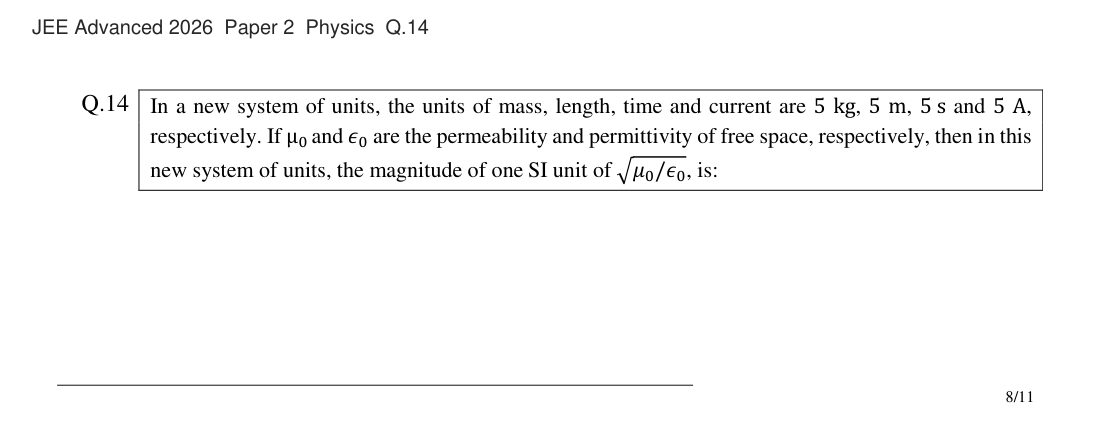
√(μ0/ε0) has dimensions of impedance (ohm): [M L² T⁻³ A⁻²]. 1 SI unit = 1 kg·m²·s⁻³·A⁻². In new units: mass unit 5 kg, length 5 m, time 5 s, current 5 A. n₂ = n₁ · (1/5)¹ · (1/5)² · (1/5)⁻³ · (1/5)⁻² = 5^(-1-2+3+2) = 5² = 25.
GPT 6 Astra
OpenAI
25
GPT 6 Astra reasoning
No written reasoning was returned for this item.
GPT 5.5
OpenAI
25
GPT 5.5 reasoning
**Calculating physics conversion** I'm tackling a physics problem where I need to analyze a new system of units: 5 kg, 5 m, 5 s, and 5 A. The question asks for the magnitude of one SI unit of sqrt(μ0/ε0), which relates to the impedance of free space (ohms). So, I need to express one SI unit in these new units and figure out how that conversion works. I have to ensure I'm careful with the wording and calculations while figuring out the magnitude. **Finding derived unit magnitude** I'm working on dimensions where M^a L^b T^c I^d equals M^1 L^2 T^-3 I^-2, and I need to derive a new unit based on 5 kg, 5 m, 5 s, and 5 A. The calculations show that the new derived unit leads to 5 raised to different powers, ultimately simplifying to 1/25 SI ohm. This means one SI unit equals 25 new units in the new system. The requested magnitude is likely 25, but I want to confirm that I'm not accidentally including extra numeric values.
Claude Sonnet 5
Anthropic
25
Claude Sonnet 5 reasoning
I need the dimension of √(μ0/ε0), which represents resistance, with units ML²T⁻³A⁻². This confirms that quantity equals the impedance of free space, roughly 377 ohms. Since the new system scales all base units by 5, converting from SI I get n2 = (1/5)^(1+2-3-2) = (1/5)^(-2) = 25. **Answer: 25** The quantity √(μ₀/ε₀) has SI units of resistance (Ohm), with dimensional formula [M¹L²T⁻³A⁻²]. Using dimensional analysis to convert 1 SI unit (in kg, m, s, A) to the new unit system (5 kg, 5 m, 5 s, 5 A): n₂ = n₁ × (M₁/M₂)^1 × (L₁/L₂)^2 × (T₁/T₂)^(-3) × (A₁/A₂)^(-2) n₂ = 1 × (1/5)^1 × (1/5)^2 × (1/5)^(-3) × (1/5)^(-2) n₂ = (1/5)^(1+2-3-2) = (1/5)^(-2) = 25 ```json