
2026 · Paper 2 · Physics
Question 15
The printed question, the official key, and each model’s JSON answer plus the reasoning it wrote.
Q15
Official 1.25
Model answers
Claude Fable 5.1
Anthropic
1.25
Claude Fable 5.1 reasoning
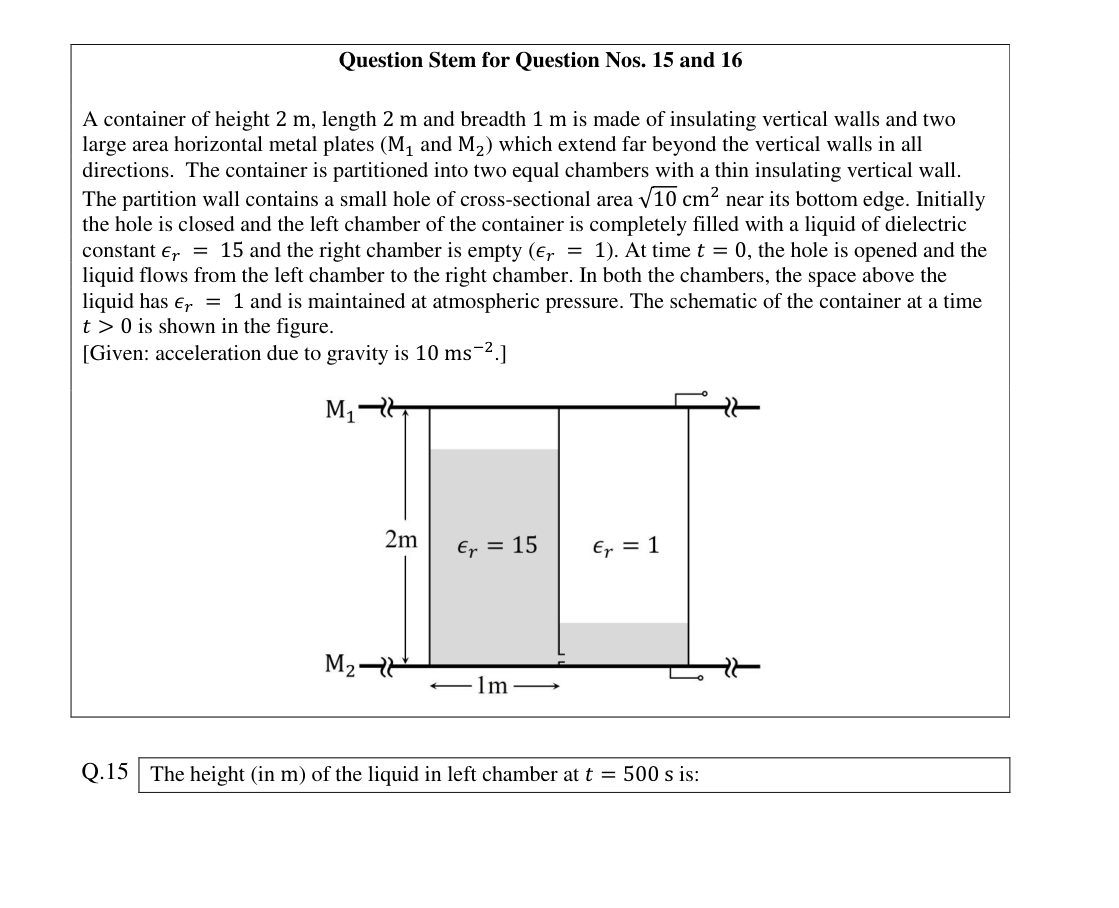
With equal cross-sectional areas of 1 m² on each side, the two heights must satisfy h1 + h2 = 2 by volume conservation as liquid drains through the small hole from the left chamber into the right. Using Torricelli's law for the flow between chambers, I set up the differential equation governing the height difference Δh = h1 − h2, then solve it since the relation between h1 and Δh is linear. Working through the constants with a/A involving √10×10⁻⁴ m² and √(2g) = 2√5, everything simplifies nicely to a factor of √2×10⁻³. Plugging in t = 500 s gives √x = √2/2, so Δh = 0.5 m, meaning h1 = 1.25 m — well before the ~1000 s it would take to fully equalize, confirming this is a valid intermediate state. **Setting up** Each chamber has base area A = 1 m × 1 m = 1 m². Hole area a = √10 × 10⁻⁴ m². Let the left height be h₁ and right height be h₂. Volume conservation gives h₁ + h₂ = 2, so the level difference is Δh = h₁ − h₂ = 2(h₁ − 1). Efflux speed through the submerged hole (Torricelli): v = √(2g·Δh). Rate of change of left height: dh₁/dt = −(a/A)√(2g·Δh) So d(Δh)/dt = 2·dh₁/dt = −2(a/A)√(2g)·√Δh Integrating: √Δh = √2 − (a/A)√(2g)·t Compute (a/A)√(2g) = √10 × 10⁻⁴ × √20 = √200 × 10⁻⁴ = √2 × 10⁻³ s⁻¹. At t = 500 s: √Δh = √2 − √2 × 0.5 = √2/2 ⟹ Δh = 0.5 m Hence h₁ − 1 = 0.25 ⟹ h₁ = 1.25 m. (Equilibrium would be reached at t = 1000 s, so t = 500 s is valid.)
GPT 6 Astra
OpenAI
1.25
GPT 6 Astra reasoning
No written reasoning was returned for this item.
GPT 5.5
OpenAI
1.25
GPT 5.5 reasoning
**Analyzing fluid flow between tanks** I'm considering how to partition two equal chambers, where each has a floor area of 1m². I need to calculate the hole area, which is approximately 3.1623e-4 m². The flow between the two tanks will depend on the head difference (h_L - h_R) and the atmospheric pressure above the liquid. Using ideal fluid dynamics, the efflux can be modeled with the formula v = sqrt(2g(h_L - h_R)), and I need to remember that as one tank loses volume, the other gains. **Analyzing capacitor fluid behavior** I’m thinking about how the top and bottom metal plates relate to fluid levels and capacitance. The presence of a dielectric and possible Maxwell stress could affect the heights of the fluids. For Q15, which asks about height at t=500, it seems the dielectric constant isn't relevant if no voltage is applied. I wonder if I should consider the area of the hole to simplify things. It appears Q15 may focus on hydrodynamics while Q16 deals with capacitance when height is unknown. **Analyzing capacitor diagram** I see that Q16 involves a dielectric, while Q15 might relate to electrostatics due to induced charges. I should check the figure and text, which describe two large horizontal metal plates, M1 and M2, possibly resembling parallel plate capacitors. They might be connected to a battery, indicated by open switches shown near the plates. There’s a cropped line at the top suggesting a wire to the battery, maybe signaling that M1 and M2 can be externally connected. Q16 might be asking about this voltage connection. **Interpreting capacitor figures** There's no mention in the stem but let’s analyze the screenshot. I see the metal plates M1 (top) and M2 (bottom) with wavy marks indicating they extend far. The symbols at the right show an open switch above the top plate and a similar setup below. They might represent terminals connecting the capacitor. The question stem seems to relate to Q15 and Q16. Q15 might be about the height at t=500s, while Q16 likely asks for the capacitance ratio at that time. I need to verify the hydrodynamic assumptions, especially regarding the submerged hole near the bottom edge. **Considering fluid dynamics** Initially, the right side is empty, but as time progresses (t>0), the water height on the right could become greater than zero. At early times, water will flow into the container and exit into the air with velocity determined by \( \sqrt{2ghL} \). If the liquid height in the right chamber is below the hole, fluid will exit, accumulate, and eventually cover the hole. I need to think about how the hole is positioned; since it's described as "near the bottom edge," it may quickly become submerged once fluid exists. The initial transient effects might be negligible. **Examining electric fields** Okay, this situation is simpler now. I'm thinking about the designed hole area and using sqrt(10) with g=10 to calculate the time factor. The time to reach equilibrium at x=1 is 1000 seconds, and at 500 seconds, it’s halfway at sqrt. I need to consider if the plates extend beyond the walls — could the electric field be present outside? If the plates are unconnected, that could change things. I wonder if liquid acts as a dielectric in this capacitor scenario. If plates M1 and M2 are charged, the electrostatic pressure on the liquid surfaces may affect pressure and hydrostatic flow. **Evaluating capacitance and final answers** I’m considering whether the plates might be connected through resistance, but the figure shows that they aren't necessarily connected to a voltage. If there’s no external charge, there would be no field. The mention of "large area" likely pertains to capacitance. I need a final numerical answer rounded to two decimal places, which I think can be 1.25. The final JSON will just contain that value without extra explanation. Alright, I’m ready for that! **Finalizing JSON output** I need to ensure the final JSON format is correct. I’m going with {"answer":1.25,"unanswered":false}. I don't think I should use null anywhere; I just need to confirm that "unanswered" is set to false. It’s important to stick to a clean JSON output with just these elements included. No need for any extra explanations or additions. Alright, I'm ready to finalize this!
Claude Sonnet 5
Anthropic
1.25
Claude Sonnet 5 reasoning
This looks like a Torricelli's law setup with two connected 1m×1m chambers in a 2m container, left side full at 2m height draining through a small hole into the empty right chamber. I'm noting the hole area is √10 cm² and working out the conversions needed to set up the flow equations. Since both chambers share the same cross-sectional area (1 m²), the velocity through the hole depends on the height difference between the two liquid columns: v = √(2g(h1-h2)). This gives coupled differential equations where the left chamber's height drops at the same rate the right chamber's height rises, driven by that height difference via the orifice equation. Because total volume is conserved and both areas equal 1 m², h1 + h2 stays constant at 2 (matching the initial condition h1=2, h2=0). Substituting h2 = 2 - h1 turns the system into a single separable ODE in h1, which I solve using the substitution u = h1 - 1, integrating du/√u to get an explicit expression for √u in terms of time. This gives h1 = 1 + [1 - (a/A)√g · t]², valid until u hits zero at equilibrium (h1 = h2 = 1), after which flow stops entirely. Plugging in a = √10×10⁻⁴ m² and A = 1 m², the product (a/A)√g simplifies neatly to 10⁻³ per second, so I'm now computing the time needed to reach equilibrium. At t* = 1/0.001 = 1000 s the levels equalize. Checking at t = 500s: the bracket term becomes 1 - 0.5 = 0.5, so u = 0.25, giving h1 = 1.25 m as the answer. Looking at this problem: **Setup:** Both chambers have base area A = 1m × 1m = 1 m². Total liquid volume is conserved as it flows through the hole, so h₁ + h₂ = 2 (constant), giving h₂ = 2 - h₁. **Flow equation (Torricelli's law for connected tanks):** Velocity through hole: v = √(2g(h₁-h₂)) = √(2g(2h₁-2)) = 2√(g(h₁-1)) Continuity: A(-dh₁/dt) = a·v, where a = √10 × 10⁻⁴ m² So: $$\frac{dh_1}{dt} = -\frac{2a}{A}\sqrt{g}\sqrt{h_1-1}$$ **Solving with substitution u = h₁ - 1** (u(0) = 1): $$\frac{du}{\sqrt{u}} = -\frac{2a}{A}\sqrt{g}\,dt$$ Integrating: $$2\sqrt{u} = 2 - \frac{2a}{A}\sqrt{g}\,t$$ $$\sqrt{u} = 1 - \frac{a}{A}\sqrt{g}\,t$$ **Computing the constant:** - a/A = √10 × 10⁻⁴ m - √g = √10 - (a/A)√g = √10 × 10⁻⁴ × √10 = 10 × 10⁻⁴ = 10⁻³ s⁻¹ So: $$\sqrt{u} = 1 - 0.001\,t$$ This reaches zero at t = 1000 s (equilibrium h₁ = h₂ = 1m reached at t=1000s). **At t = 500 s:** $$\sqrt{u} = 1 - 0.001(500) = 0.5$$ $$u = 0.25$$ $$h_1 = 1 + u = 1.25 \text{ m}$$ ```json