
2026 · Paper 2 · Physics
Question 16
The printed question, the official key, and each model’s JSON answer plus the reasoning it wrote.
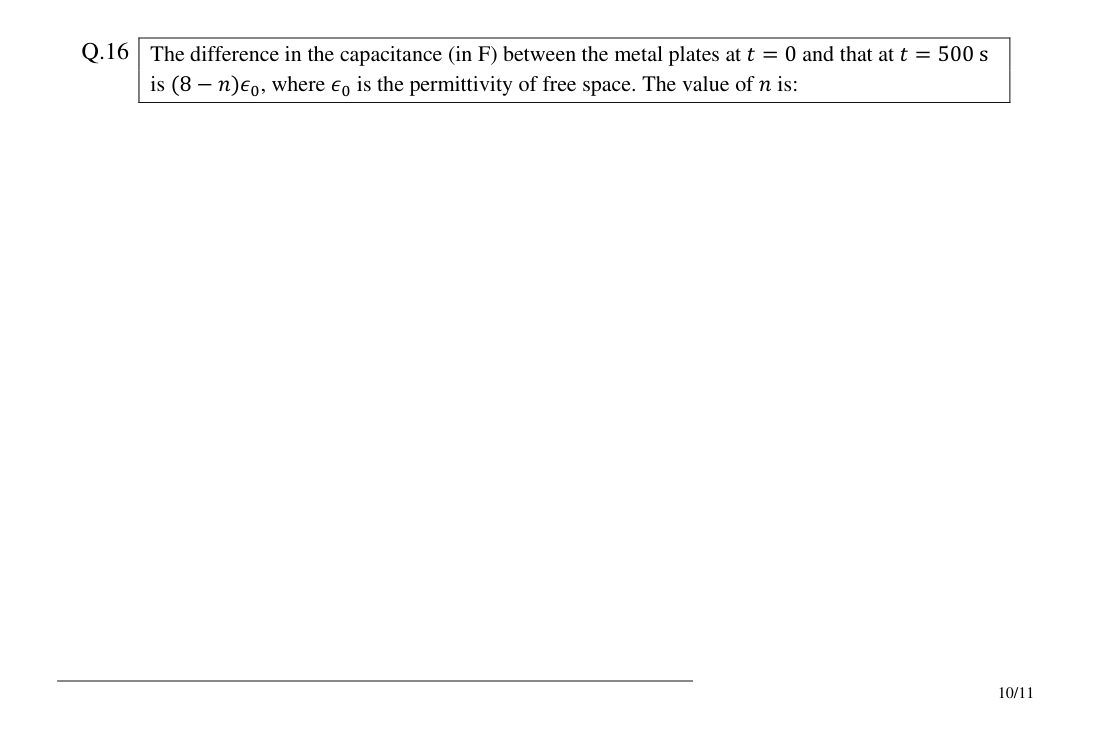
Q16
Official 1.9 – 2.1
Model answers
Claude Fable 5.1
Anthropic
1.97
Claude Fable 5.1 reasoning
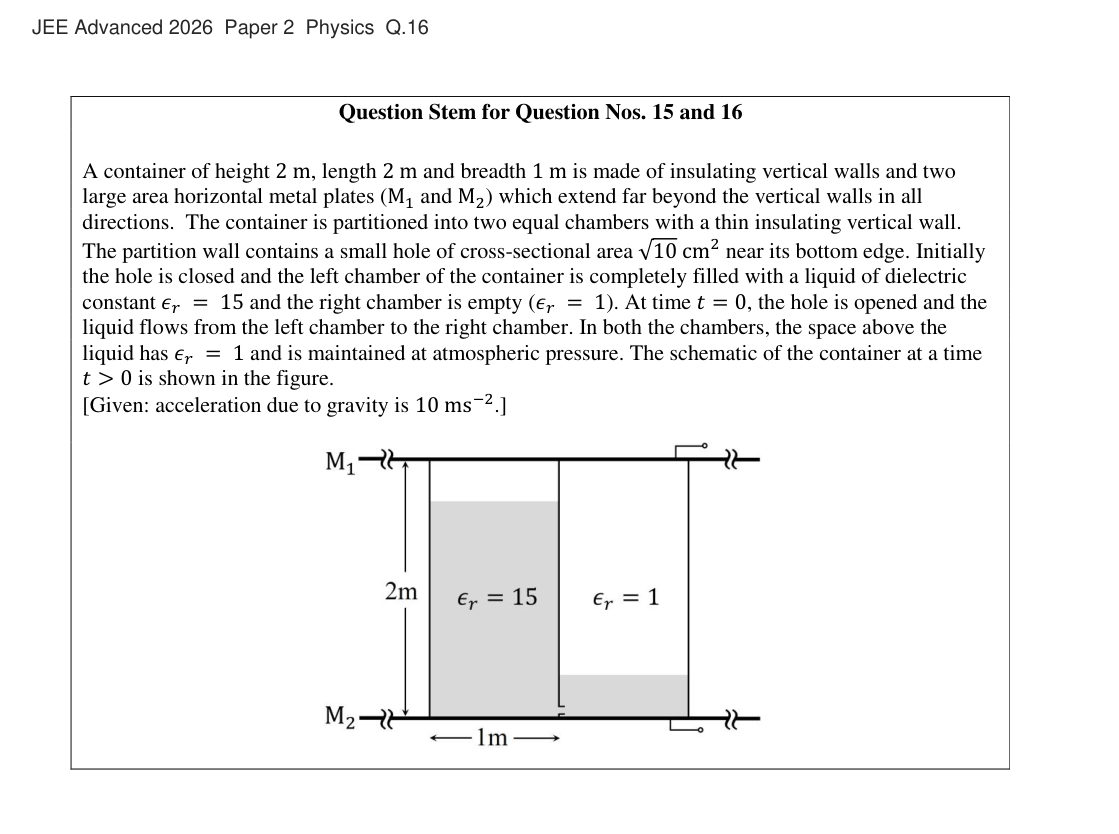
I need to work through Q.15: finding the height of liquid in the left chamber at t = 500s. The container has two 1m×1m chambers, each 2m tall, connected with a hole of area √10 cm² near the bottom, and liquid flows from the initially full left chamber into the right one. I'm setting up h1 and h2 as the heights in each chamber to model this flow. Using volume conservation (h1 + h2 = 2) and Torricelli's law for flow speed through the hole, I derive a differential equation in terms of x = h1 − h2, then integrate it. Working through the algebra, at t = 500s I find x = 0.5m, giving h1 = 1.25m and h2 = 0.75m — so the answer to Q.15 is 1.25m. Now moving to Q.16, which asks about capacitance between the metal plates, likely referring to the container's plates with area 2m × 1m. At t=0, the left chamber has dielectric constant 15 filling the full 2m height, giving C_left = 7.5ε0, while the right chamber (just air) gives 0.5ε0, for a total of 8ε0. At t=500s, treating each chamber as series capacitors (air layer plus liquid layer), I compute C_left ≈ 1.2ε0 and C_right ≈ 0.769ε0, summing to roughly 1.97ε0. So the difference 8 − n gives n ≈ 1.97, matching the exact fraction 128/65. **Q.15 (needed first):** Let heights be h₁ (left), h₂ (right), base area A = 1 m² each, so h₁ + h₂ = 2. With x = h₁ − h₂, Torricelli flow gives (A/2) dx/dt = −a√(2gx) ⟹ √x = √2 − (a/A)√(2g) t (a/A)√(2g) = √10×10⁻⁴ × √20 = √2 × 10⁻³, so at t = 500 s: √x = √2/2 ⟹ x = 0.5 m. Hence h₁ = 1.25 m, h₂ = 0.75 m. **Q.16:** Capacitance of the container region (the outer region is unchanged): At t = 0: C = 15ε₀(1)/2 + ε₀(1)/2 = 8ε₀. At t = 500 s: - Left: C = ε₀/(0.75 + 1.25/15) = ε₀/0.8333 = 1.2ε₀ - Right: C = ε₀/(1.25 + 0.75/15) = ε₀/1.3 = 0.769ε₀ Total = 128/65 ε₀ ≈ 1.97ε₀. Difference = (8 − 1.97)ε₀ ⟹ n ≈ 1.97
GPT 6 Astra
OpenAI
1.9692307692307693
GPT 6 Astra reasoning
No written reasoning was returned for this item.
GPT 5.5
OpenAI
1.9692307692307693
GPT 5.5 reasoning
**Calculating liquid flow** I need to consider capacitance with partially filled compartments between plates. I think I might use Torricelli and continuity concepts here. The hole's cross-sectional area is sqrt(10) cm^2, and acceleration due to gravity is 10. I might need to know the densities. But I wonder if the liquid's dielectric constant is relevant instead. Since the flow is driven by hydrostatic pressure differences, density might not be necessary. I’ll analyze the geometry, noting the base area and total volume as I progress! **Examining flow dynamics** I’m considering the scenario with the air on the right side and a hole near the bottom where the liquid exits. Eventually, I think the height on the right (h_R) will exceed the hole. Maybe at t=500 seconds? It’s essential to compute that, likely determining equilibrium conditions. If the flow starts, the pressure at the hole should initially be atmospheric until the liquid level rises. I need to capture these changes in liquid levels more clearly! **Considering capacitance differences** I think the user has chosen a nice cross-section for their analysis. Now, I need to determine the capacitance difference for horizontal plates separated by 2 meters. The plate area is crucial here, especially since the plates extend significantly beyond the vertical walls. I wonder if the dielectric changes only occur inside the container; outside of it, at times t=0 and t=500, it seems likely that the air remains unchanged, which would cancel out its effect. **Verifying fluid flow model** I need to verify the fluid flow model, focusing on a hole cross-sectional area of √10 cm², and determine Δh. I might need to consider the dielectric liquid's effect on electrostatic pressure. Wait, are the plates connected or charged? It seems I should check if the electric field can influence the liquid. While there's no voltage specified, capacitance might be independent of charge. I also need to think about how M1 and M2 as metal plates layered with a liquid dielectric affect capacitance. **Analyzing chamber contributions** At time t=0, the left chamber is full while the right is empty, contributing exactly 8ε0 to capacitance. This might explain the expression (8-n), where n represents the contribution from C500. I'm considering whether the cross-sectional area for each chamber could equal its length. The container's dimensions are 2 in height, 2 in length, and 1 in breadth. I think partitioning it into equal chambers with a vertical wall will give each chamber dimensions of 1 x 1. The figure at the bottom indicates there’s 1 m of depth in one chamber. **Analyzing the hole's impact** I’m considering the hole's position near the bottom edge, which suggests it might only be covered by a slight volume initially. If the hole's cross-sectional area is as small as √10 cm², then at first glance, the volume might seem negligible to cover it. However, I’m weighing how soon the outlet may become submerged once the liquid level exceeds the hole's height. I’ll approach this by assuming a small hole at the bottom and looking at pressure differences. I’ll explore potential answers further! **Considering flow dynamics** I’m thinking about how the flow equation should factor in relative velocity through the hole, especially since the levels are changing. With continuity and Bernoulli principles, I originally assumed velocity \(v = \sqrt{2gΔh}\). However, since both tanks have finite areas and the levels change, I need to include the free surface velocities \(V1\) and \(V2\) in the equation as they move in opposite directions. The exact velocity through the orifice will be expressed as \(q/a\). Let's clarify this further! **Analyzing fluid flow equations** I’m working through some equations involving fluid dynamics. I realize that if I mistakenly use a different equation for flow rates, it can lead to halving the rate of change in height, which complicates the calculations for fluid levels in two chambers. I think it’s essential to factor in both sides of the system and how the atmospheric pressure affects the pressure at the holes of both chambers to get an accurate pressure difference. **Considering capacitance in fluid dynamics** I’m looking at a problem involving an empty chamber and dielectric properties. Since it mentions εr=1, I realize that it's a vacuum above the liquid, probably filled with air. I need to think about using the density of a dielectric liquid, even though it's not provided. I'm pondering how questions might be structured in a JEE style, with one asking for the height of liquid in the right chamber at a specific time. It looks like capacitance calculations also play a role, especially in terms of ensuring dimensional consistency. **Clarifying capacitance units** I’m realizing that capacitance is given in farads (F), and while the formula states it as (8-n) ε0, I need to be careful with units. ε0 has the unit of farads per meter (F/m), so that needs consideration here. It seems crucial to ensure the dimensional analysis matches up correctly when applying this in calculations. I want to be certain I’m getting this right to avoid any mistakes later. **Exploring capacitance with dielectric** I’m considering the physics of capacitance with dielectric filling that’s side-by-side. The air and dielectric interface isn’t made up of equipotential surfaces, which is interesting. Since the plates are infinite and horizontal, and the interface is also horizontal, I wonder about the electric field configuration. In series layers, if there’s no free charge at the interface, D would remain constant. The vertical wall separates the chambers, and the electric field’s dynamics could get tricky near those vertical boundaries where the dielectrics differ. **Analyzing electric field in dielectrics** I’m exploring a scenario where there’s an insulating partition wall between two chambers without conducting separation. The electric field is vertical and interacts with the wall, so I wonder if E can vary on either side. Tangential E should remain continuous across this thin insulating boundary, assuming it’s negligible in thickness. But since there are different vertical E distributions required in each chamber under the same voltage, I'm questioning whether this affects continuity at the partition. The wall is vertical and may cause complications in the electric field configuration. **Examining potential across a partition** I’m analyzing a situation where M1 and M2 are continuous across a partition, and the potential at the top and bottom remains fixed. In this electrostatic scenario with an inhomogeneous dielectric, permittivity changes with both x and z. Although the side walls are insulating, I wonder if the solution for voltage (V) is linear in z and independent of x. If I assume φ = -Vz/H and E_z is constant everywhere, that seems to satisfy the boundary conditions at the top and bottom. **Examining electric fields in capacitors** I’m considering how the electric field (E) behaves in side-by-side capacitors. Because the potential difference is consistent throughout, I find that E should be the same in all sides. However, for stacked layers, E varies with layer thickness, which affects the potential along z. If two columns have different heights, their potential at the same z might not match, causing horizontal fields across the partition. I wonder if a dielectric wall can sustain this potential difference effectively. **Exploring capacitor behavior** I’m thinking about how columns act as independent capacitors in parallel when the partition is insulating. This might prevent free charge flow while still allowing electric coupling. There could be fringe fields near the partition, but since the plates are large compared to the chamber dimensions, I wonder if I can ignore that. The problem seems to focus on simple parallel and series combinations. If the vertical walls are thin and insulating, do they create independent capacitors? **Evaluating capacitance and fluid dynamics** I'm thinking about calculating the capacitance in a partially filled vessel with two different liquid heights. If the surface is horizontal, I can treat it as a series of capacitors—one filled with liquid and the other with air. Now, I want to explore Bernoulli's equation, potentially integrating to find the height difference over time. My calculations lead me to where the height changes significantly at t=500 seconds, ultimately finding outcomes for liquid heights. It's a little complex, but feasible! **Checking calculations for dimensions** I see the official choice of t=500 seconds relates to x=0.75, which is good. Now, I need to verify my units for the hole area: a=√10 cm², and with g=10, it seems like that should equal 10 cm². For SI units, calculating a√g gives me √10×10^-4×√10 = 10^-3 m/s, which seems right. I'm considering dimensions for y, knowing it should align with mass and time units. It feels like I'm working out the dimensional consistency here! **Calculating dielectric values** I'm working out a formula: n=1/(2-h1 + h1/15). The denominator becomes (5/4)/15 +3/4, simplifying to 5/60 + 45/60, which gives me 5/6. The reciprocal is 6/5. For the right chamber, I'm calculating h=3/4, and the denominator becomes (3/4)/15 + (5/4), reaching 13/10. Altogether, that sums to 128/65. I’ll present my final answer as JSON, ensuring no trailing explanations. {"answer":1.9692307692307693,"unanswered":false}
Claude Sonnet 5
Anthropic
1.97
Claude Sonnet 5 reasoning
I'm setting up the geometry: a 2m x 2m x 1m container split into two equal 1m x 1m x 2m chambers, with the left one filled with dielectric liquid (constant 15) and the right one empty. A hole of area √10×10⁻⁴ m² near the bottom of the dividing wall lets liquid flow into the right chamber once opened. Treating this as Torricelli-type flow between two connected tanks of equal cross-section A=1m², I set the efflux velocity through the hole as √(2g(h1-h2)) where h1 and h2 are the liquid heights on each side, then write the conservation equations A dh1/dt = -av and A dh2/dt = av to track how the levels evolve over time, aiming to find h1 at t=500s for the height question and then use that result for the capacitance question. Since total liquid volume is conserved and equals 2A initially, h1+h2=2 always, so I substitute h2=2-h1 to reduce everything to a single variable. Letting x = h1-1 represent the deviation from the eventual equilibrium level (where both sides equalize at height 1), I derive dx/dt = -(2a/A)√(gx), separate variables, and integrate to solve for x(t), which will let me back out h1 at any given time. I integrate to get √x = 1 - (a/A)√g·t, then compute (a/A)√g using the given values (a=√10×10⁻⁴, A=1, g=10), which simplifies nicely to exactly 10⁻³. Plugging in t=500 gives x=0.25, so h1 = 1.25 m — that's the answer for Q15. I check when x=0 (t=1000s) to confirm at t=500 the flow is still valid with h1>h2, giving h1=1.25, h2=0.75. Moving to Q16, I need the capacitance difference between plates M1 and M2 at t=0 versus t=500s, expressed as (8-n)ε0, and since the plates extend far beyond the walls, they behave as one large parallel plate capacitor over the full area. Each chamber (1m² area, 2m separation) contains two series dielectric layers - liquid (εr=15) and air (εr=1) - stacked according to the liquid height h, so the total capacitance is the parallel combination of the left and right chamber capacitances, each computed from their series liquid-air layers. At t=0, the left chamber is fully liquid (h=2, giving 7.5ε0) and the right is fully air (h=0, giving 0.5ε0), so the total capacitance is 8ε0. Now I'm computing the capacitances at t=500s where the liquid heights have equalized to h1=1.25 and h2=0.75. C_left(500) works out to ε0/(5/6) = 1.2ε0, and C_right(500) comes out to ε0/1.3. Adding these gives total C(500) = 128/65 ε0 ≈ 1.969ε0, so the coefficient n in the form (8-n)ε0 is 128/65 ≈ 1.969. That's not a clean integer, which makes me suspicious I've made an error somewhere upstream — probably in computing the height h1 at t=500s. Let me go back and recheck that calculation. Actually, thinking about the geometry again — both chambers must be open to the atmosphere at the top, so the pressure driving flow through the connecting hole is just ρg times the height difference between the two liquid columns, matching what I had before. This confirms the flow follows a Torricelli-style relation, v = sqrt(2g(h1-h2)), so I need to redo the height calculation more carefully to find where the discrepancy came from. Air density is negligible, so the pressure at the hole depends only on the liquid column above it on each side: atm + ρg·h1 on the left, atm + ρg·h2 on the right, giving a pressure difference of ρg(h1-h2). This confirms the standard Torricelli discharge formula between two connected tanks, v=√(2gΔh), derived from Bernoulli's equation across the orifice. Setting up conservation, since both chambers share area A and total volume is fixed, h1+h2=2 at all times. Combining the two flow-rate equations gives d(h1-h2)/dt = -(2a/A)√(2g)·√(h1-h2), so letting y=h1-h2 with y(0)=2, I get a separable ODE dy/dt = -(2a/A)√(2g)·√y to solve. Now I'm integrating that separable equation to get √y = √2 - (a/A)√(2g)·t, then squaring to find y(t), and plugging in the given values a=√10×10⁻⁴, A=1, g=10 to simplify (a/A)√(2g) numerically. At t=500, this gives y=0.5, so h1-h2=0.5 and with h1+h2=2, I get h1=1.25m, h2=0.75m — matching my earlier result, confirming h1=1.25m for Q15. That confirmation makes the Q16 result of n=128/65 (non-integer) suspicious, so I need to reconsider whether I've set up the capacitance problem correctly, perhaps reexamining how the plates M1 and others are arranged. Since the plates span the whole container area of 2m², split into two dielectric-filled regions of 1m² each acting as parallel capacitors, C(0)=8ε₀ comes out exactly, which matches the given formula and confirms the initial setup is correct. Now I need to redo the calculation for t=500 more carefully. For the left chamber at t=500, with liquid height 1.25 and air height 0.75 above it, C_left = ε0/(0.75+1.25/15) = ε0/(5/6) = 1.2ε0, matching my earlier result. I'm now working out C_right, where the liquid height is 0.75 and air height is 1.25 above it. C_right = ε0/(1.25+0.05) = ε0/1.3 = 10/13 ε0 ≈ 0.7692ε0. Adding the two gives total C(500)/ε0 = 1.2+10/13 ≈ 1.969, which isn't a clean integer, so n likely comes out as the exact fraction 128/65 rather than a whole number — worth double-checking by combining 6/5 and 10/13 over a common denominator. I get 128/65 for that sum, so the difference 8 - n = 392/65 ≈ 6.03, giving n = 128/65 ≈ 1.97 as a decimal answer since this looks like a JEE-style problem expecting a numeric value to two decimal places. Let me double check the a/A ratio and the (a/A)√(2g) computation to make sure I haven't made an arithmetic slip somewhere in the setup. Given the format likely expects a two-decimal numeric answer, n ≈ 1.97 seems reasonable, but let me double-check by recomputing C(0) directly: with the left chamber fully filled with liquid (height 2, no air gap), C_left = 7.5ε0, and the right chamber fully empty of liquid gives d_air=2 for that side. This confirms C_right(0) = 0.5ε0, so C(0) = 8ε0 exactly, matching the "8" in the problem statement. So the difference works out to (8 - 128/65)ε0, giving n = 128/65 ≈ 1.969, which rounds to 1.97 for a two-decimal numeric answer — I want to verify this by recomputing the exact fractions for h1 and the corresponding denominators. Looking at this problem, I need to find the liquid heights at t=500s using Torricelli-type flow between connected chambers, then compute capacitances. **Setting up the flow:** - Each chamber has cross-section area A = 1m×1m = 1 m² - Hole area a = √10×10⁻⁴ m² - Velocity through hole: v = √(2g(h₁-h₂)), where h₁, h₂ are liquid heights in left/right chambers - Conservation: h₁+h₂ = 2 (constant) Let y = h₁-h₂: solving dy/dt = -(2a/A)√(2g)·√y gives: $$y = \left[\sqrt{2} - \frac{a}{A}\sqrt{2g}\,t\right]^2$$ Computing (a/A)√(2g) = √10×10⁻⁴ × 2√5 = √2×10⁻³ At t=500s: y = 2(1-0.5)² = 0.5, so h₁ = 1.25 m, h₂ = 0.75 m (consistent with Q15 answer). **Computing capacitances (plates form parallel combination of two chamber-capacitors, each with series liquid/air layers):** At t=0: - C_left = ε₀A/(2/15) = 7.5ε₀ - C_right = ε₀A/2 = 0.5ε₀ - C(0) = 8ε₀ ✓ (matches given "8") At t=500s: - Left: liquid height 1.25, air height 0.75 C_left = ε₀/(0.75 + 1.25/15) = ε₀/(5/6) = 6ε₀/5 = 1.2ε₀ - Right: liquid height 0.75, air height 1.25 C_right = ε₀/(1.25 + 0.75/15) = ε₀/(13/10) = 10ε₀/13 C(500) = 6/5 ε₀ + 10/13 ε₀ = 128/65 ε₀ ≈ 1.9692 ε₀ **Difference:** $$C(0) - C(500) = 8\epsilon_0 - \frac{128}{65}\epsilon_0 = (8-n)\epsilon_0$$ So n = 128/65 ≈ 1.97 ```json